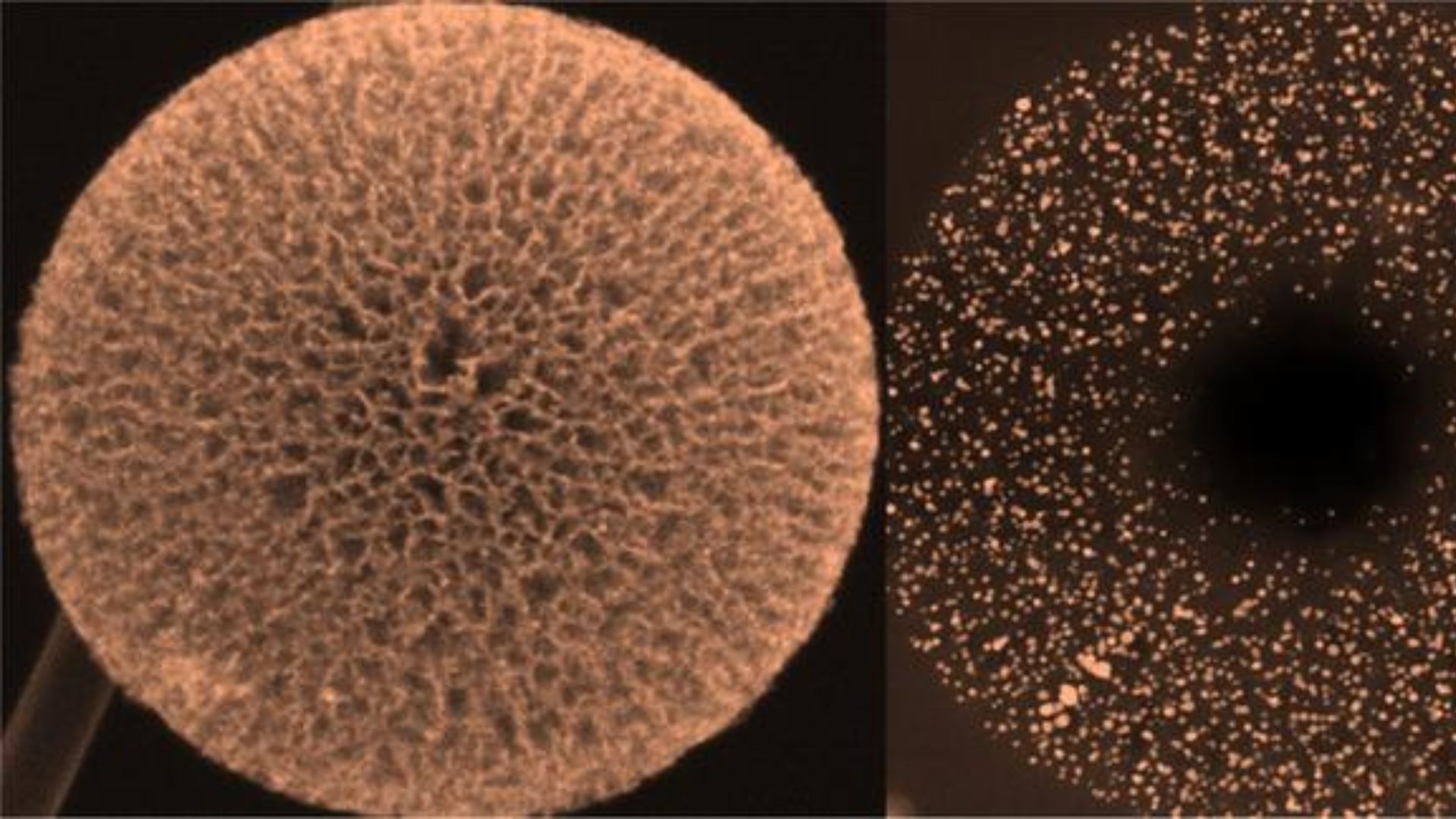
A newly unveiled catalyst architecture has been designed for low-temperature hydrogen fuel cells. The development could solve a long-standing compromise in clean energy tech: keeping expensive platinum catalysts stable without destroying their power output. In testing, the researchers led by Gang Wu at Washington University in St. Louis found that the catalyst maintains high performance with minimal precious metal content. Interestingly, the tech retained 85% of its performance after 150,000 voltage cycles (roughly equivalent to 25,000 hours of operation). “Our strategy is using this new carbon nanostructure to synthesize platinum cobalt intermetallic nanoparticles that can reduce precious metal content and enhance activity and stability,” Wu said. Cage the nanoparticles Hydrogen fuel cells produce clean electricity by combining hydrogen and oxygen, leaving behind nothing but heat and pure water. To drive that reaction efficiently, fuel cells rely on platinum, a rare, expensive metal. Platinum is a great catalyst for energy conversion. Engineers shrink bulk platinum down to tiny nanoparticles to maximize its surface area. It works to achieve strong catalytic performance with tiny amounts, but only for a while. Under operational stress, those tiny nanoparticles dissolve, drift, and clump together, gradually degrading during fuel-cell operation. Also, heating platinum-cobalt alloys above 700°C creates a highly ordered intermetallic structure that drastically improves durability. But at those blistering temperatures, the nanoparticles aggregate. Smaller particles mean more activity. Bigger particles mean longer lifespans. Until now, scientists had to pick one. In this new work, the team decided to overcome this issue by redesigning the underlying carbon support. And designed a porous, hollow carbon spheres built with ordered, radial nanochannels. These tiny carbon cages lock the platinum-cobalt nanoparticles in place. Nanostructures perform well in testing This specialized high-surface-area architecture securely anchors dense, well-dispersed platinum-cobalt nanoparticles, allowing them to withstand the high temperatures required to form a fully ordered intermetallic phase without clumping or losing their fine dispersion. Standard methods are limited to maximum heating temperatures below 700°C and suffer from particle clumping at high heat. The new approach tolerates temperatures up to 1000°C while maintaining precise particle sizes under 5 nanometers. Furthermore, this structural stability under high heat translates directly into exceptional operational longevity. Interestingly, the nanostructures retain 85% of their output even after 150,000 cycles. The open channels also help ionomers spread evenly. That lets protons, oxygen, and water move effortlessly through the electrode during operation. “As a result, the platinum cobalt nanoparticles built into this support showed best-in-class performance and long-lasting durability,” Wu said. The rapid expansion of US data centers is driving a sharp rise in power demand, with annual electricity consumption projected to more than double from 4% of total generation in 2023 to up to 9% by 2030. To address these growing energy and cooling needs, commercializing resilient fuel cells with industrial partners offers a viable solution. It could allow facility operators to depend less on local utilities by generating electricity on-site directly from hydrogen. The team aims to collaborate with industry partners to resolve remaining catalyst challenges and accelerate the development of highly efficient, sustainable fuel cell technologies. The study was published in the journal Nature Nanotechnology on August 6. Recommended ArticlesGet the latest in engineering, tech, space & science - delivered daily to your inbox.Mrigakshi is a science journalist who enjoys writing about space exploration, biology, and technological innovations. Her work has been featured in well-known publications including Nature India, Supercluster, The Weather Channel and Astronomy magazine. If you have pitches in mind, please do not hesitate to email her.
New catalyst holds 85% performance after 150,000 cycles advancing H2 fuel cells
Full Article
Original Source
Read the full article at Interestingengineering →KhanList aggregates and links to publicly available news content. We do not host full articles from third-party sources. Always verify important information with original sources.