
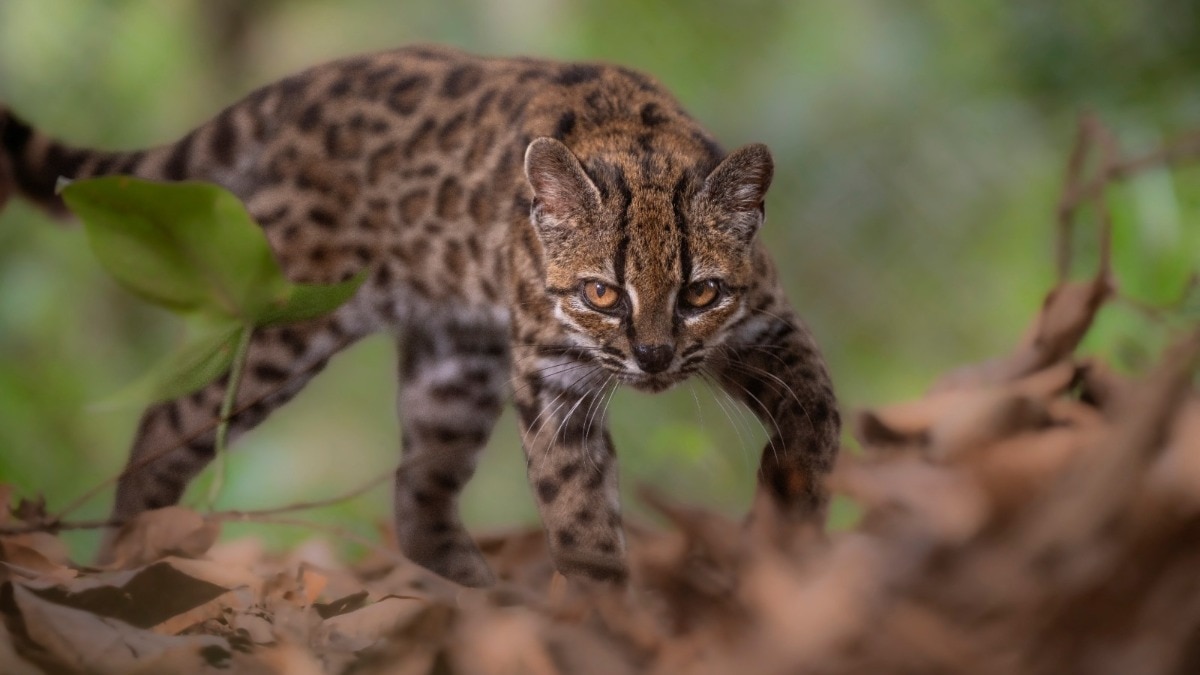
Meet Leopardus tilcayo, a newly identified wild cat from Bolivia that diverged from other tiger cats about 1.4 million years ago.A Leopardus tilcayo cat walks at the Senda Verde animal refuge in Bolivia. (Photo: Reuters)A tiny wild cat hiding in the cloud forests of Bolivia has just altered the history of the world's cats. It's also safe to say that it was a long time coming.Scientists have formally identified the animal as a new species, Leopardus tilcayo, making it the first living cat species to be newly named and described in more than 100 years. A close up image of the newly discovered cat in Bolivia. (Photo: National Geographic) The spotted cat, known locally as the Tilcayo, lives in Bolivia's lush Yungas forest, a mountainous region where forests are often wrapped in clouds and high humidity.The cat is only about 46 centimetres long and weighs around 1.4 kilograms, making it smaller than the average domestic cat. The discovery began when researchers noticed that the Bolivian animal did not look quite like the tiger cats they already knew.“Its fur is light brown ... with irregularly shaped rosettes,” Paola Nogales-Ascarrunz, a National Geographic Explorer and study author, told news agency Reuters. National Geographic Explorer Paola Nogales Ascarrunz observes Leopardus tilcayo cat. (Photo: Reuters) Tiger cats are particularly difficult to distinguish because several species can look similar. For years, they had largely been treated as one species, although genetic research had already hinted that the group was more diverse.The researchers analysed DNA from 38 cats from across South America, including eight museum specimens. The results later revealed that what had been treated as one group actually contains five genetically distinct species.“We never expected this Bolivian tiger cat to be a separate species,” evolutionary biologist Jonas Lescroart told Reuters.ONCE A TIGER, NOW A CATThe genetic evidence suggests that the Tilcayo lineage separated from other tiger cats about 1.4 million years ago.Researchers said that the genetic gap is large enough to represent a species-level difference among cats. A close of the Tilcayo cat taken at an animal refuge in Bolivia. (Photo: Reuters) The team has so far studied only two live Tilcayos and a small number of camera-trap records, meaning much about the animal remains unknown.“Our information at this moment is limited,” Lescroart said.Initial evidence suggests the cat may be active mainly at night and may feed on small rodents.The study, published in Current Biology, also identified a new tiger-cat subspecies in Peru's Yungas, named Leopardus tigrinus antisuyo.A DISCOVERY AND A WARNINGThe finding is, of course, something to pay attention to, but it also comes with an asterisk. Leopardus tilcayo is seen sitting. (Photo: National Geographic) A new cat has been identified, and it's also at risk as its home is under growing pressure from deforestation, agriculture, fires and mining.Researchers have shared their findings with the International Union for Conservation of Nature (IUCN), which plans to assess the five tiger-cat lineages separately.The Tilcayo could potentially be considered endangered when assessed on its own.As senior study author Eduardo Eizirik told news agency Reuters, "There are many undiscovered species out there in the world, and they are at risk of disappearing before we even discover them."- EndsPublished On: Sep 18, 2026 12:07 IST
New cat species discovered for the first time in over 100 years. See pics
Full Article
Original Source
Read the full article at Indiatoday →KhanList aggregates and links to publicly available news content. We do not host full articles from third-party sources. Always verify important information with original sources.