
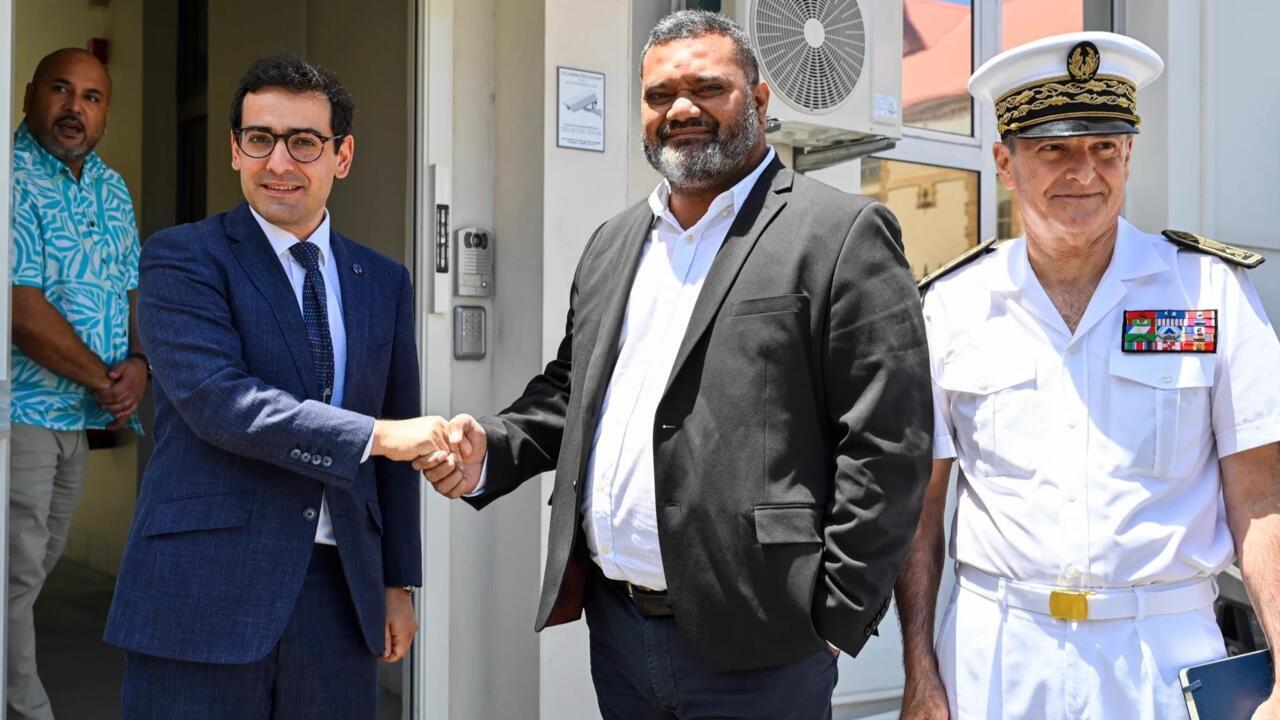
The French territory of New Caledonia in the South Pacific signed a strategic partnership with the European Union on Tuesday, paving the way to new markets and investment for its struggling nickel industry. The agreement aims to bring producers closer to European supply chains, although funding and industrial projects are yet to be secured. Issued on: 20/10/2026 - 18:17 3 min Reading time The memorandum of understanding, signed in New Caledonia's capital Nouméa, sets out cooperation on raw materials, cleaner production and investment, as Brussels seeks to diversify the supply of minerals essential to European industry. European Commission executive vice-president Stéphane Séjourné signed the agreement alongside New Caledonia's President Milakulo Tukumuli and Alcide Ponga, the government member responsible for nickel. Addressing the territory’s Congress on Monday, Séjourné said New Caledonia could become “a pillar” of Europe’s effort to diversify its nickel supplies, particularly by forging closer links with the battery sector. He said the partnership would be “non-exclusive” and would not require the territory to surrender control over its resources. Fifteen other countries have agreements of this kind with the EU, he added. For New Caledonia, the agreement represents broader commercial opportunities and support for modernising an industry facing high energy costs and a loss of competitiveness. For Brussels, it forms part of a wider push to strengthen European industrial sovereignty and reduce dependence on China for strategic supplies. Embattled New Caledonia nickel mine to lay off 1,200 staff From plans to projects The deal provides a framework for cooperation, but does not guarantee the purchase of New Caledonian nickel, or funding or immediate investment. A roadmap is to be drawn up within six months, identifying priority projects, how cooperation will work and possible sources of European funding, according to TV channel Nouvelle-Calédonie La 1ère. Reducing the carbon footprint of production is expected to be an important consideration. Cleaner energy could help address the nickel sector’s heavy operating costs, while making the product more attractive to buyers seeking lower-emission supplies. However, the agreement offers no immediate answer to the difficulties faced by the territory’s three nickel plants. The New Caledonian government says it must be accompanied by a locally defined nickel strategy and investors willing to support industrial facilities and jobs. Speaking in Congress, Vaimu’a Muliava of centrist party L’Éveil Océanien – Oceanian Awakening – said the memorandum was not binding, but paved the way to work on a further agreement. “We are at a turning point where Europe must tell us what our competitive advantage is in being European today,” he said. The partnership extends beyond the nickel industry. Séjourné said the EU had committed nearly €32 million to New Caledonia’s energy transition since 2023, citing the proposed Tontouta pumped-storage power station – a project estimated to cost €400 million. Other initiatives under consideration include an aviation maintenance and training centre and undersea cables in the Pacific. European Investment Bank vice-president Ambroise Fayolle is due to visit New Caledonia in early December, while a €5 million European training and integration programme is scheduled to begin in the first quarter of 2027. Could nickel reserves be the key to independence for New Caledonia? Political divisions The agreement has also exposed political divisions over who should shape the future of New Caledonia’s resources. The pro-independence Kanaky NC group boycotted Monday’s Congress session, criticising the decision to proceed with the signing without first consulting elected members. It said it was not opposed to a partnership with Europe, but wanted the nickel strategy developed locally with the provinces, Congress, customary authorities, industry operators and the French state. Only one representative from the National Union for Independence attended the session, without taking the floor. The anti-independence Rassemblement-LR described the boycott as a “political blunder”, while loyalists welcomed Europe’s approach as a “gesture of goodwill”. Alongside the partnership, the European Commission is proposing to double the EU budget allocation for overseas countries and territories to €1 billion for 2028–2034 – a proposal which remains subject to negotiations between the European Parliament and EU member states. (with newswires)
New Caledonia looks to EU for new markets for troubled nickel sector
Full Article
Original Source
Read the full article at Rfi →KhanList aggregates and links to publicly available news content. We do not host full articles from third-party sources. Always verify important information with original sources.