
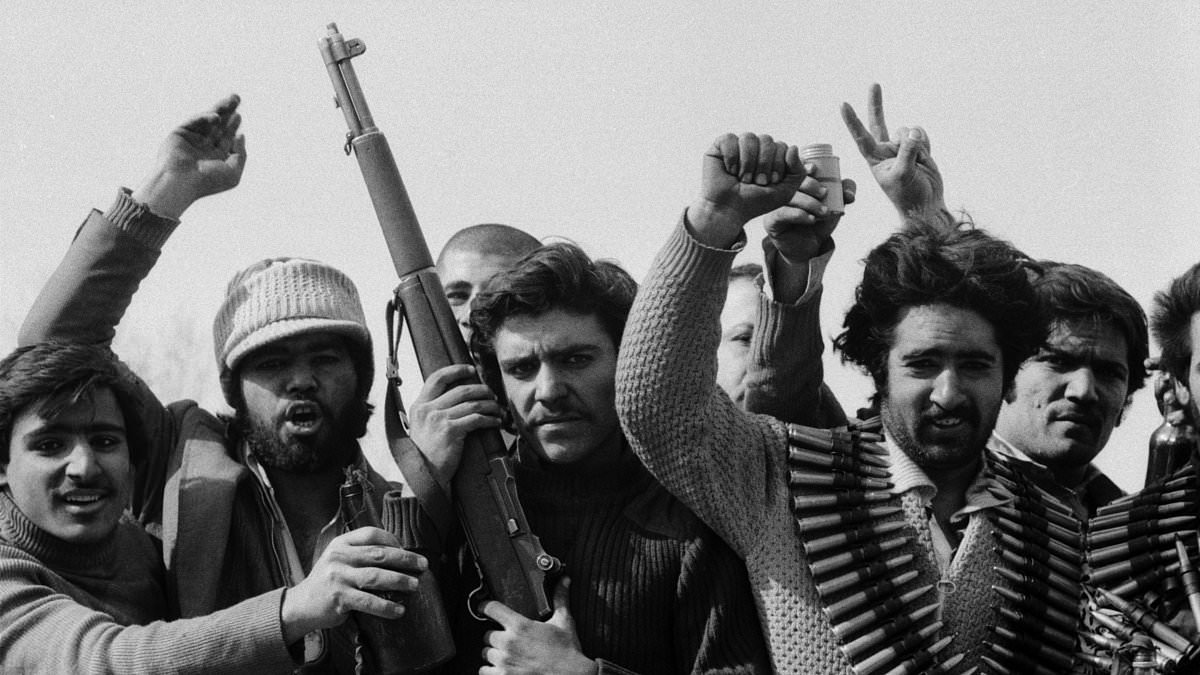
History in the Middle East, Simon Sebag Montefiore writes, ‘seems more alive than anywhere else, the past less dead’. His aim in his ambitious new book is to cover events in the region across 19 different states and over more than a century. To do so, he has to find a way to unfold a vastly complicated succession of uprisings, coups, assassinations and massacres. The Middle East, he notes, is ‘defined as much by the abundant delights of its way of life… as its interminable wars and tournaments of power’. The Cauldron shows us far more of the latter than the former. The Middle East is ‘defined as much by the abundant delights of its way of life… as its interminable wars and tournaments of power’.Montefiore’s path through the maze is basically a chronological one. In 1900, the region was caught between the decline of one empire, the Ottoman, and the expansion of others, the European empires of the British, French and Germans. The last semi-effective sultan-caliph of the Ottoman Empire, ruler of much of what is now the Middle East, was Abdulhamid II, a Sherlock Holmes fan and a translator of Verdi operas into Turkish. He had been swept into power in 1876, ‘amid war, death, madness and conspiracy’, and was swept out of it in 1909 by the so-called Young Turk Revolution against his autocratic rule. The empire’s new rulers had to choose an ally among the Western powers. They chose Germany and suffered the consequences of defeat in the First World War.The years immediately after the First World War saw the final collapse of the Ottoman Empire. An event that ‘had been anticipated for three centuries suddenlyhappened in three weeks’ in 1922. The new nation of Turkey emerged from the wreckage. The victorious powers from the war came together to decide what would happen to the other lands once ruled by the Ottomans. At Versailles and afterwards, the British and French prime ministers, Lloyd George and Clemenceau, reshaped the Middle East. REVOLT: Protesters in 1970s Iran call for the Shah to be replaced by Ayatollah KhomeiniUnfortunately, as Faisal, king of newly created Iraq, pointed out, ‘The Westerners were profoundly ignorant about the Arabs, and their information was mainly derived from the tales of the Arabian Nights.’ For better or worse, new states such as Iraq and Syria were brought into being.Jewish emigration to Palestine increased throughout the 1930s. Many of the emigrants hoped to live in peace with their Arab neighbours. In the words of David Ben-Gurion, later the first prime minister of Israel, the country was ‘like a sofa – there was room for both’. The optimism has not been justified. The creation of the state of Israel in 1948 triggered the first of what has been a succession of military confrontations between Arabs and Jews. Abdullah, king of Jordan, predicted that, ‘There will be another war and another war and another war, and we shall lose all these wars.’ He advocated peace. He was assassinated in 1951 by a member of a Palestinian nationalist group.Throughout the 1950s, the murderous antagonism between the two peoples continued. The charismatic Egyptian leader Nasser, described by the British prime minister Anthony Eden as ‘the Arab Mussolini’, humiliated Britain and France during the Suez crisis. He also once said, ‘our basic aim is the eradication of Israel’. Secular Arab leaders such as Nasser were not nearly radical enough for Islamist ideologues. Montefiore writes, ‘The Middle East continues to be a region where the sword still decides who rules.’There was a failed plan by the Muslim Brotherhood, a revolutionary Islamic organisation, to kill Nasser for his supposed treachery in signing a treaty with the British. The Muslim Brotherhood’s primary theorist in Egypt was Sayyid Qutb, an intellectual who had spent two years in the USA. There he had been shocked by what he saw as the American woman’s knowledge of, in his words, ‘her body’s seductive capacity’. He was also disgusted by the suggestiveness of American popular music, particularly, for some reason, the song Baby It’s Cold Outside.In 1966, Qutb was convicted of another plot to assassinate Nasser and was executed.As Montefiore makes abundantly clear, far more murderous Islamists have followed Qutb. The Islamic Revolution in 1979 overthrew the Shah of Iran and brought the austere cleric Ayatollah Khomeini to power. It was, Montefiore writes, ‘a world-changing epochal moment as significant as 1789 and 1917’.Khomeini ordered the mass killings of his opponents. ‘We will oppress them by God’s order,’ he stated. The war between Khomeini’s Iran and Saddam Hussein’s Iraq in the 1980s resulted in hundreds of thousands of deaths. ‘It’s a pity both sides can’t lose,’ the former US secretary of state Henry Kissinger said. In a sense, they did.More recent history in the region has seen American interventions in the wake of 9/11, the false dawn of the Arab Spring, when democracy briefly seemed likely to triumph in several countries, and the rise and fall of Isis, which, at its height, controlled 40 per cent of Iraq and 30 per cent of Syria.In September 2023, Jake Sullivan, Joe Biden’s national security adviser, stated that, ‘The Middle East region is quieter today than it has been in two decades.’ This was eight days before the October 7 Hamas attacks on Israel and the consequent overwhelming Israeli response in Gaza. As Montefiore writes, ‘The Middle East continues to be a region where the sword still decides who rules.’ Trump’s America is today embroiled in a Third Gulf War, as it strives to nullify what it sees as the nuclear threat of Iran.Current events in the Middle East can only be understood in the context of its history. Montefiore’s brilliant, headlong race through the past century and a quarter gives his readers that context.
New book proves that in the Middle East the sword still decides who rules
Full Article
Original Source
Read the full article at Dailymail →KhanList aggregates and links to publicly available news content. We do not host full articles from third-party sources. Always verify important information with original sources.