
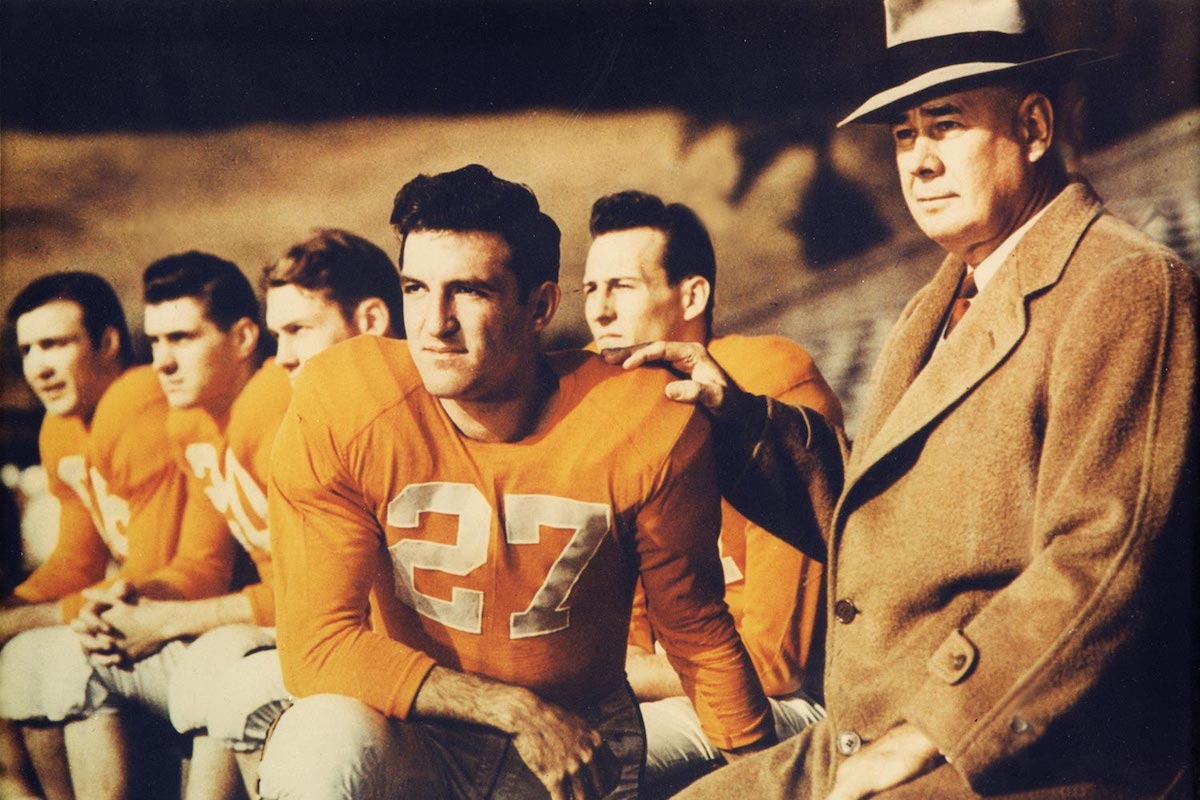
Tim Johnson was sitting inside of an office at the Pilot headquarters in Knoxville four years ago. Jim Haslam, the then-91-year-old founder of the multi-billion dollar oil-retailer and member of Tennessee’s 1951 football national title team, walked in and sat across from him. Johnson, a history professor at Lipscomb University in Nashville, was in the beginning stages of a book about legendary Tennessee head coach Robert R. Neyland. Haslam was one of the few living primary sources left that knew him. “Here you have a very successful, wealthy businessman in his 90s,” Johnson recalled. “He told me, ‘If General Neyland walked through that door right now, I would be nervous. The man still intimidates me.’ That was just the kind of presence he had.” Johnson’s book, ‘Robert Neyland: The West Point Engineer Who Built Tennessee Football,’ that released this week, tells the story of Neyland’s military career, his service in two World Wars and how it helped him transform Tennessee into a national football power on the 100th anniversary season that he took over the program. Neyland’s successes have been well-documented. He was named Tennessee’s head coach in 1926, taking the job with the expectation of turning the tide in the Volunteers’ lopsided series with rival Vanderbilt. What followed was 173 wins over 21 seasons, seven conference championships, four national titles and a litany of All-American and College Football Hall of Fame players. What inspired Johnson four years ago to write about Neyland was his military career and that few books about him existed. Sports writer Bob Gilbert wrote ‘Neyland: The Gridiron General’ in 1990 and former Neyland player Andy Kozar published rare journals and letters written by his head coach in ‘Football as a War Game’ in 2002. Johnson, who has written eight previous books on 19th century warfare in America, thought it was time to tell Neyland’s story again. “For maybe 20 years I kind of had it in the back of my mind to find out all I could about Neyland,” Johnson said. “When I started working on this book, it dawned on me that 2026 would be the 100th anniversary of his first year as head coach. I thought if I’m ever going to do a research project, maybe I should write a biography on the man.” Johnson spent several weeks in Knoxville going through boxes of Neyland’s writings at the University of Tennessee library. He read over hundreds of newspaper articles, interviewed all of the living players that played for Neyland and consulted former Tennessee sports information director and now athletics department historian Bud Ford and Neyland’s grandson, Blake Neyland. Johnson reached out to the granddaughter of M.A. Banks, who hired Neyland to his Tennessee staff in 1925. He drove to Ohio to comb through letters Banks had written about his young assistant coach. Johnson saw into the mind of a master tactician who used his experiences in the U.S. Army Corps of Engineers on the battlefields of France during World War I to design one of the most disciplined and unyielding defensive schemes in college football less than a decade later. “I knew that he had a dominating defense, I knew that his 1939 team hadn’t been scored on in the regular season and all of those things that avid UT fans know,” Johnson said. “But there were things I ran across where I was like, ‘Man, I’ve got to really get into this and retell this.” While the book covers Neyland’s football prowess, Johnson’s biggest aim is to introduce readers to Neyland, the man. Neyland’s experiences as a cadet at West Point are chronicled, including how he became a stellar three-sport star and self-taught boxing champion at Army. It delves into his quiet and even mysterious nature that could make a room go silent when he entered. “There was an aura about him,” Johnson said. “Neyland was football royalty. He was so intimidating with his presence.” Even with all of the championships, Cotton Bowl and Orange Bow triumphs, unrelenting defenses posting records that will never be broken and a coaching tree with roots spread across the sport, Johnson writes of Neyland’s greatest personal accomplishment. It was in Calcutta, India, where he oversaw the movement of supplies and troops in the China-Burma-India theater of World War II. “Neyland was an organizational genius,” Johnson said. “He took Calcutta from an underperforming supply base and turned it into one of the most prolific military supply bases in the world in four months…Late in life, a visitor came to campus to see him. The person said to the General, ‘What is the greatest accomplishment that you would most like to be remembered for?’ And Neyland said, ‘I’d like to be remembered for what I did in Calcutta.’ “This is a man who won four national championships and with all of the football accolades, what does he want to be remembered for? His contribution to the war effort.”
New book covers Robert Neyland’s football, military accomplishments
Full Article
Original Source
Read the full article at On3 →KhanList aggregates and links to publicly available news content. We do not host full articles from third-party sources. Always verify important information with original sources.