
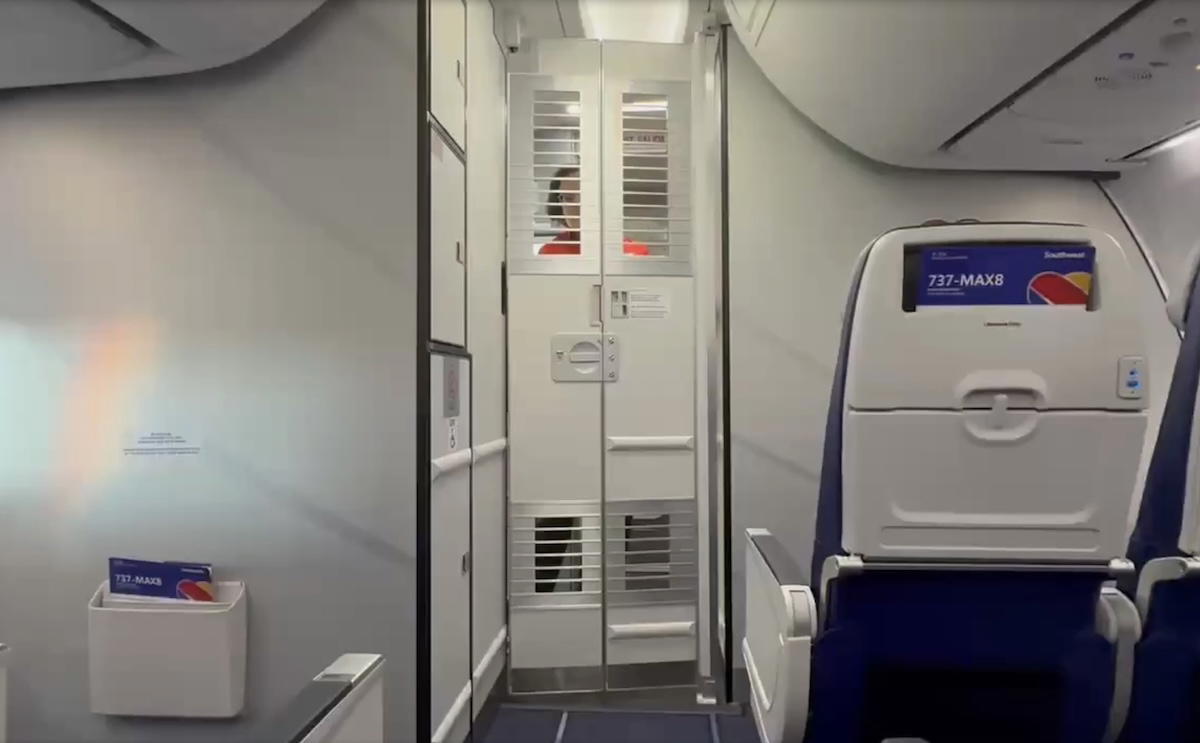
For years, there had been talk of the flight decks of commercial aircraft in the United States getting a second flight deck barrier. This started to become more serious in 2022, when regulators moved forward with a recommendation to implement this change. Then in 2024, we saw the signing of the FAA reauthorization bill, which finalized this. While we’ve started to see airlines take delivery of planes with the new secondary barrier, this policy has now formally been put into place — as of August 25, 2026, all newly delivered commercial planes in the United States need to have this feature. Let’s talk a little about that. Is this a sensible development that will make flying safer, or unnecessary and a waste of money? While pilots are applauding this change, they’re also demanding more… FAA now requires second flight deck barrier on new planesPilots union demands existing planes be retrofitted as wellIs a second flight deck barrier necessary?Bottom line FAA now requires second flight deck barrier on new planes The Federal Aviation Administration (FAA) has now implemented a rule that requires a secondary barrier on the flight deck of new Part 121 commercial airplanes in the United States, to ensure the safety of the aircraft, crew, and passengers. As the FAA describes this, the intent is to slow any attack on the flight deck long enough so that the flight deck can be closed and locked before an attacker could reach it. With this, aircraft manufacturers have to install a second barrier for all planes delivered as of August 25, 2026. However, there are no plans to require existing aircraft to be retrofitted with this feature. This concept was actually proposed many years back — the FAA was supposed to have adopted this rule by 2019 under a 2018 federal law, but the agency didn’t act until more recently. Of course the terrorist attacks of 9/11 changed aviation forever. Since 9/11, we’ve seen the introduction of reinforced flight deck doors, which realistically can’t be broken into. This new law is intended to address situations where one of the pilots has to leave the flight deck (whether to go to the bathroom, go on break, etc.). Previously in these situations, a flight attendant would simply block the aisle with a cart while the door is open. The FAA estimates that this secondary barrier costs $35,000 per aircraft, including the purchase of the barrier plus the installation. After the addition of training and other costs, the present value costs for this rule are $236.5 million at a 7% discount rate, and $505 million at a 3% discount rate. For those curious about how this works, see the below video showing this in action on a Southwest Boeing 737 MAX. As you can see, it’s essentially a folding door that can be stored during most phases of the flight. Then when it’s needed, it can easily be extended, and acts like a gate. It’s worth noting that some airlines have had some sort of “gates” installed in front of the flight deck for years. At least going back many years, I remember United 757s having these kinds of “gates” (I’m not sure if it’s still the case). Pilots union demands existing planes be retrofitted as well The Air Line Pilots Association (ALPA), the largest union representing pilots in the United States, has released a statement about the implementation of this new requirement. While the union is expressing support for the changes being implemented, the union is arguing that this requirement should also be added for existing aircraft, rather than just newly delivered ones. Here’s what ALPA President Jason Ambrosi had to say: “We honor the progress we’ve made but our work isn’t done. Every plane already in service, already carrying passengers, is still allowed to fly without a secondary barrier. A quarter-century removed from September 11th, that’s a gap we shouldn’t live with. We are calling on the Federal Aviation Administration to issue rulemaking requiring airlines to retrofit the in-service fleet with secondary flight deck barriers without delay so that protection for the flight deck doesn’t depend on which aircraft happens to show up at the gate.” Merits to the second flight deck barrier aside (I’ll talk more about that below), I totally get their narrative. If the argument is that this barrier is needed to keep planes safe, why is it only being applied to planes going forward, and not to existing planes? Obviously not all planes could be retrofitted overnight, but you’d expect that this would be something that could be required within a certain number of years. I don’t understand the inconsistency of the logic — either this is important, or it isn’t important. Pilots want the second flight deck barrier on existing planes as well Is a second flight deck barrier necessary? It goes without saying that aviation has become so safe over the years thanks to all the incremental improvements that have been made. As a matter of fact, this change is the last 9/11 Commission recommendation to be implemented. That being said, this seems like a solution that doesn’t actually solve a whole lot. How many people have successfully broken into a flight deck of a commercial airplane in the roughly 25 years since 9/11? I think zero globally, but someone correct me if I’m wrong. That comes down to multiple factors: It comes down to reinforced flight deck doors, which mean that you can’t break into flight decks It comes down to the mentality around hijackings having changed; previously if someone threatened an airline employee with a weapon, they’d typically let them into the flight deck, while that wouldn’t happen in a post-9/11 world Passengers wouldn’t allow a hijacking to happen; in the past they would have probably cooperated with hijackers, thinking that would be the solution that leads to the least damage, while I think that mindset has changed post-9/11 Let’s talk about another aspect of the reinforced flight deck door. How many planes have crashed in the past 12 or so years due to one pilot being locked out of the flight deck and not being able to get back in? In November 2013, LAM Mozambique flight 470 crashed while the captain was in the flight deck and the first officer was locked out of the flight deck In March 2014, Malaysia Airlines flight 370 went missing, and the leading theory is that the captain hijacked the plane while the first officer was locked out of the flight deck In March 2015, Germanwings flight 9525 crashed while the first officer was in the flight deck and the captain was locked out of the flight deck In March 2022, China Eastern flight 5735 crashed, and US officials believe that this was intentional based on data from the flight While I’m not suggesting we should get rid of reinforced flight deck doors, one has to wonder how many lives have really been saved by them. To me, pilot mental health and one person in a flight deck presents a much bigger risk to aviation than the number of flight deck barriers there are. Admittedly this is more of a global problem than a US problem — at least US airlines are required to always have two people in the flight deck, which is why a flight attendant always has to enter the flight deck when a pilot leaves. This doesn’t apply to foreign airlines flying to the US, though. I’m much more concerned about the actions of pilots Bottom line The FAA now requires airlines to install a second flight deck barrier, which extends out when the flight deck door needs to be opened. This applies on all newly delivered aircraft as of August 25, 2026, though the requirement won’t be implement for existing aircraft (despite unions representing pilots demanding this). On the one hand, I guess this can’t hurt, other than the cost. On the other hand, this seems to address what I’d consider to be an absolutely tiny risk. And I know it’s an uncomfortable reality, but given how safe aviation is, it seems the bigger risk involves the mental health of those inside the flight deck, rather than those outside the flight deck. What do you think — is a second flight deck barrier on commercial airplanes really necessary?
New Airplanes Get Second Flight Deck Barrier, But Pilots Want More
Full Article
Original Source
Read the full article at Onemileatatime →KhanList aggregates and links to publicly available news content. We do not host full articles from third-party sources. Always verify important information with original sources.