
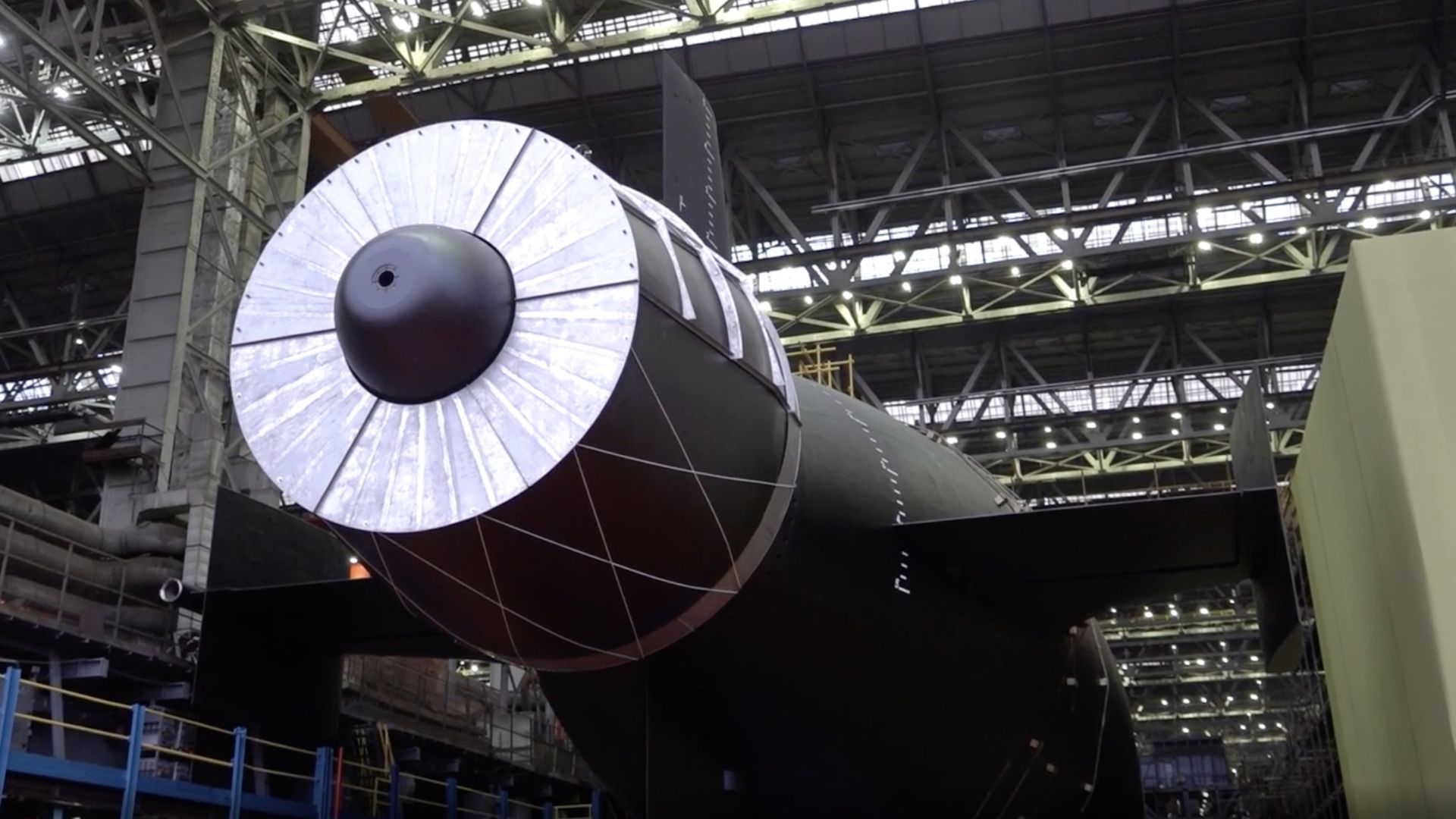
Russia’s Khabarovsk nuclear-powered submarine has started its first factory sea trials in the White Sea. This is a key milestone for Moscow’s Poseidon strategic weapon program. The Project 09851 submarine left the Sevmash shipyard in Severodvinsk to test its propulsion, steering, diving, hull strength, and onboard systems, according to reports. The trials will determine whether the submarine is ready to progress toward state acceptance and eventual deployment. Khabarovsk was built specifically to carry Poseidon, unlike the larger Belgorod, which was converted from an unfinished Soviet-era Oscar II submarine. A submarine built around Poseidon Khabarovsk is reportedly configured to carry six 2M39 Poseidon autonomous underwater vehicles, which is more than the four usually linked to Belgorod. The submarine measures about 443 feet in length, with a beam of roughly 44 feet and a submerged displacement of approximately 11,023 U.S. tons. Its widened bow reflects the unusual mission. Two large longitudinal compartments are believed to contain six 2P39 launch installations for Poseidon vehicles. Its stern and pump-jet propulsion arrangement reportedly resembles Russia’s Project 955A Borei-A ballistic missile submarines. The forward section, however, was redesigned around the oversized strategic weapons. — Massimo Frantarelli (@MrFrantarelli) August 18, 2026 Poseidon brings a huge payload Each Poseidon vehicle is estimated to measure about 66 feet long and between 5.9 and 6.6 feet in diameter. Experts estimate its weight range from roughly 61 to 121 U.S. tons. At the upper estimate, six vehicles could represent about 728 U.S. tons of payload before accounting for launch equipment and supporting machinery. Khabarovsk is also believed to have a smaller conventional weapons section with six to eight 21-inch torpedo tubes. These could support heavyweight torpedoes, mines, and potentially Kalibr cruise missiles. Poseidon is a nuclear-powered underwater weapon. Open sources estimate it can travel about 6,200 miles, dive as deep as 3,281 feet, and move at around 60 to 70 knots. The size of its warhead is still unclear, with estimates ranging from 2 to 25 megatons. Years behind its original schedule Construction of Khabarovsk began on July 27, 2014, after Russia awarded Rubin the design contract. Delivery was initially expected around 2020, but the submarine reached sea trials in 2026. Sevmash rolled the submarine out of its workshop in November 2025 before crews prepared its reactor, propulsion, navigation, electrical, and other systems for testing. The submarine is believed to use a single-shaft pump-jet system. Reported specifications include a reactor producing about 200 MW of thermal power and a turbine rated at roughly 50,000 horsepower. Its submerged speed is estimated at 30 to 32 knots, while its operating depth is around 1,640 feet. Pacific deployment remains ahead Russia currently has one commissioned Poseidon carrier, Belgorod, while Khabarovsk remains under testing. Once accepted, Khabarovsk is expected to join the Pacific Fleet, with supporting facilities being prepared at Krasheninnikov Bay on Kamchatka. The program still faces further trials, acceptance testing, and infrastructure requirements before deployment. The development comes after Ukrainian forces struck Russia’s Novorossiysk naval base on August 12. Four Russian warships reportedly suffered varying degrees of damage, including the Project 11356 frigates Admiral Makarov and Admiral Essen, the Project 21631 Buyan-M missile ship, and the Project 22160 patrol ship Vasily Bykov.Get the latest in engineering, tech, space & science - delivered daily to your inbox.A versatile writer, Sujita has worked with Mashable Middle East and News Daily 24. When she isn't writing, you can find her glued to the latest web series and movies.
New 443-foot nuclear submarine built to carry six long-range torpedoes begins sea trials
Full Article
Original Source
Read the full article at Interestingengineering →KhanList aggregates and links to publicly available news content. We do not host full articles from third-party sources. Always verify important information with original sources.