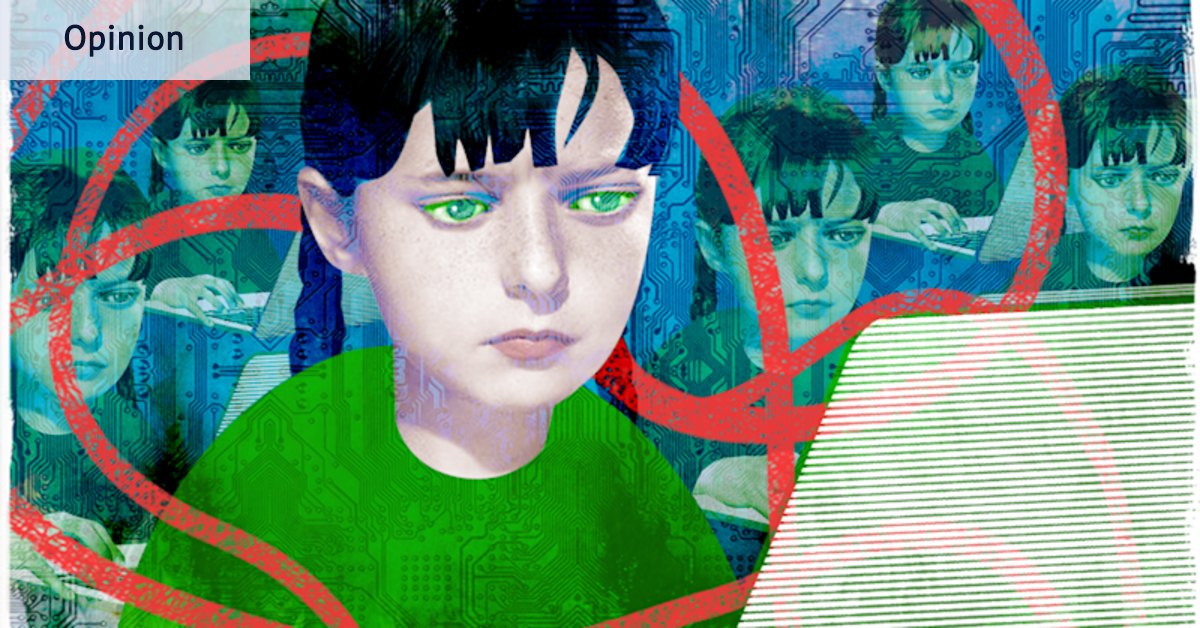
OpinionPolitical scientist and writerJuly 30, 2026 — 5:00amIn the 1932 classic Brave New World, Aldous Huxley imagined a future in which social class was determined not by education, inheritance or access to opportunity, but by cognitive capacity. Alphas and Betas occupied the jobs that required logic and critical thinking, while menial roles were assigned to lower strata with cruder cognitive abilities enforced by genetic and social conditioning. At the bottom were the Epsilons: “semi-morons” whose cognition was so diminished they were incapable of learning to read or write.As AI continues its relentless colonisation of everything from the labour and stock markets to the arts, media, warfare and the internet itself, it’s never been more critical to safeguard the capacity of our own brains. Photo: Illustration: Dionne GainThose of us who came of age in an era of books, paper and dial-up modems have had our intellectual scaffolding shaped by now seemingly quaint notions like truth, facts, nuance and common sense. To us, it might seem obvious that mental labour and application is required to master one subject or another. That the learning is in the effort itself, and that this is a good thing.When Gen X and Millennials offload some of our mental effort to AI we can mostly still draw on the foundational skills learnt during those intensive years of childhood education. This knowledge base theoretically equips us to critically evaluate whatever the bot serves up, sorting fact from hallucination and knowing how to refine any follow-up prompts.Worryingly, research is beginning to indicate that shifting too much “cognitive load” onto AI can lead to the atrophy of core intellectual processes, including memory, concentration and analytical skills.A recent study that measured brain activity during an essay-writing task showed that ChatGPT users had “significantly reduced cognitive engagement” in contrast to those who relied on brain power alone. Research out of France has argued that the more the brain offloads cognitive tasks to AI, the less the prefrontal cortex is used, leading to “cumulative cognitive debt”. We risk losing the ability to infer, summarise and critically examine information in the process. Neural networks appear to be like muscles: if you don’t use them, you lose them.While this already sounds a bit like something Huxley cooked up in Brave New World, it’s worth noting that most of this emerging evidence comes from studies conducted on those of us who have had the chance to develop our brain capacity pre-AI. Where we may really see the emergence of Alphas and Epsilons is in the brains of those who have never known a world without Claude or ChatGPT.We’ve been here before, and recently too. From the early 2010s governments have been bamboozled by the flashy, shiny novelty of tech in the classroom. “A laptop for every child” became the rallying cry of progress, never mind the lack of evidence base and the astronomical cost to schools, parents and taxpayers.Study after study has since shown that reading, writing and mathematics have fallen off a cliff and experts point the finger at the very devices that were meant to revolutionise education for the better.Despite this, a surprising number of people seem to think AI for kids is a good idea. The Queensland government is rolling out an AI bot to all public high schools to aid students to “brainstorm, check, draft, revise, research and summarise information”. Or, in other words, the very foundational cognitive tasks that are at risk of atrophy if surrendered to AI.As with laptops and online learning platforms, this is happening before the research on both educational outcomes and child brain development has had time to catch up.In fact, the research we do have on AI in education raises the prospect of Huxley-esque divisions in cognitive equity. One US team conducted a randomised controlled trial that involved giving a thousand high school maths students access to ChatGPT tutoring tools. They concluded that while unrestricted access to AI improved maths results, when the technology was taken away the students underperformed, “indicating reduced skill acquisition”.Unsurprisingly, it turns out copy-pasting answers from AI doesn’t indicate a deep understanding of the material. The authors ultimately concluded that “unfettered access to [Chat] GPT-4 can harm educational outcomes”.Research published in science journal Nature on medical student training reflected similar themes. The authors described a phenomenon called “never-skilling,” wherein trainee doctors “who rely on AI during the early formative years of clinical education may fail to develop the foundational reasoning skills that safe, independent practice requires”. In short, reliance on AI is quite literally making med students dumber, and this is dangerous.It’s perhaps no longer science fiction to imagine a future in which “luxury brains”, those trained in high-level literacy, numeracy and critical thinking skills, might be the privilege of an intellectual elite who can afford to educate their children with more analogue forms of learning.Some private schools are already reprioritising pens, paper and books over tech in the classroom, given the poor learning outcomes associated with screens. Silicon Valley tech billionaires famously send their kids to tech-free Waldorf schools.Meanwhile, in Australia, cash-strapped state governments are poised to double down on AI in public schools, with AI tutors marketed as a low-cost panacea for overcrowded and unruly classrooms and overworked teachers. Or, as the Queensland government optimistically spins it, an opportunity to foster “future-focused learning practices”.The federal government’s Australian Framework for Generative Artificial Intelligence in Schools doesn’t mention risks to foundational learning or child brain development at all. Meanwhile, Norway has recently banned AI from all primary and early secondary schooling, citing “the risk that young children skip important steps in their education”.Social media, phones and screens in schools have turned a generation of kids into guinea pigs, with disastrous results for attention spans, mental health and learning outcomes. Do we really want to repeat the same mistakes with AI?Providing children with a solid foundation of knowledge and skills is the best way to nurture critical thinking and intellectual curiosity. Disrupting their cognitive development with AI risks raising a generation of Epsilons. Kylie Moore-Gilbert is a research fellow in Security Studies at Macquarie University and a regular columnist.The Opinion newsletter is a weekly wrap of views that will challenge, champion and inform your own. Sign up here.From our partners
‘Never-skilling’: High school rush to AI threatens to create a generation of dunces
Full Article
Original Source
Read the full article at Smh →KhanList aggregates and links to publicly available news content. We do not host full articles from third-party sources. Always verify important information with original sources.