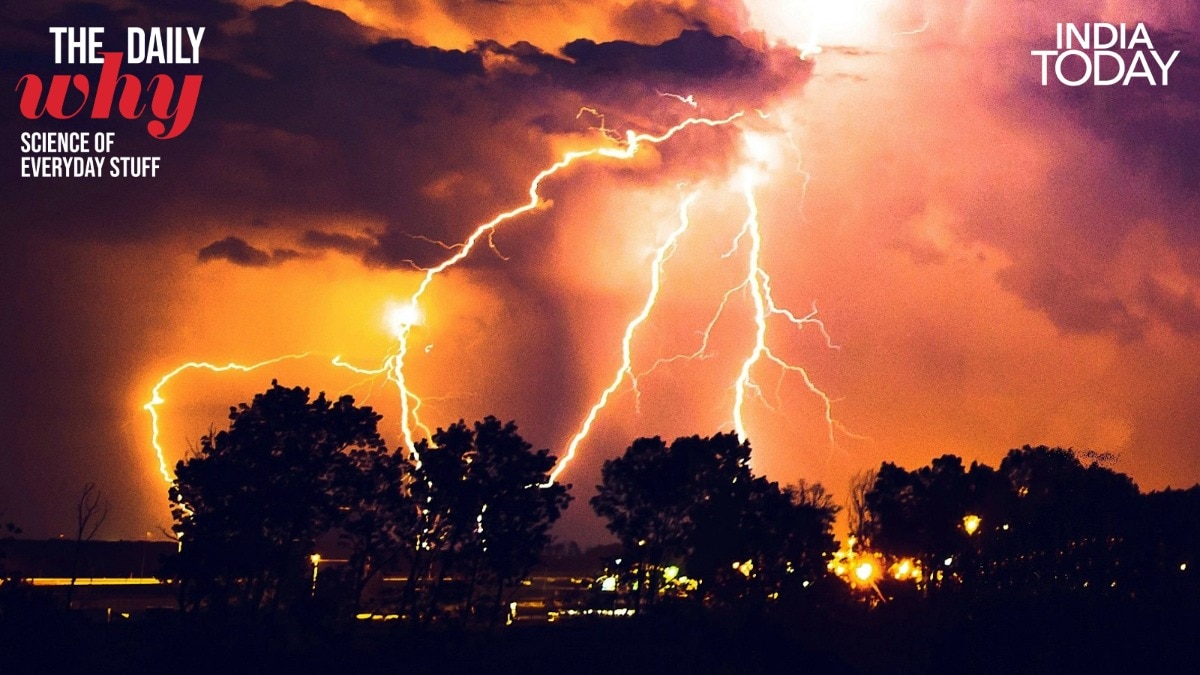
When rain arrives and thunder follows, every instinct says run to the nearest tree. Physics says the opposite, and the reason involves side flashes, step voltage, exploding sap, and a return stroke five times hotter than the surface of the Sun.Trees stand in an open field as lightning splits the sky behind them. Tall, moist, and pointed at every tip, a living tree is one of the most dangerous places to shelter when a storm arrives. (Photo: Unsplash)The instinct is ancient and wrong. When rain comes fast and the sky begins to growl, the body does something automatic. It scans the landscape, and moves towards the tallest shelter nearby. It moves towards the tree.Long before lightning was a word, a wet human in an open field knew that trees meant cover. It is one of the oldest survival instincts on Earth. And in a thunderstorm, physics says plainly, it may be one of the most dangerous.This series from India Today Science explores the why and how behind everyday phenomena we notice, wonder, but often overlook. Each edition breaks down the science behind familiar experiences in simple terms.Today, as monsoon storms sweep across India and thunder follows the rain, we look at why the tree you run towards may be the last place you should stand. WHY DO TREES ATTRACT LIGHTNING IN THE FIRST PLACE?Lightning does not simply fall from the sky. In the truest physical sense, it rises to meet what is already coming down.Inside a thunderstorm, billions of ice crystals and soft hail pellets collide violently inside the cloud, separating electrical charge much like rubbing a balloon creates static electricity. The lower part of the cloud accumulates a vast negative charge. The earth beneath it, drawn by that charge, builds an answering positive charge on the surface of everything below, particularly on tall, pointed, conductive objects.Trees qualify on all three counts. They are tall. They taper to a thousand tips and twigs, each one concentrating the electric field at its point. And a living tree is full of sap and moisture, making it far more electrically conductive than the dry air surrounding it. A lightning bolt strikes a tree in a forest during a monsoon storm. What appears as a single downward flash is actually a return stroke surging upward along a channel established when invisible charge from the cloud met upward streamers rising from the tree. (Photo: Unsplash) As the storm intensifies, the cloud sends an invisible, branching channel of charge towards the earth, called the stepped leader, descending in discrete jumps of tens of metres at a time, feeling its way towards the shortest path to the ground. From the tips of trees, buildings, and people standing in open fields, positive charges shoot invisibly upward in return, as sparks called upward streamers.When one streamer meets the descending leader, the circuit closes. A return stroke surges upward along the newly conducting channel at roughly one-third the speed of light, carrying tens of thousands of amperes of current.The channel heats to approximately 30,000 degrees Celsius, about five times hotter than the visible surface of the Sun. That is the flash. The explosive expansion of the surrounding air is thunder.The tree, in all of this, is not a victim. It is a participant. And anyone sheltering beneath it becomes part of the same circuit.WHAT HAPPENS TO A PERSON SHELTERING UNDER A STRUCK TREE?In the 2008 David Fincher film The Curious Case of Benjamin Button, an old man named Mr Daws tells the same story every time he meets someone. "Did I ever tell you I have been struck by lightning seven times?" he asks Brad Pitt's character.The film plays each strike in grainy, sepia-toned footage. The character was drawn from Roy Cleveland Sullivan, a real park ranger who survived seven verified strikes between 1942 and 1977 and carried a bucket of water in his truck in case his hair caught fire again. In The Curious Case of Benjamin Button, the character Mr Daws, played by Ted Manson, tells Benjamin the same story every time they meet. Did I ever tell you I have been struck by lightning seven times? Each strike plays out in grainy, sepia-toned footage. Roy Sullivan was extraordinarily lucky. Most people who stand beneath a struck tree are not.The danger rarely comes from the direct strike. It comes from what happens in the instant after.The first hazard is the side flash. Wood is a poor electrical conductor compared to the human body, which is largely salt water. When lightning races down a trunk and meets the tree's natural resistance, it looks for an easier path. If you are standing within a few feet, that easier path is you.The current leaps sideways through the air in a brief arc, entering your body at the head or shoulders, passing through the brainstem and the heart on its way to the ground. It is not looking for you.It is simply following the path of least resistance, and your body is more conductive than the wood it just left.The second hazard is step voltage, and it is responsible for the greatest number of casualties. When lightning enters the earth at the base of a tree, it does not stop. A tree split by a lightning strike, its bark stripped in long spirals from crown to root. When current races down the trunk and meets resistance, it leaps sideways through the air toward any person standing nearby, entering the body at the head or shoulders. (Photo: Unsplash) It spreads outward through the soil in all directions, the way ripples travel from a stone dropped into still water. The voltage is highest at the tree and diminishes with distance, but the gradient can remain lethal 30 metres away and beyond.Here is the danger. If you are standing anywhere in that radius with your feet apart, one foot sits at a higher voltage point than the other.The difference drives current up one leg, through the body, and down the other leg into the lower-voltage ground. You need not have touched the tree. You need not even have seen the strike. The current asks nothing of you except your proximity to the earth.Cattle and horses, whose front and hind legs span a wide distance, are killed in numbers after single strikes for exactly this reason.WHY DO TREES SOMETIMES EXPLODE WHEN LIGHTNING STRIKES?This is the physics that turns a tree from a conductor into a weapon.A living tree contains water in its sap and in the vessels just beneath its bark. When tens of thousands of amperes of current surge through that tissue, the water does not gradually heat. It flash-boils into steam almost instantaneously. Step voltage, the difference in electrical potential across the ground after a strike, spreads outward through the soil and can remain lethal for thirty metres or more from the base of the tree. (Photo: Unsplash) Steam occupies roughly 1,700 times the volume of liquid water. The expansion is sudden and violent, with nowhere to go. The pressure builds until the tree itself ruptures, stripping bark in long spirals from crown to root, shattering branches, and hurling wooden splinters outward at high velocity.Standing beneath a struck tree in that moment means standing in a storm of shrapnel. The lightning may not have touched you at all. The tree has done its own damage.HOW DID ROY SULLIVAN SURVIVE SEVEN TIMES?Because lightning, for all its violence, lasts for almost no time at all.The main return stroke endures for microseconds. In that vanishingly brief window, much of the current travels over the surface of the body rather than through its interior, a phenomenon physicists call the flashover effect.Sweat, rain, and wet clothing create a conducting layer across the skin that electricity prefers to the higher-resistance path of the organs beneath. The current rides the outside of the body, leaving burns on the skin and melting jewellery, while the heart sometimes escapes catastrophic damage.It is the same principle that sometimes spares a rain-soaked tree. Wet bark carries the current down the surface, leaving the interior intact. A dry tree beside it may explode. Roy Cleveland Sullivan, a park ranger at Virginia's Shenandoah National Park, survived seven verified lightning strikes between 1942 and 1977, earning the Guinness World Record. He took to carrying a bucket of water in his truck after his fourth strike, to extinguish his own hair. His survival was not proof that lightning is survivable. It was proof of how unpredictably the physics of each strike plays out. (Photo: Wikimedia Commons) Sullivan's seven survivals were not proof that lightning is survivable so much as proof of how much the physics of a single strike depends on angle, wetness, duration, and anatomy, none of which can be chosen or predicted.When the next storm arrives this monsoon season, the advice from every physicist who has studied this is identical. Move away from the tree. Move towards a building, or a hard-topped vehicle with windows closed. If neither is available, crouch low with your feet together, minimising the voltage difference between them, and wait.The tree has been drawing lightning towards itself since before the first human being stood beneath one and called it shelter. It is doing what it has always done.Do not stand in its way.#TheDailyWhy- EndsPublished By: Radifah KabirPublished On: Jul 30, 2026 13:26 IST
Never run to a tree to take shelter during lightning. Science explains why
Full Article
Original Source
Read the full article at Indiatoday →KhanList aggregates and links to publicly available news content. We do not host full articles from third-party sources. Always verify important information with original sources.