
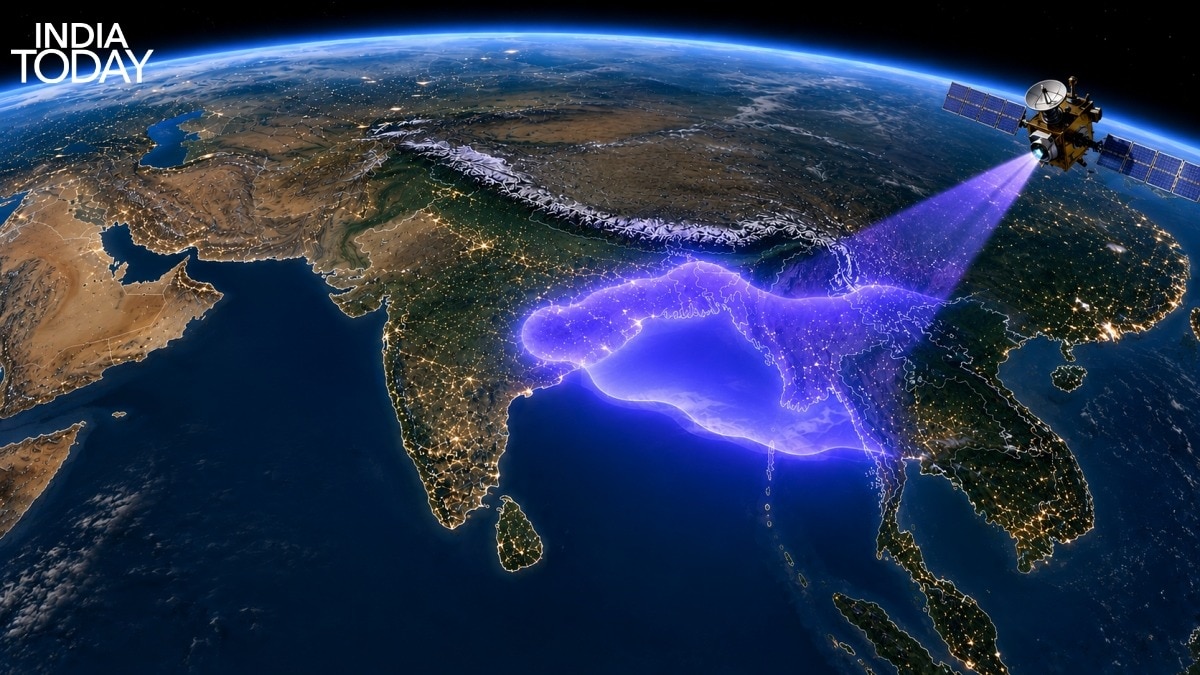
Scientists detected an unusually thick ozone layer over the North Bay of Bengal during a nationwide observation campaign. The finding shows how ozone-rich air can be transported downward and redistributed across the Indian subtropical region.Scientists concluded that the unusual ozone enhancement was primarily caused by the transport of ozone-rich air. (Photo: Generative AI by India Today)Scientists have detected an unusually thick layer of ozone high above the North Bay of Bengal, offering new clues about how ozone-rich air is transported and redistributed through Earth's upper atmosphere.The unusual ozone enhancement was found at an altitude of around 21-23 kilometres, in the lower stratosphere, during a nationwide atmospheric observation campaign. Researchers found that the concentration was significantly higher than normally observed over eastern India, with the unusual layer persisting for more than a day.The ozone layer is a region of Earth’s stratosphere, roughly 15-35 km above the surface, containing relatively high concentrations of ozone (O). It acts as Earth’s natural shield, absorbing most of the Sun’s harmful ultraviolet (UV) radiation, protecting humans, animals, plants and marine ecosystems from radiation damage.The discovery was made as part of the Phase-I NetRAD-ASMA campaign, a coordinated effort involving atmospheric research institutions across India. Scientists used an extensive network of instruments, including atmospheric radars, weather balloons, satellites and advanced atmospheric models, to track the movement of ozone and air masses across the country.A key role was played by the Aryabhatta Research Institute of Observational Sciences (ARIES). The enhanced ozone layer was detected during both day and night. (Photo: Reuters) During the campaign, ARIES' indigenously developed 206.5 MHz Stratosphere-Troposphere (ST) Radar at Nainital collected observations alongside similar radars at Haringhata, Gadanki and Kochi. Weather balloons equipped with instruments were also launched to measure atmospheric conditions and ozone concentrations.Scientists further used observations from the Aura MLS and INSAT-3DR satellites, allowing them to track the unusual ozone structure from space and compare it with ground-based measurements.The observations revealed something particularly intriguing. The enhanced ozone layer was detected during both day and night, suggesting that sunlight-driven chemical reactions were unlikely to be the main reason for its formation.Researchers instead examined atmospheric convection, wind shear, horizontal transport and vertical air movements. Their analysis showed persistent downward air motion in the lower stratosphere above the region.By combining observations from the radars, balloons, satellites and atmospheric models, scientists concluded that the unusual ozone enhancement was primarily caused by the transport of ozone-rich air, followed by downward movement and compression of the air mass.The ozone layer normally reaches its highest concentration around 25–30 kilometres above Earth and plays a crucial role in shielding life from harmful ultraviolet radiation.The findings, published in Earth and Space Science by the American Geophysical Union, provide new quantitative evidence of how atmospheric circulation can redistribute stratospheric ozone over the Indian subtropical region.- EndsPublished By: Sibu Kumar TripathiPublished On: Aug 10, 2026 18:06 IST
Never-before-seen ozone layer detected over Bay of Bengal. Isro tracking it
Full Article
Original Source
Read the full article at Indiatoday →KhanList aggregates and links to publicly available news content. We do not host full articles from third-party sources. Always verify important information with original sources.