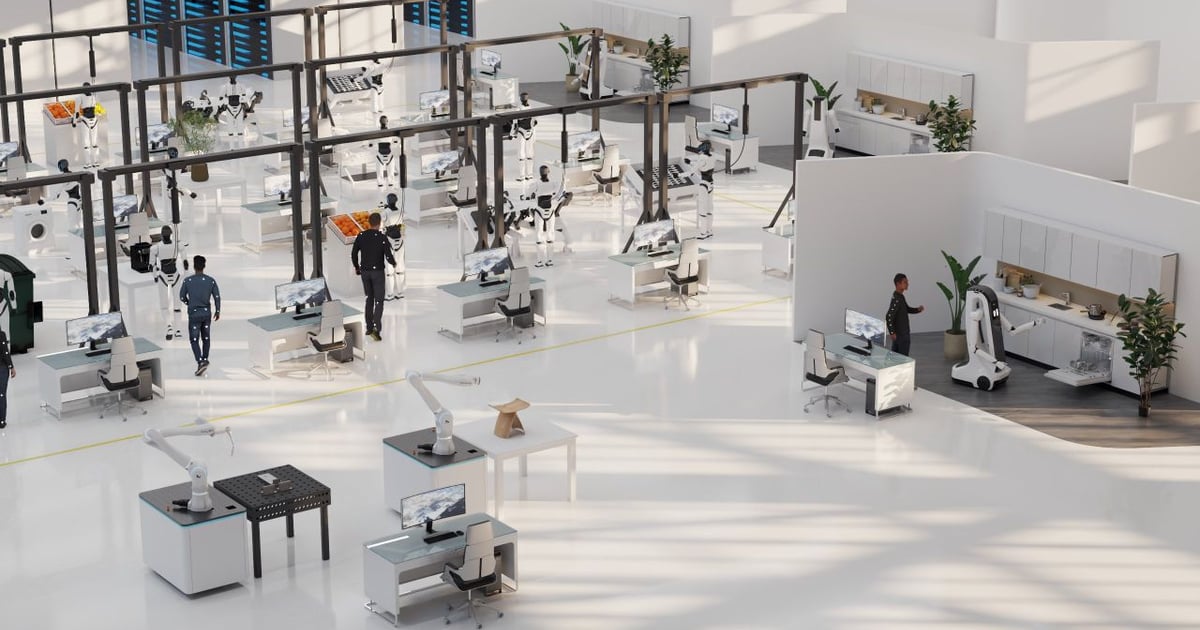
German robotics startup Neura Robotics has formed a partnership with Germany’s RWTH Aachen University to establish a robotics training facility that will provide real-world training data for robotic systems.The new site, whose plans were unveiled last week, joins Neura’s existing network of physical AI training centers, which the company calls Neura Gyms. Neura said the sites are built to address the biggest barrier to the rollout of intelligent robots: scarcity of real-world training data.The facilities combine physical training with high-fidelity simulation, creating datasets that feed directly into the Neuraverse, Neura's open, cloud-based platform connecting robots, developers and industry partners.Robot Gym RolloutThe sites are also designed to enable partners to train and validate robots for specific applications before committing to full industrial deployment, reducing adoption risks and accelerating time to deployment.Related:UK Robot Maker Humanoid Valued at $1.35 billionThe latest Neura Gym is scheduled to open by the end of 2026, with another 10 locations under development. Neura said half of these are expected to be operational by the end of the year across Europe, China and the U.S.In addition to the RWTH Aachen University site, Neura’s second flagship facility is scheduled to open at Munich Airport in the fourth quarter in collaboration with the Technical University of Munich and its Munich Institute of Robotics and Machine Intelligence.Together, Neura said these two centers position Germany as the backbone of Europe's physical AI infrastructure.Phil Solis, an analyst at IDC, said the launch at the German university site is significant as it goes beyond simply a place to test robots and collect data.“It combines simulation, a place to physically test robots, and developers and other industry partners can all leverage this,” he told AI Business. “AI-based development of software is one step that is greatly accelerating improvements in robotics compared to traditional programming, and this accelerates the way various companies can work together.”This could also be used for what Solis called shared learning, in which improvements made in testing environments can be pushed out to on-site robots.The global rollout is backed by the $1.4 billion Neura raised last month in a Series C financing round.Neura Gyms in a Global ContextMeanwhile, robotics gyms are already standard practice in China, where multiple regional hubs have been established to enable standardized and cooperative data collection, training and validation of physical AI systems, according to Himanshu Kumar Ojha, an analyst at Gartner.Related:Google Cloud, Nvidia Collaborate With German Startup for AI Robots“Compared to the digital world and knowledge tasks, availability and accessibility of relevant data is the limitation for physical AI,” he said. ”A scalable approach is necessary for collection and utilization for real-world data, to make these systems achieve necessary levels of performance for specific tasks and environments, through post-training and fine-tuning of base and foundation AI models.”Neura’s RWTH Aachen University center, he said, aligns with the recent scaling of physical AI in Europe to rival the more established robotics markets in the U.S. and China.“This provides a collaboration platform for Germany and overall Europe’s existing ecosystem of manufacturing and technology companies to contribute to the advancement of physical AI, and benefit with its adoption by various industries,” he added.Looking ahead, he said, given the current lack of global standards for regulation and compliance for physical AI, robotics hardware manufacturers and systems integrators could use the platform for standardization efforts, validation and testing for compliance.“Such initiatives will accelerate regional innovation and reduce Europe’s dependence on China or U.S. for physical AI, which is increasingly becoming a strategically important technology domain,” he added.Related:Agibot Expands Embodied AI Portfolio With Four New ProductsSolis said the launch is more focused on data sovereignty than global competition.“China has the most deployed robots and thus has much more data that can be collected,” he said. “Neura Gyms’ data and intelligence layer will be in Germany. Companies will be able to access this from any country, but it will likely be countries like this that … hold most of the data.”About the AuthorContributing WriterScarlett Evans is a freelance writer with a focus on emerging technologies and the minerals industry. Previously, she served as assistant editor at IoT World Today, where she specialized in robotics and smart city technologies. Scarlett also has a background in the mining and resources sector, with experience at Mine Australia, Mine Technology and Power Technology. She joined Informa in April 2022 before transitioning to freelance work.
Neura Robotics to Open Physical AI Training Center
Full Article
Original Source
Read the full article at Aibusiness →KhanList aggregates and links to publicly available news content. We do not host full articles from third-party sources. Always verify important information with original sources.