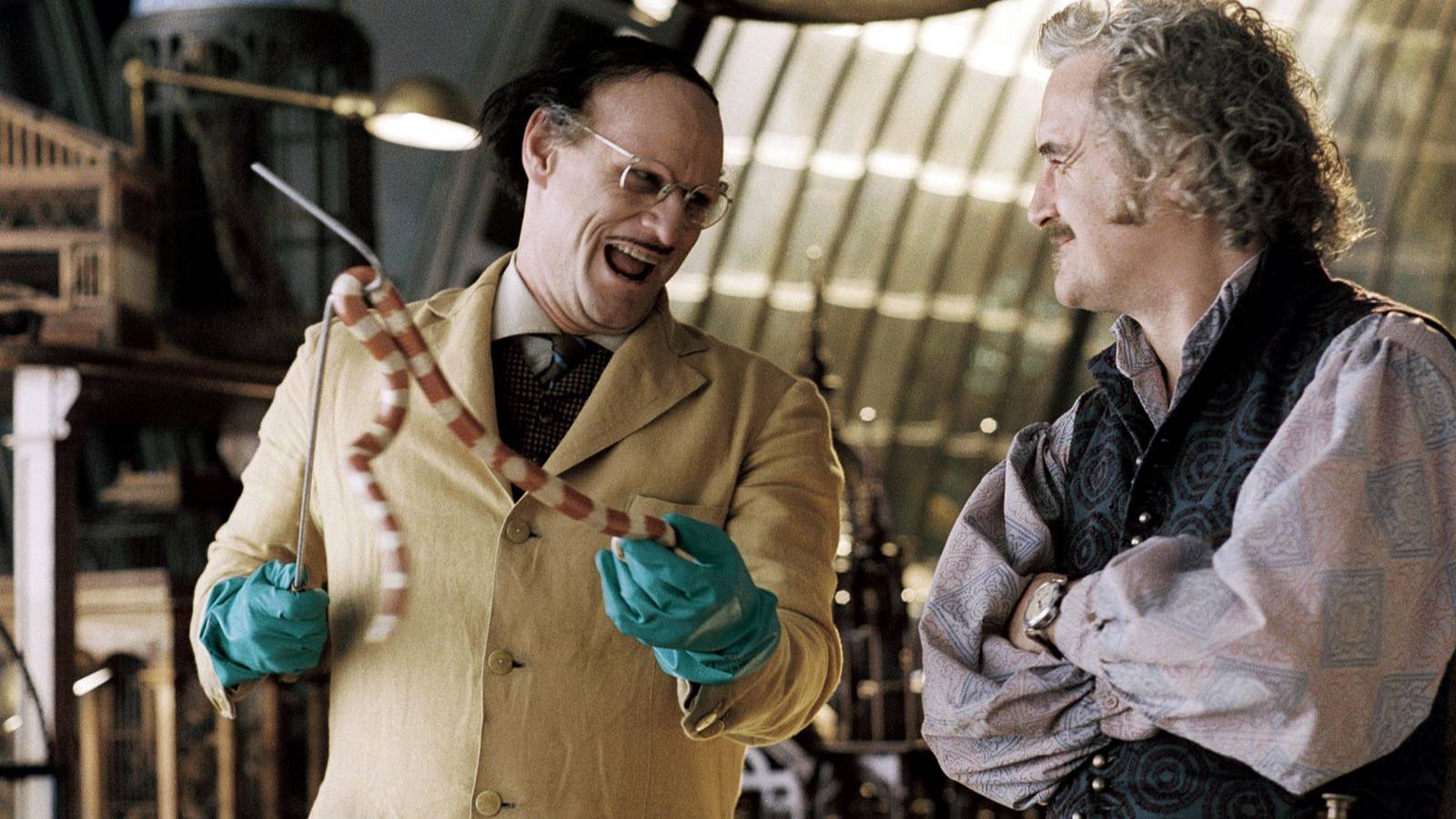
Image via Paramount/Courtesy Everett Collection Published Aug 2, 2026, 8:20 PM EDT Rae Torres is a Features Editor at Collider. Her past 13-year-old self wouldn't have believed you if you told her that she would get to channel her unhealthy obsession with TV shows into a career. Her favorite shows are all over the place, from Breaking Bad to Gilmore Girls, The Boys to Boy Meets World, The Punisher to Sex Education, and the list goes on. Most importantly, she will watch anything Jon Bernthal appears in, even if he's only there for 37 seconds. Prior to working in entertainment journalism, Rae was a writer for educational companies such as Aztec Software, SuperSummary, and APass Education. She has also worked as a textbook editor and a marketing director of legal textbooks. With an MA in Rhetoric and Composition and an M.Ed. in English Language Arts, Rae has spent over ten years working closely with writers as a writing consultant, college writing instructor, and middle school ELA teacher. (And yes, Abbott Elementary hits too close to home, so she can't watch it anymore, even though it's brilliant. Sorry, Quinta Brunson.) When she isn't typing away, you can find her hanging out with her husband, stepson, and their three cats, Raisin, Gollum, and Smeagol, reading Brandon Sanderson, and aggressively defending Taylor Swift. Sign in to your Collider account In Netflix’s A Series of Unfortunate Events, Lemony Snicket (Patrick Warburton) tells the dreadful tale of the Baudelaire orphans, Violet (Malina Weissman), Klaus (Louis Hynes), and Sunny (Presley Smith), who recently lost their parents in a terrible fire and are being pursued by a treacherous villain named Count Olaf (Neil Patrick Harris), who is dying to get his greedy hands on their fortune. Visually stunning, delightfully whimsical, and perfectly cast, the series is an adaptation of Lemony Snicket’s (an alias for author Daniel Handler) 13-book children’s series — a much more successful adaptation than the failed 2004 film (sorry, Jim Carrey). For the average viewer, especially an older viewer, A Series of Unfortunate Events is a fun, if repetitive, ride that roughly follows the same formula: The highly intelligent Baudelaires are placed in the care of a completely incapable guardian, Count Olaf finds them and fools the completely incapable guardian with a terrible disguise, chaos ensues, and then the Baudelaires are shipped off to another incapable guardian. It is, quite literally, a series of unfortunate events. But underneath the theatricality, satire, and brilliant original songs, A Series of Unfortunate Events offers something a little deeper than that. 'A Series of Unfortunate Events' Adapts the Tone and Feeling of the Original Series A Series of Unfortunate Events is a children's story, but if you look closer, it is also a surprisingly sophisticated musing on the nature of morality. As a child reading the book series, I saw a trio of kids outsmarting the adults time and time again — the classic "adults are clueless, kids are smart" trope that is so common in children's literature. I laughed at the complete incompetence of Mr. Poe (K. Todd Freeman) and all the other foolish adults who were, without fail, astounded when it was revealed that (gasp!): it was Count Olaf in a disguise all along! Collider Exclusive · Universe Personality Quiz Which Iconic Universe Do You Belong in the Most? Star Wars · Lord of the Rings · Harry Potter · Game of Thrones · Star Trek Five legendary universes. Five completely different visions of what the world could be — or already was. One of them is the world your instincts, your values, and your particular way of existing were built for. Eight questions will tell you which one. 🚀Star Wars 💍Lord of the Rings 🧙Harry Potter 👑Game of Thrones 🖖Star Trek FIND YOUR UNIVERSE → 01 What gives your life its deepest sense of meaning? Every universe is built around a different answer to this question. ABeing part of something larger than myself — a cause, a rebellion, a fight for freedom that outlasts me. BThe journey itself — the places I'll go, the companions beside me, the world I'll discover on the way. CLearning — unlocking what I'm capable of, understanding the world's hidden mechanics, growing into something more. DLegacy — the name I leave behind, the power I build, the mark I make before the world moves on without me. EUnderstanding — exploring what exists beyond the horizon and asking what it means to be alive in a universe this vast. NEXT QUESTION → 02 Which kind of world do you most want to inhabit? The environment shapes who you become. Choose carefully. AA galaxy of planets, each with its own culture — connected by conflict, trade, and the Force. BAncient lands of breathtaking beauty, deep history, and a creeping darkness at the edges. CA world hidden inside our own — full of wonder, community, and magic waiting to be learned. DA brutal, beautiful continent where power is everything and every alliance is a calculation. EA future where humanity has reached the stars — and must decide what kind of species it wants to be. NEXT QUESTION → 03 How do you prefer your conflicts resolved? The shape of a world's conflicts tells you everything about its soul. AThrough sacrifice and courage — someone has to make the impossible choice so others don't have to. BThrough fellowship — the impossible becomes possible when the right people walk the same road. CThrough growth — confronting what you fear, understanding what you lack, and becoming equal to the challenge. DThrough strategy — outthinking, outmaneuvering, positioning yourself so the outcome was never in doubt. EThrough dialogue — finding the third option, the peaceful resolution, the answer that doesn't require a body count. NEXT QUESTION → 04 Who do you want beside you when things get difficult? Your ideal companions reveal the world you were made for. AA small crew — a pilot, a rogue, a warrior — each broken in their own way, unbeatable together. BA fellowship of different kinds of people, bound by purpose and deepened by the long road. CFriends who grew up alongside me — who knew me before I knew myself, and stayed anyway. DAllies whose loyalty I've earned — and tested — and whose ambitions align with mine, for now. EA crew of brilliant, curious, principled people from every corner of known space. NEXT QUESTION → 05 What is your relationship with power? How you seek, wield, or resist power is the map of who you are. AI want to use it to protect — and I'm terrified of what I might become if I'm not careful. BI distrust it. The most important power in this story is the courage to give it up. CI want to earn it — through knowledge, through effort, through becoming someone worthy of it. DI want to wield it. Preferably before someone else decides to wield it against me. EI want to understand it — its structures, its limits, its ethical dimensions. Power without accountability is the real threat. NEXT QUESTION → 06 How does your universe treat good and evil? A world's moral architecture tells you more about it than any map. AThere is a dark side and a light side — and the choice between them is always present, always personal. BEvil is real and ancient and patient — and goodness, however small, is the only thing that can undo it. CGood and evil are real, but they live inside people — and people are complicated, always capable of both. DGood and evil are mostly a matter of perspective and proximity. Power is the only honest currency. EEvil is usually the result of ignorance, fear, or broken systems — and understanding it is the first step to solving it. NEXT QUESTION → 07 What role would you naturally fall into? Every universe has archetypes. Which one fits you without trying? AThe reluctant hero — ordinary origins, extraordinary moment, changed forever by the choice to act. BThe unlikely carrier — the one nobody expected to matter most, quietly bearing the weight of everything. CThe student — not yet who I'll become, learning through every mistake, growing into something the world needs. DThe player — sharp enough to see the game for what it is, ambitious enough to try to win it. EThe explorer — drawn to the unknown, driven by curiosity, most alive when standing somewhere no one has stood before. NEXT QUESTION → 08 What do you ultimately believe about the future? The answer to this is the clearest window into which universe already lives inside you. AThat hope is real — that even in the darkest galaxy, a new hope is always possible. CThat even the smallest person can change the course of the future, if they have the courage to try. CThat love and friendship and doing what's right will matter in the end, even when everything says otherwise. DThat the wheel keeps turning — that power shifts, winters end, and what endures is those willing to fight for it. EThat humanity — or whatever we become — is capable of extraordinary things, if we choose to be. REVEAL MY UNIVERSE → Your Universe Has Been Chosen You Belong In…Your answers point to the iconic universe your values, your instincts, and your particular way of seeing the world were built for. This is where you would find your people — and your purpose. Star WarsYou believe in the cause — in the idea that freedom is worth fighting for even when the odds are impossible and the empire is vast. You are drawn to the moral clarity of a universe where hope itself is a form of resistance. You'd find your people in the Rebellion — a ragtag coalition of true believers held together by conviction more than resources. Star Wars is fundamentally a story about ordinary people choosing to matter in an extraordinary conflict — and that is exactly your kind of story. The Force may or may not be with you. But the will to use it for something larger than yourself certainly is. Lord of the RingsYou understand, in the deepest part of yourself, that the journey matters as much as the destination — and that the world's beauty is worth protecting even at great cost. Middle-earth is a world of ancient wonder, deep friendship, and a darkness that only retreats when enough small acts of courage accumulate. You would thrive here because you value the fellowship more than the glory — the road more than the arrival. Tolkien's universe rewards patience, loyalty, and the willingness to carry something heavy across a very long distance. Those are not burdens to you. They are simply how you move through the world. Harry PotterYou believe that love, loyalty, and doing what's right are not naive sentiments — they are the most powerful forces in any world, magical or otherwise. The Wizarding World is a place of wonder hidden in plain sight, where learning is transformative and the bonds you form at school follow you into every battle. You would flourish here because you take both the magic and the friendships seriously — and you understand that one without the other is incomplete. Harry Potter's universe ultimately rewards those who choose to stand for something even when standing is terrifying. That choice — made quietly, without guarantee — is something you understand completely. Game of ThronesYou see the world clearly — its power structures, its hypocrisies, its brutal arithmetic — and you are not paralysed by that clarity. You use it. Westeros is a world that rewards intelligence, adaptability, and the willingness to understand that every alliance is also a negotiation. You would survive here — possibly thrive here — because you don't confuse the world as it is with the world as you'd like it to be. Game of Thrones is a story about what happens when the idealists and the realists collide. You are sharp enough to know which one lasts longer. Winter always comes. You are already prepared. Star TrekYou believe the future is worth building — that curiosity, cooperation, and the expansion of understanding are not just ideals but the most practical path forward for any civilisation. Star Trek is a universe where the questions matter as much as the answers, and where encountering something utterly alien is cause for wonder rather than fear. You would belong here because you are fundamentally optimistic about what intelligence and decency can achieve — while being honest about how hard that achievement is. The Federation is the universe's most ambitious thought experiment: what if we actually got better? You don't just hope that's possible. You think it's the only thing worth working toward. ↻ RETAKE THE QUIZ A Series of Unfortunate Events is a faithful adaptation of the book series. It’s tremendously gloomy. It’s hilariously absurd. It’s wildly theatrical. It’s a faithful portrait of everything I envisioned in my head when I was a child. As an adult watching the series come to life on screen, I still laugh just as heartily as I did then because there's no question that A Series of Unfortunate Events is rich with an absurd, sardonic wit. But unlike when I was just a child with my nose stuck in a book, cracking up over Count Olaf's latest disguise, I now also find myself struck by how surprisingly, beautifully introspective the series is as the narrative unfolds. 'A Series of Unfortunate Events' Doesn't Shy Away From Confronting Moral Dilemmas Image via Netflix The final season of A Series of Unfortunate Events in particular explores difficult, complex questions about morality. In "Grim Grotto," the Baudelaire orphans meet Fiona (Kassius Nelson), the daughter of the missing Captain Widdershins and interim captain of his submarine, the Queequeg. They are horrified to learn that Fiona's mysterious brother is none other than Fernald (Usman Ally), Count Olaf's hook-handed henchman. While the Baudelaires have started to question the nature of nobleness and treachery after they were forced to make some questionable decisions of their own, their confrontation with Fernald is perhaps their greatest moral conflict yet. Up until this point, the Baudelaires have based all their decisions and their beliefs on the black and white ideology that there are noble people (their parents, the Snickets), and there are villainous people (Count Olaf, Esme). But Fernald forces them to face the reality that there is always more than one side to the story. Fernald, a former V.F.D. apprentice of Anwhistle Aquatics, burnt down the Anwhistle Aquatics headquarters when he learned that Gregor Anwhistle was doing dangerous research on Medusoid Mycelium, a poisonous mushroom he planned to use on their enemies. The Baudelaires have trouble reconciling the fact that Fernald did a wicked thing, even if it was for a noble reason. Fernald then says what captures the heart of what A Series of Unfortunate Events is really about: Can a person be both noble and villainous? And if so, then where do you draw the line? When does doing something wicked for a noble reason just not cut it? He says, in a classic Snicket fashion, "People aren't either wicked or noble. They're like chef's salads, with good things and bad things chopped up and mixed together in a vinaigrette of confusion and conflict." 'A Series of Unfortunate Events' Made the Baudelaires Question Themselves The Baudelaires have also done wicked things for noble reasons, which is something they have to confront during the trial in "Penultimate Peril." It seems like perhaps the Baudelaires have finally found a safe place where they can tell their side of the story after being unfairly persecuted at every turn by foolish adults who fall for Count Olaf’s schemes. But as Lemony Snicket tells us, there is no happiness in this story. When the Baudelaires call Count Olaf to the stand, he flippantly admits to all of his crimes. (Of course, we know later that he’s not worried because the man with a beard but no hair and the woman with hair but no beard are the two mysterious members of the court.) But unlike the Baudelaires, he says, he doesn’t pretend to be noble. Suddenly, the tables are turned when Olaf reminds them of the wicked things they’ve done, like burning down Caligari Carnival or stealing Hal's (David Alan Grier) key and breaking into the hospital’s Library of Records. Any viewer with a conscience knows the Baudelaires are victims, and they were forced to make difficult decisions in order to survive. But the Baudelaires are suddenly not so sure. They plead innocent “enough.” Now they have to face the very thing they accused Fernald of: When is it okay to do a wicked thing for a noble reason? At the end of "Penultimate Peril," the Baudelaires choose to set fire to the Hotel Dénouement so that the occupants (who are, again, completely useless) evacuate before Count Olaf can release the Medusoid Mycelium. Setting a fire in A Series of Unfortunate Events is the most unforgivable offense, but the Baudelaires are doing it for the noblest of reasons: to save innocents. Of course, every adult they try to warn about the fire acts like a complete fool, as expected. We can safely assume that everyone in that hotel perished in that fire that the Baudelaires themselves set in motion. Now that is dark for a kids’ series. As the Baudelaires escape with Count Olaf, they are plagued by guilt, wondering if it was right to fight fire with fire, literally and figuratively. Their moral compass says what they've done is wicked; but is it really that simple? 'A Series of Unfortunate Events' Makes Us Question Our Prejudice Against Count Olaf Image via Netflix Count Olaf is one of the most wicked villains in any children’s series. He tries to marry Violet, a 14-year-old girl, so he can obtain her fortune; he threw Aunt Josephine (Alfre Woodard) to the leeches; he threw a very brave and noble librarian into a pit of lions. But even Count Olaf has brief moments of moral clarity. In “Penultimate Peril,” the Baudelaires step in front of Dewey Denouement (Max Greenfield) before Count Olaf can shoot him with his harpoon gun. As Olaf tentatively gives them to the count of ten to get out of his way, he wavers. The Baudelaires slowly walk toward him and remind him that he doesn’t have to do this. And then, in perhaps the first time in the whole series, Count Olaf appears conflicted, and maybe even a little defeated. He lowers his harpoon gun and, with a regretful slump of his shoulders, says, "It’s all I know how to do." Later, we learn that it isn’t in fact all he knows how to do since Olaf was originally on the “good” side of the schism — but after Beatrice (Morena Baccarin) accidentally kills his father with a poison dart, making him an orphan, he does what any person facing a tragic loss would do and decides to turn his back on the people who inflicted that loss. Having lost someone obviously doesn’t excuse any of Olaf's treacherous deeds, but it does bring the concept of good and evil into focus in a way that many kids’ shows do not. 'A Series of Unfortunate Events' Gave Its Most Dastardly Villain Depth in a Brand New Way Image via Netflix In the final episode of the series, appropriately titled "The End," Count Olaf performs one act of kindness before his demise and carries a pregnant Kit (Allison Williams), his lost love, to shore so that her baby will live. Before he dies, he does something shocking. Count Olaf, a proud anti-intellectual, starts to recite a poem to Kit, "The Night Has a Thousand Eyes." They recite the poem together, and it's a bittersweet reminder of the life Olaf used to have before the schism, a man who lived in a world that valued literature and art, who then felt betrayed by that world. His final words — an excerpt from "This Be the Verse" by poet Philip Larkin — are, "Man hands on misery to man. It deepens like a coastal shelf. Get out as early as you can, And don’t have any kids yourself." It seems like strange parting words, but it makes perfect sense for Olaf, who was yet another person caught up in the cycle of violence, heartbreak, and death that comes with V.F.D. In the end, the Baudelaires are the ones who have the chance to finally break that cycle with Kit’s child, Beatrice II. Lemony Snicket told us that this story has no happy endings, and it does seem that way in some respects. In the end, the Baudelaires are essentially alone, no guardian and no adults because they’ve all let them down. But the Baudelaires do get a happy ending with Beatrice. They will be her guardians, and they will break the cycle by teaching her that the world is not as simple as heroes and villains, nobility and treachery. The truth is somewhere in between.
Netflix's Whimsical 3-Part Black Comedy Is the Most Underrated Show You Haven't Rewatched
Full Article
Original Source
Read the full article at Collider →KhanList aggregates and links to publicly available news content. We do not host full articles from third-party sources. Always verify important information with original sources.