
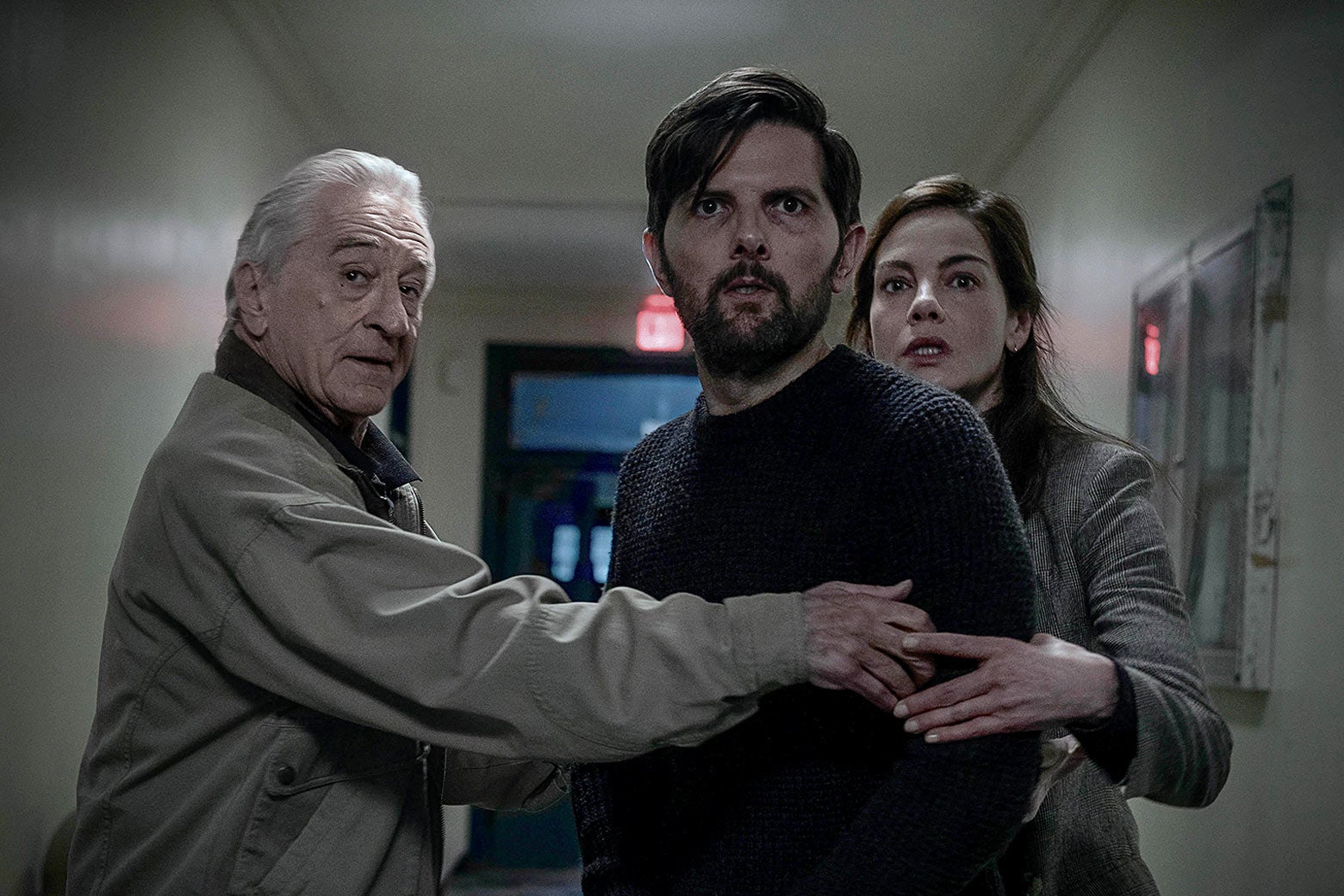
Movies The Real Mystery of The Whisper Man Is How This Movie Ever Got Made Robert De Niro and Michael Keaton star in a thriller that’s so ridiculous it’s almost impressive. By Enter your email to receive alerts for this author. Sign in or create an account to better manage your email preferences. Unsubscribe from email alerts Are you sure you want to unsubscribe from email alerts for Laura Miller? Aug 28, 20265:40 AM David Lee/Netflix Sign up for the Slatest to get the most insightful analysis, criticism, and advice out there, delivered to your inbox daily. This article contains spoilers for The Whisper Man. Just about every worn-out cliché known to the serial-killer thriller genre gets trotted out in the new Netflix movie The Whisper Man, from the first scene of a team of searchers spread out in a line as they make their way through the gray, drizzly woodlands of northern New Jersey to the movie’s grotesque, nonsensical climactic act of violence. The real mystery here is how a relatively inexperienced director (New Zealander James Ashcroft), with only two previous and obscure features to his credits, landed a cast that includes Robert De Niro, Michelle Monaghan, Adam Scott, and Hamish Linklater, as well as a special “surprise” performance by Michael Keaton that the movie’s publicists have directed critics not to reveal in advance of release, even though a mug shot of the actor is flashed on the screen within the first 15 minutes. It can’t have been Ben Jacoby and Chase Palmer’s screenplay that won anyone over. Based on the bestselling novel by crime writer Alex North, The Whisper Man leans heavily on a creepy premise—the killer lures little boys out of their bedrooms by whispering at their windows—and assembles a rickety contraption of coincidence and plastered-over plot holes around it. There are lines of dialogue you can see coming from miles away, as when the main character, a widowed thriller author named Tom (Scott), drives with his young son, Jake (Acston Luca Porto, in the film’s only really affecting performance), to their new home. They wistfully mention Tom’s late wife. The kid is going to say, “I miss her, Dad,” I thought as I watched the scene. “I miss her, Dad,” said Jake. The dad is going to say, “Me too, buddy,” I thought. “Me too, buddy,” says Tom. Of course there is a police detective, Amanda (Monaghan), obsessively pursuing the case of a missing boy in the very town to which Tom has blithely decided to move with his child of the same age. While searching the woods for the abducted kid, the police find the decomposed body of another boy. “That’s not Neil Spencer,” Amanda announces grimly, but who is it? This is never explained, and the victim is never identified or given any further attention. Given how blasé most of the town’s other residents seem to be about a string of crimes that would surely command nonstop national headlines, perhaps child murders are no big deal there? Convenient coincidences pile up like unidentified underage corpses in The Whisper Man. It just so happens that the house Tom rents contains the secret grave of the final victim of the eponymous Whisper Man. That notorious killer is revealed to be none other than—one more spoiler warning here, for prudence’s sake—Keaton’s Frank Carter, who has been locked up for 25 years. Pete (De Niro), the now retired detective who caught Frank back then (how? Good question, but don’t expect an answer), claims to be indifferent to the similarities between the recent copycat killings and Frank’s decades-old modus operandi. He initially shoos Amanda away when she comes to him pleading for help because (of course) Pete is the only person the imprisoned Frank will consent to talk to. Nevertheless, Pete, like all retired detectives in crime fiction, remains haunted by the Whisper Man case and has a stash of files he drags out to muse over after his lonely dinners of homemade gnocchi. He’s also got a map marked with dozens of pushpins, presumably indicating places he has searched for the body of that final Whisper Man victim. Oh, and Tom? Whose new home contains that body Pete is obsessed with finding? He also just happens to be Pete’s estranged son. Then, of course, Tom’s own son, Jake, becomes the next child abducted by the Whisper Man copycat. Does the copycat intentionally target Pete’s grandson? Who knows! Was Tom somehow manipulated into moving into the house containing the concealed corpse for which his own father has been searching for a quarter of a century? Your guess is as good as mine. The police, despite Amanda’s earnest commitment, miss several significant clues, such as the fact that a violent ex-convict (not Frank, but a minor character of unclear significance) once lived in the house. Even before Jake disappears, Tom disturbs an intruder in the basement, and the patrolman who responds to his report shrugs the incident off as a startled vagrant, even though presumably the entire force has been mobilized to search for a kidnapped child in the area. Surely a similar child living in the home where the break-in has occurred would set off alarms? Perhaps the only truly realistic thing in The Whisper Man is the incompetence of the police, something all too familiar to readers of true crime but seldom represented onscreen. The underlying theme of The Whisper Man has to do with bad fathers. Pete was a poor parent to Tom in some unspecified way that evidently involved a lot of drinking. This lack of paternal care, we’re asked to believe, is how the killer is able to coax children out of their bedrooms and into his clutches by whispering at their windows, although it’s hard to believe that any child, however lonely, would find this approach anything but terrifying. Besides, Tom is clearly a loving, attentive father whose only real transgression is snapping at Jake over the boy’s insistence that his imaginary friend—“the girl in the blue sweater”—is real. The audience can see her too and will also easily guess who she is long before the film’s final reveal, a supernatural twist that’s meant to add eeriness to The Whisper Man but instead just feels pat. Unsurprisingly, given their previous slow-wittedness, it takes the detectives an excruciatingly long time to figure out that the second serial killer is—another spoiler warning here—Frank’s son (Owen Teague), who has been in communication with his dad and is apparently making a (doomed) attempt to impress him. To get there, we have to sit through scenes of Keaton’s Frank “getting into the head” of De Niro’s Pete, implying that the two of them are alike in some sinister way. Such interactions too have become a shopworn trope of serial-killer fiction, but in this case Frank’s manipulation fails to land due to De Niro’s phoned-in performance. His Pete comes across as concerned, perplexed, and regretful, rather than a roiling crucible of secret homicidal urges, a mood perhaps brought on by reflecting on his decision to play a character who makes so little sense. The subtext to Frank’s attempted manipulation seems to be that all fathers long to murder their sons, a reversal of the usual Oedipal formula. I’ll hazard a guess that this is largely untrue, although, to be frank, The Whisper Man is one baby that perhaps ought to have been strangled in its crib. Books Crime Movies Netflix Thrillers
Netflix’s Star-Studded New Thriller Poses One Real Mystery: How on Earth Did This Get Made?
Full Article
Original Source
Read the full article at Slate →KhanList aggregates and links to publicly available news content. We do not host full articles from third-party sources. Always verify important information with original sources.