
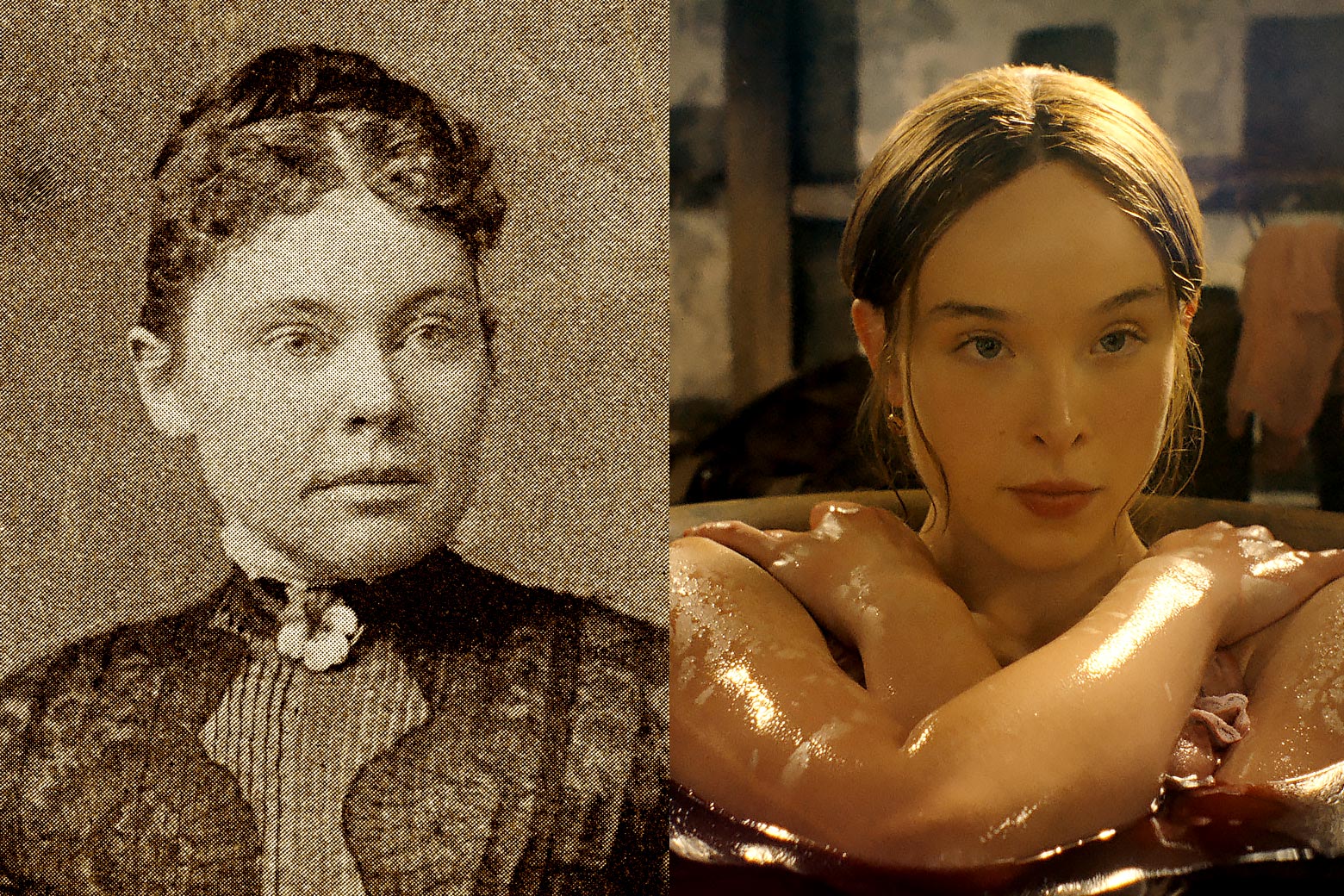
Television Netflix’s Monster: The Lizzie Borden Story Takes On One of History’s Most Infamous Crimes. But Did She Really Do It? I asked the author of two books about the history of ax murder. By Enter your email to receive alerts for this author. Sign in or create an account to better manage your email preferences. Unsubscribe from email alerts Are you sure you want to unsubscribe from email alerts for Rebecca Onion? Sept 24, 20263:47 PM Photo illustration by Slate. Photos via Bettmann and Netflix. Sign up for the Slatest to get the most insightful analysis, criticism, and advice out there, delivered to your inbox daily. In the beginning of the third episode of Netflix’s Monster: The Lizzie Borden Story, a Ryan Murphy–created true-crime miniseries full of puke, blood, and guts that’s been the streamer’s No. 1 show for the past week, Bridget (Vicky Krieps), a maid employed in the Borden household, proposes to Lizzie (Ella Beatty) that they must use an ax to murder her shrew of a stepmom and her uncaring father. “A knife is too sexual. It’s like sliding it into them. It’s almost too kind a way to go,” Bridget says. “And a rifle is what you use for hunting. How you dispatch an animal. … An ax is the most personal way of killing someone. Put all your feelings into the swing.” And oh boy, does Lizzie let them have it. The resulting onscreen murders are extremely wet, producing operatic crunches, squishes, and splatter. Bridget’s little speech, and the huge popularity of this Lizzie Borden show, prompted me to call up Rachel McCarthy James, who wrote the book Whack Job: A History of Axe Murder. (The name of the Lizzie Borden show’s third episode is also “Whack Job!” It’s catchy. ) “I think if there’s an ax murder you want to get really silly about, it’s Lizzie Borden,” James, who watched the miniseries at my request, said. She observed that the show, while shocking to my eye, doesn’t exactly break new ground; like every Borden adaptation, it presumes Lizzie, who was acquitted of this crime, actually did the deed. It’s not even the only recent Lizzie Borden adaptation to propose that Bridget and Lizzie may have been in love and committed the crime together. The only truly groundbreaking Lizzie Borden adaptation, James said, would be one that presumed what James herself believes: Lizzie Borden was innocent. Over the course of our phone call, I became convinced of a few things: There are more kinds of axes than I ever knew, ax murder is the unfunniest funny crime out there, and Monster: The Lizzie Borden Story isn’t as bad of a show as I had thought. Our conversation has been condensed and edited for clarity. Slate: Would you say Lizzie Borden is the most famous ax murderer in American culture? Rachel McCarthy James: Yeah, absolutely I would say so. The only other one that would even come close would be fictional, The Shining’s Jack Torrance. I mean, throughout history and around the world you could maybe argue for King Henry VIII, as I did in my book—he could be maybe a little bit more famous, but that’s basically the only one that really rivals it. Oh yeah, but people don’t necessarily think of him as an ax murderer, although maybe he was! Definitely a crazed ax murderer in a way, but of course he wasn’t so specific to the ax.He used a lot of different stuff. Lizzie, it was just the ax. Why do you think people find her and her crime so fascinating? I actually feel like the show kind of missed out on what makes this crime so interesting, because it’s not really the ax, and it’s not really all the Victoriana. There are a lot of other murders that are done with axes, a lot of other murders where a young woman is accused, a lot of other murders where Victorian social mores play heavily into how it was covered at the time, and all of that. What’s interesting is the ticking clock. Andrew Borden [Lizzie’s father, played on the show by Charlie Hunnam] walked into the house as late as 10:40 that morning. A half-hour later, his very fresh corpse was seen by dozens of people. Abby [Lizzie’s stepmother, played by Rebecca Hall] was killed earlier. She was seen by John [Morse, Lizzie’s uncle], whose story I don’t think there’s a lot of reason to question, at 9 a.m. or thereabouts, so she couldn’t have been killed any earlier than that. There’s not a lot of time between 9 a.m. and 11 a.m. to do what Lizzie and Bridget did in the show—to go and dig a hole and bury all the evidence, and then take a nice milk bath afterward. And what about Lizzie’s dress? They showed her burning it, but they didn’t show her quick-change and how she got clean. That’s right. On the show there’s a moment after both parents are dead where the doorbell rings, the show skips into its second timeline (featuring Sarah Paulson as early-1990s serial killer Aileen Wuornos), then it cuts back and Lizzie has magically changed into a deep-blue dress and is completely clean. That’s right. I kind of have to admire how the show just discards any element of the actual crime that was irritating to them, but it doesn’t make sense to do that because the whole event is irritating little snaggles. There’s so much they left out. The handle, for one thing! What was up with the handle? The ax that Lizzie was accused of using at her trial almost certainly was not the ax that was used in the crime. The investigators went down to the basement, and there certainly was not, like there is on the show, an ax cabinet with nicely arranged, labeled, and named axes down there. There were just several axes scattered around the cellar. They found several hatchets in one box, and they got fixated on this one hatchet. They actually did use the right hatchet for Lizzie in the show; it’s very close. I do have to compliment them on that. But in real life, the investigators came up with this story where they found this hatchet head that didn’t have a handle. They thought, Oh, that looks suspicious. Maybe she got blood on the handle and couldn’t clean it off and went and pried off the handle and then stuck it in the furnace to hide the evidence—which is kind of a crazy enough story, given, again, the ticking clock and the fact that, if she did murder them, she’s got to change her clothes completely and do all this other stuff. But also, once they got to the trial and they were asking a police officer about this hatchet on the stand, the prosecution was like, And there’s no handle, correct? Where could that handle have been? And he was like, Oh, there’s a handle. It’s in the box still. We just didn’t bring this up. So this completely tanked their own case. And by the end of the trial, the defense was referring to this hatchet more than the prosecution was. In the papers of the day, they called it the “hoodoo hatchet” because it was playing tricks on the prosecution. I love that. They tore that house apart. Wherever they would have hidden axes, they would have found the murder weapon, and they never really found it. So if she did it, I don’t think she used that ax. Maybe another ax, maybe a cleaver or something like that. Oh, interesting. So even if she did it, Lizzie might not even have been an “ax murderer”? Yes! None of the axes were right. I think if she did it, a cleaver would have been easier to overlook or explain away. I noticed the show includes the murder of Bertha Manchester, another ax murder in the same town of Fall River, Massachusetts, that in real life happened after the deaths of the Bordens, while Lizzie was in jail. In the show, Lizzie and Bridget commit that murder as well, before killing her parents, as kind of a warm-up. Was it a common thing in the 1890s for people in one smallish city to experience this many ax murders? Actually, ax murders were on the decline by this point. Just as now, a gun, which was becoming more available, was more convenient, a much more surefire way to kill someone. But there were also a lot more axes floating around at that point in American history than there had ever been before. The Bessemer process made it much easier to make steel, so there was an explosion of steel tools in the second half of the 19th century. It was pretty common for them, just like you might today, to just pick up an ax for one job and then kind of forget about it and then buy a new one when the handle’s rotted so you can’t use the first safely anymore, or whatever. They were affordable-ish, and they were pretty common, and there were a lot of different kinds of axes. There was a lot more specialization for different tasks in labor and carpentry. The ax was definitely still a somewhat common weapon. Crime and Punishment was published only a few decades before Lizzie Borden’s story, and in that story, the ax used in the murder is a kitchen tool. Regardless, ax murderer definitely wasn’t a term people used at that time. I actually appreciated how nobody in the 1893 storyline calls Lizzie an “ax murderer,” but they do in the Aileen Wuornos storyline, which takes place around 1990, so that’s accurate. Yes, and in the show, Mr. Borden is depicted as a little bit eccentric because he likes his axes so much. Oh yes. I should say, in real life Andrew wasn’t obsessed with axes, and certainly wouldn’t have kept a poleax around, like the one he uses on the show to drunkenly chop a corpse in half—though the rumor that he chopped off corpses’ legs to fit them in coffins did circulate at the time. The show also made him 40 years younger, and Lizzie 10 years younger. In real life, she was already settled into her life as an unmarried woman. I laughed as soon as I saw Andrew, because Andrew Borden was a 70-year-old man, and he looked it. He did not look like Charlie Hunnam. And the hair was silly; that’s not how hair looked back then. But I get it, it’s a winking tone. I liked the parts of the show when Bridget told Lizzie about Countess Elizabeth Báthory, and Lizzie goes, Is this real? And Bridget goes, It’s real as you and me in this room. I liked that. I thought that was a good way to be like, Yeah, this is not what happened at all. I felt like they knew the details of the case, from things like they got Andrew’s death position right. Rebecca Hall in that opening scene looks a lot like the real photo of Abby’s body. So let me ask. People debate whether Ryan Murphy is “camp.” (Murphy himself rejects the label.) Is ax murdering also camp? Oh, absolutely. While I was promoting my first book, The Man From the Train [also about an ax murderer], people kept using the phrase ax murderer as a way to kind of make it into a joke. And I was like, How did this happen? How did we go from this being a real tragedy to this being a joke? The story of Lizzie Borden is on a similar journey, where it was a very real tragedy, but it’s become such a myth and a legend that it’s also a way to safely joke about murder. The term ax murderer was first used in the 1910s, 1920s, as a grabby newspaper headline. And then it was being really used as a joke by the 1950s. Shirley Jackson makes a reference to it in her domestic memoir—she says that she’s looking for a distraction in the morning papers and sees an ax murder that she might be interested in. But what really made it something that we still use, and didn’t just disappear from our lexicon like so many little jokes do, was first The Shining, and that “Here’s Johnny” image, and then another movie, So I Married An Axe Murderer. That bombed pretty hard when it came out in 1990, but it’s become a cult classic since. And so you’ll see a lot of people using “ax murderer” basically in the same tone that that title does, just as kind of a punchy but safe way to relieve some tension. OK, before I let you go, I just have to ask you straight out: Do you think Lizzie did it? No, I do not think she did it. I don’t think she did it, but I’m not completely convinced. I’m only like 55 percent convinced. Oh, OK! That’s not a very high percent! No, it’s not! So first I’ll say I understand why people think she’s guilty. No. 1, she was in the house and two people were murdered, brutally. She doesn’t have a good alibi. She was not murdered. She was not harmed at all. And I don’t know if I think that she had a burning motivation to murder, but I do think that she was glad to be out from under their thumb. Her life was better afterwards. But there’s just too many little things that don’t add up. The ax is not right. I’ve got a couple of ideas for what else she could have used, but nobody has really made a good argument for any one of those weapons. And that’s what Lizzie’s sister Emma said. It’s not depicted this way in the show, but they did fall out well after the trial, and late in her life, Emma still said: I don’t think she did it. And the main reason was the ax they never found. They tore that house apart. They looked in the cistern. They looked in the walls. What else could it have been? Her inquest was obviously weird, but it also sounds to me like someone who’s been through a huge shock, a huge trauma, and is getting a lot of pressure from people and is just collapsing under that pressure. That doesn’t say “cool, calculated murderer” to me. And she always maintained that she didn’t do it. One thing that surprised me, looking at a lot of murders in my career, is how many people who kill someone ultimately have a lot of trouble keeping that inside. A lot of people who commit murders eventually find some way to admit it because the psychological weight is enormous. Obviously people do lie about it, but when someone maintains their whole life that they didn’t do it, that’s a meaningful data point to me. And the rest of her life, she didn’t kill anybody else. She wasn’t a violent person, it doesn’t seem like. People can, and do, do one terrible thing and then cover it up and live with it for the rest of their lives. Again, I am not wholly convinced that she didn’t do it. But just on the balance and just on instinct, I think she didn’t. OK, but who did? I was on Threads talking about this and someone said, “I don’t think she did it, and I don’t think anybody else did it.” There’s really not a satisfying answer, which is why the crime is so interesting. It’s like someone stepped in from an alternate universe. Sometimes that happens. Sometimes there is a serial killer who comes in, kills someone, leaves, is never caught. I also think, and I don’t have a lot of evidence for this, but something was hinky with Andrew Borden’s finances. I mean, obviously there was money, but he was very close with the dollar, extremely cheap. You’ve got to wonder, could he have had trouble with organized crime? Could it have been a hit man, something like that? That’s kind of preposterous, but the whole case is preposterous. Now that would be a cool alternate history. I’ve looked through all the Lizzie Borden adaptations on Wikipedia. None of them have her as innocent. Every one is: Here’s how I think she did it. Slate receives a commission when you purchase items using the links on this page. Thank you for your support. “Here’s how she didn’t do it” is a great idea for your next book. Yes! It can be my ax murder trilogy. Why stop now? Books Crime History How Accurate Is TV
Netflix’s New No. 1 Show Takes On One of History’s Most Infamous Crimes. But Did She Really Do It?
Full Article
Original Source
Read the full article at Slate →KhanList aggregates and links to publicly available news content. We do not host full articles from third-party sources. Always verify important information with original sources.