
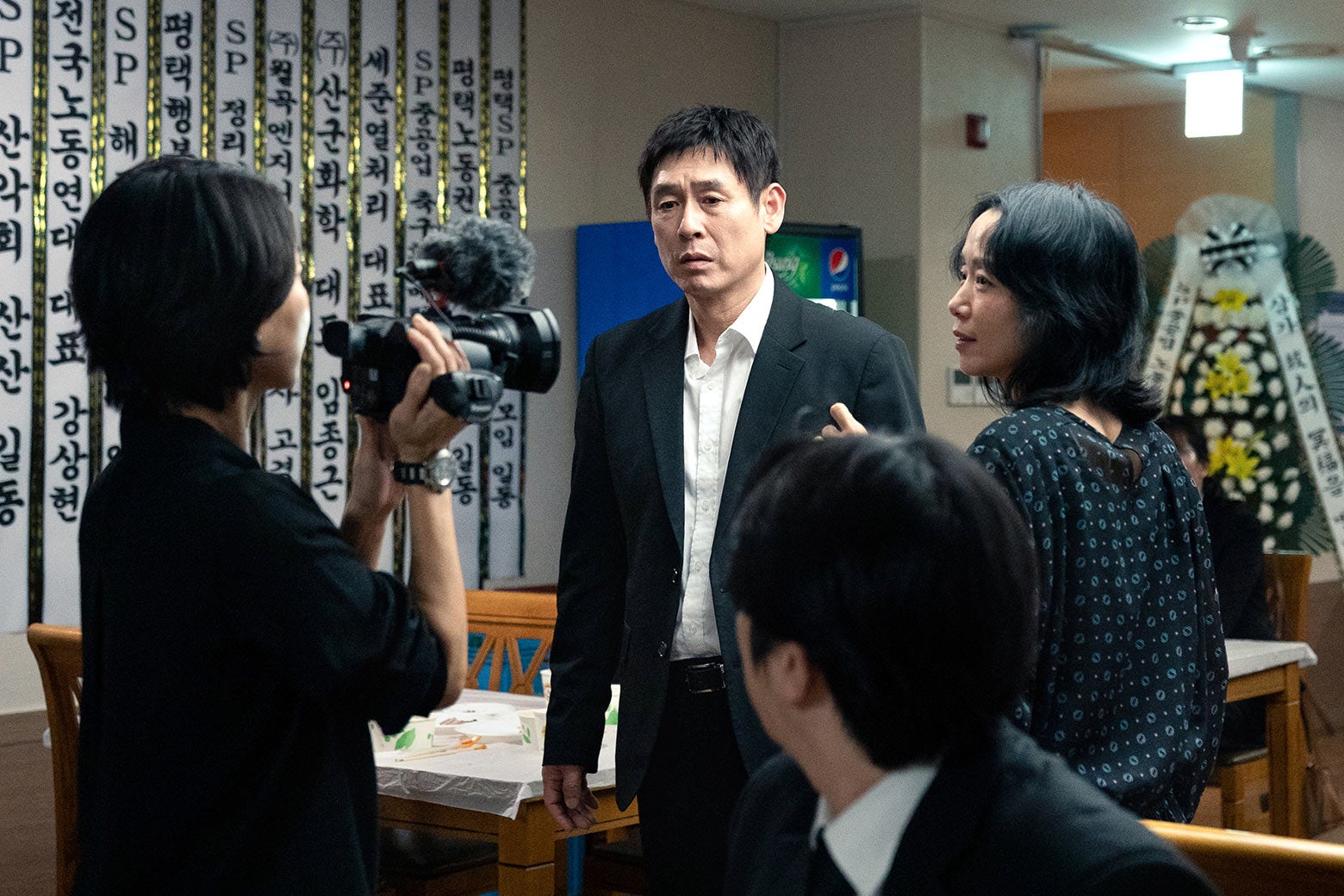
Movies Possible Love Is Earning Comparisons to Parasite, but There Are Other Masterpieces It Resembles Even More Burning director Lee Chang-dong is back with another evocative study of haves and have-nots. By Enter your email to receive alerts for this author. Sign in or create an account to better manage your email preferences. Unsubscribe from email alerts Are you sure you want to unsubscribe from email alerts for Sam Adams? Nov 06, 20261:23 PM Joo Jae-bum/Netflix Sign up for the Slatest to get the most insightful analysis, criticism, and advice out there, delivered to your inbox daily. As if the tale of Nathan Fielder and Elizabeth Holmes weren’t warning enough about the dangers of letting a documentary filmmaker into your life, Netflix’s Possible Love, the new movie from Burning director Lee Chang-dong, charts the increasingly tangled relationship between a well-meaning documentarian and the working-class couple she’s chosen to put in her viewfinder. Ho-seok (Sul Kyung-gu) is a welder whose company was bought and stripped for parts by a private equity firm, still reeling two years later from his union’s brutal confrontation with the police. Ye-ji (Cho Yeo-jeong) is a novice filmmaker intent on capturing the state of South Korea’s factory workers. It’s not, perhaps, the most groundbreaking topic—early on, she applies for a grant to finance the project, and one of the people on the funding panel asks if she shouldn’t be focusing on something more current, like A.I. But she argues, and Lee and co-screenwriter Oh Jung-mi would seem to agree, that the fallout of corporate restructuring is no less devastating because it’s less novel. Ye-ji meets Ho-seok at a funeral for one of his former colleagues who has died by suicide—or rather she meets his wife, Mi-ok (Jeon Do-yeon), because Ho-seok, a muscled knot of a man, is still so shaken up by the strike and its aftermath that he can’t bear to go inside. He’s unable, in fact, to talk about much of anything at all. Even in the group therapy sessions for laid-off workers, many of whom have still not found new jobs, he maintains a stony silence and the posture of someone who might sprint for the door at any second. Given that his mouth might as well be wired shut, he’s hardly an ideal subject for a documentary, but Ye-ji fixates on him, perhaps because she sees his deep pain and wants to help him confront it, or perhaps because she’s got a strong instinct it will play well on camera. While she’s waiting for him to crack, she grows close to Mi-ok, who seems as quiet and inward-looking as Ye-ji is upbeat and outgoing. The two develop a real friendship, and Lee and Jung-mi don’t flatten the two women’s dynamic into a simple matter of a predatory filmmaker and her unsuspecting subject. (The movie’s nearly three-hour length gives it room to follow its developments without pushing us to draw easy conclusions.) But Ye-ji’s camera both figuratively and literally comes between them. Once, while sitting outside one of Ho-seok’s therapy sessions, they’re chatting, and Mi-ok relates a story from her childhood about how her mother, who worked in a car wash, grew upset when she saw her playing with a hose, because she didn’t want her daughter to live the same difficult life she had. Ye-ji listens to her, but we can feel a growing anxiety as Mi-ok keeps talking, and finally she breaks: That’s a great story, she tells Mi-ok. Can you just wait for me to get my camera, so you can tell it again? While Ye-ji is sprinting back to her car, Mi-ok furtively snaps a picture of her fancy leather backpack and searches the image to find out how much it costs—a reminder of the gulf that exists between them. (Later, Mi-ok discreetly advises Ye-ji that it might not be such a good idea to be interviewing laid-off factory workers in her expensive clothes, and Ye-ji abruptly starts showing up to work in worn t-shirts.) As Mi-ok re-tells her story, Possible Love jumps back in time to show us the moment she’s thinking about, although it’s not clear if we’re meant to be in her memory or the images that her words are creating in Ye-ji’s mind. (She’s already revealed that, while she’s making documentaries “for the moment,” she expects to eventually move into fictional narrative.) In fact, for a movie that explicitly deals with the way the presence of a camera affects how we see our own lives, the passage from present to past happens with a surprising absence of fanfare, so seamlessly it may take you a moment to notice it’s even happened. Lee does it a few more times over the course of the movie—to show us, for example, an episode from early in Mi-ok and Ho-seok’s relationship, when she was working in a factory and he was finishing his military service. But they don’t seem to be evolving toward any particular end, so much as reminding us that there are pieces of these characters’ lives that we will never see or entirely understand. Where Mi-ok and Ho-seok live, those who still work at Ho-seok’s company are called “the living,” and former workers are called “the dead.” Ho-seok’s co-workers still describe the sense of solidarity they felt banding together against the company’s restructuring, and Mi-ok refers to it as an “okswae” strike, roughly equivalent to “all or nothing.” But nothing is what Ho-seok feels like he’s been left with. Sul played the man whose mysterious suicide sent Lee’s 1999 movie Peppermint Candy spiraling backward in time in an attempt to explain it, and he carries a similar sense of grief with him here, but it’s mixed with rage and a profound sense of betrayal—not to mention a fear, as much on the audience’s part as his, of what might emerge if the walls protecting him from his own emotions were ever to crack. As their wives grow closer, he and Ye-ji’s husband, Sang-woo (Zo In-sung), end up spending more time together, but Sang-woo is tall and handsome and comes from money that he’s made into even more money, and he moves through a world that seems impossible for Ho-seok to imagine. Possible Love isn’t interested in condemning Ye-ji and Sang-woo, or holding up Ho-seok and Mi-ok as exemplars of blue-collar stoicism. And though the movie’s nationality and the common presence of Cho Yeo-jeong has drawn some comparisons to Parasite, I’m put more in mind of the movies of Ryusuke Hamaguchi, which often trace how economic disruptions ripple through the fabric of a community, or even Krzysztof Kieslowski’s The Decalogue, which it’s semi-officially adjacent to. (Kieslowski’s frequent collaborator Krzysztof Piesiewicz is an executive producer, and the movie opens with the text of the Tenth Commandment: Thou shalt not covet.) Lee isn’t going for razor-wire satire; when we find out Sang-woo makes his money in private equity, the same field that led to the destruction of Ho-seok’s job, it’s not so we can quickly judge him—he still seems like a nice enough guy. But it wants to insert the idea that when there are larger forces at play, individual characteristics get swept away. Toward the end of the movie, Sang-woo triumphantly closes a deal he’s been working on for a long time, but we’re so distant, physically and otherwise, from wherever it’s taking place that we have no way of understanding its consequences, and neither does he. There are no easy outs in the movie’s performances, either. Lee’s stellar quartet of leads give us complicated humans rather than representative figures, people who may do things for good reasons or bad but rarely for only one, whose best intentions are tempered by failure and self-interest, whose feelings come nearer to the surface but rarely break all the way through. Ye-ji’s filmmaking brings them closer together, at least for a time, but as with the solidarity between Ho-seok and his former comrades, that closeness is born of circumstances that are intense because they’re temporary. Larger, more lasting change stays just out of reach: possible, but never quite real. Labor Movies Netflix The Oscars Documentaries Income Inequality South Korea
Netflix’s New Movie Is Being Compared to Parasite, but It Resembles Other Masterpieces Even More
Full Article
Original Source
Read the full article at Slate →KhanList aggregates and links to publicly available news content. We do not host full articles from third-party sources. Always verify important information with original sources.