
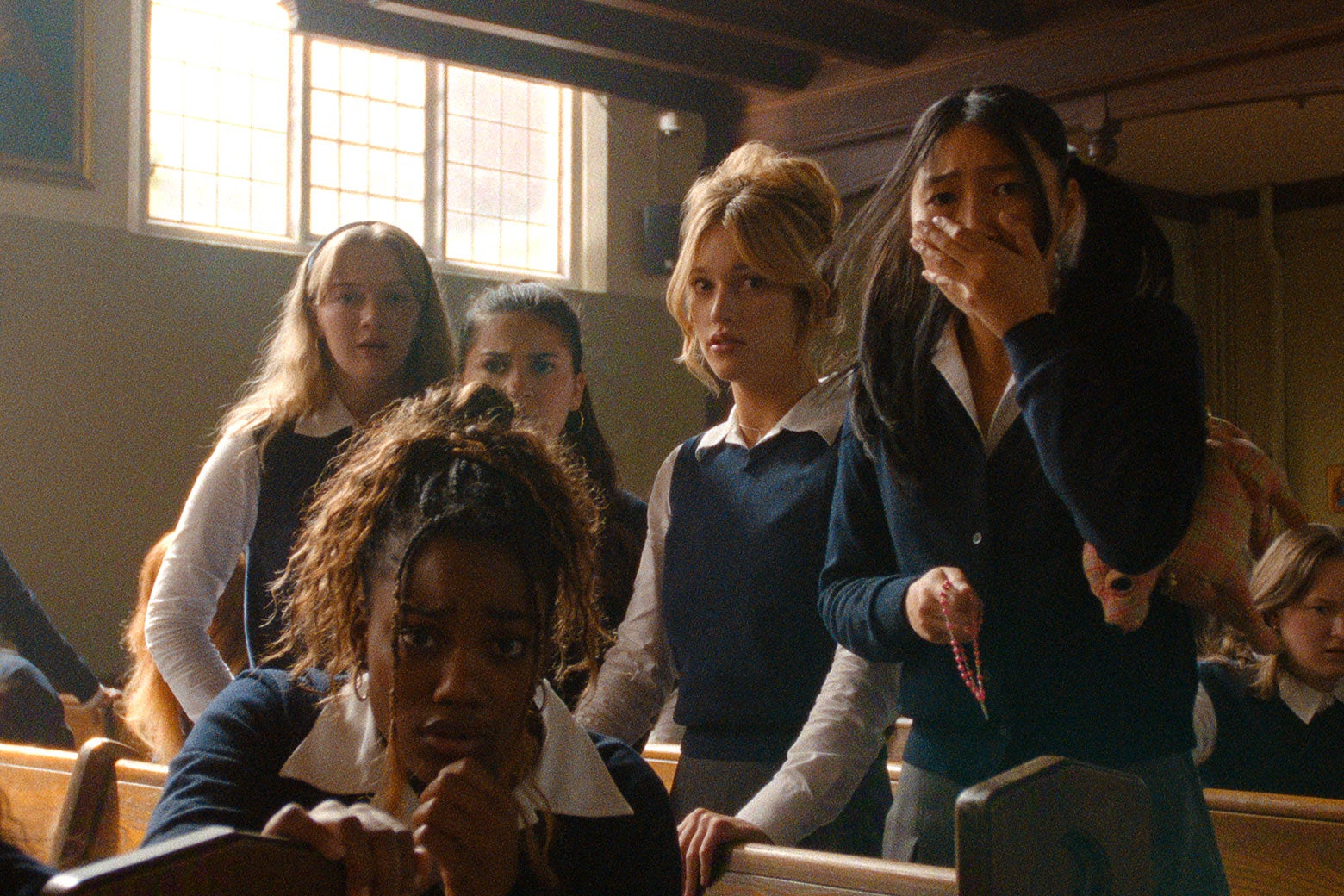
Television The Body Is Worth Obsessing Over By Enter your email to receive alerts for this author. Sign in or create an account to better manage your email preferences. Unsubscribe from email alerts Are you sure you want to unsubscribe from email alerts for Nadira Goffe? Nov 20, 202612:58 PM Netflix Sign up for the Slatest to get the most insightful analysis, criticism, and advice out there, delivered to your inbox daily. There is no better narrative setting for exploring the cross section of guilt and desire than a Catholic school full of repressed teenage girls at the dawn of the digital age. Judging by the cheeky tagline—“They pray hard and sin harder”—of Netflix’s latest hit series, this is something The Body understands. The eight-episode drama, which follows a group of schoolgirls after they jokingly perform a satanic ritual that results in a mass hysteria event, has turned into something of a mass hysteria event itself. The Body swiftly became a Netflix No. 1 show, achieved internet virality, and, judging by how hard the streamer is promoting the series and its relatively unknown stars, has become a Netflix darling approaching the breakout success of last year’s Heated Rivalry. At the same time, a reported 100,000 people of Christian faith have signed a petition demanding that Netflix ban the show for spreading “blasphemous” ideas about their faith and encouraging shameful behaviors. (A counterpetition in support of the series has already garnered over 20,000 signatures.) With its core of psychological horror, sapphic longing, and tonal and aesthetic throwbacks to Y2K-era girlhood classics—think Mean Girls, Carrie, and Jennifer’s Body meet Jawbreaker, Gossip Girl, and even a dash of the 1998 horror film Ring—it’s no wonder The Body has blown up in every way imaginable. And after watching it myself, I can safely say that I get it: The Body is one of the best shows of the year. The series drops us off in 2004, on Halloween, at St. Mark’s, a Catholic high school nestled in a small religious town where the school’s all-girl dance team, the Lions, is holding auditions to find a replacement for an injured classmate. The head captain and quintessential popular girl, Anya (Kristina Bogic), oversees the auditions, which have a clear front-runner: Grace (Sofia Wylie), the niece of the St. Mark’s headmaster. Following tradition, the Lions have to haze a new member, which is how, at a Halloween party that evening, the girls end up jokingly performing a satanic ritual offering up Grace, whom they’ve pressured to take ecstasy, as a virgin sacrifice. But after Grace falls into a coma later that night, the girls’ paranoia about their complicity in her ailment—was it the drugs, or was she actually possessed by Satan?—puts them on edge. When one teammate falsely claims to have seen a vision of Grace, it sparks a chain of other students experiencing sightings of Grace; soon, rumors about the comatose girl’s so-called spiritual powers begin to take hold over the entire town. In reality, much of the hysteria is orchestrated by Lisbeth (Geena Meszaros), a loner who covets both Grace’s spot on the team and a closer relationship with Anya, who is busy struggling to accept her mutual attraction to her best friend, Elise (Sara Boustany). Here, the phrase the body serves as a reference to the body of Christ—which already has multiple meanings: the church, Communion, and a reminder of the violation of Jesus’ body—as well as to the body of a teenage girl and all it suffers, from eating disorders to drug use to frustrating sexual experiences. Though heavy-handed, the metaphor doesn’t feel rudimentary. While the Lions, in their guilt, believe that their visions of Grace are some sort of godsent comeuppance, reading between the lines suggests that these anomalies are more easily chalked up to a psychosomatic response to copious drug use and teenage paranoia. The few coping mechanisms—drugs, sex, religious absolution—these girls have only cause them to wig out further. The themes that creator Quinn Shephard tackles—the tensions of growing up as a girl, of having a queer sexual awakening, and of Catholicism’s weaponizing of guilt to hold power over its disciples—are familiar but irresistible in this complex portrait of girlhood. Guilt already plagues the teenage girl experience even without the weight of religion or sin. It’s a time in girls’ lives when everything is changing, from bodies to identities to relationships with parents and faith. The Body is a poignant story about the unlikely places where the teenage mind will run in order to explain truths it doesn’t want to confront. What makes The Body so good, though, is that it explores all of this without sacrificing its biting humor or sense of fun. My favorite media about the trials and tribulations of being a teenage girl shoulder those burdens with style and whimsy, both of which The Body has in abundance. There are the charming, era-appropriate references: flip phones, the AOL Instant Messenger notification sounds, Jeff Buckley needle drops and a refrain of Grace’s Kelly Clarkson “Breakaway” ringtone, and even the show’s bejeweled title card, which looks like something you’d see on the backside of an early-aughts Juicy Couture sweatsuit. Lisbeth’s fearsome conniving is undercut by the hilarity of her having no eyebrows. The dance scenes are rare but fun and frenetic, and the personalities of even the show’s background players (like The Traitors’ Gabby Windey, who plays the Lions’ pregnant coach) carry the humor. If there are any glaring anachronisms, they lie with the boys, like Anya’s boyfriend, Steven (Orlando Norman), who is much more up to 2026’s social standards of a significant other than one would expect of a 2004 Catholic schoolboy jock. It’s fine, though—the boys aren’t the stars here, thank God. It’s been a minute since we’ve had a hit high school drama, and even longer since we’ve been treated to a good follow-up to the likes of Jennifer’s Body, a cult-favorite film that is as smart and funny as it is unapologetically brutal about the devastation and rage that occurs when predatory men meet young girls. In this moment, when the present-day culture wars—tradwives! incels! rollbacks on reproductive rights!—have wreaked havoc on young women’s (and men’s) bodies and minds, The Body couldn’t have come at a better time. Netflix Religion TV Catholic Church Teens LGBTQ+
Netflix’s Controversial New Hit Is One of the Best Shows of the Year
Full Article
Original Source
Read the full article at Slate →KhanList aggregates and links to publicly available news content. We do not host full articles from third-party sources. Always verify important information with original sources.