
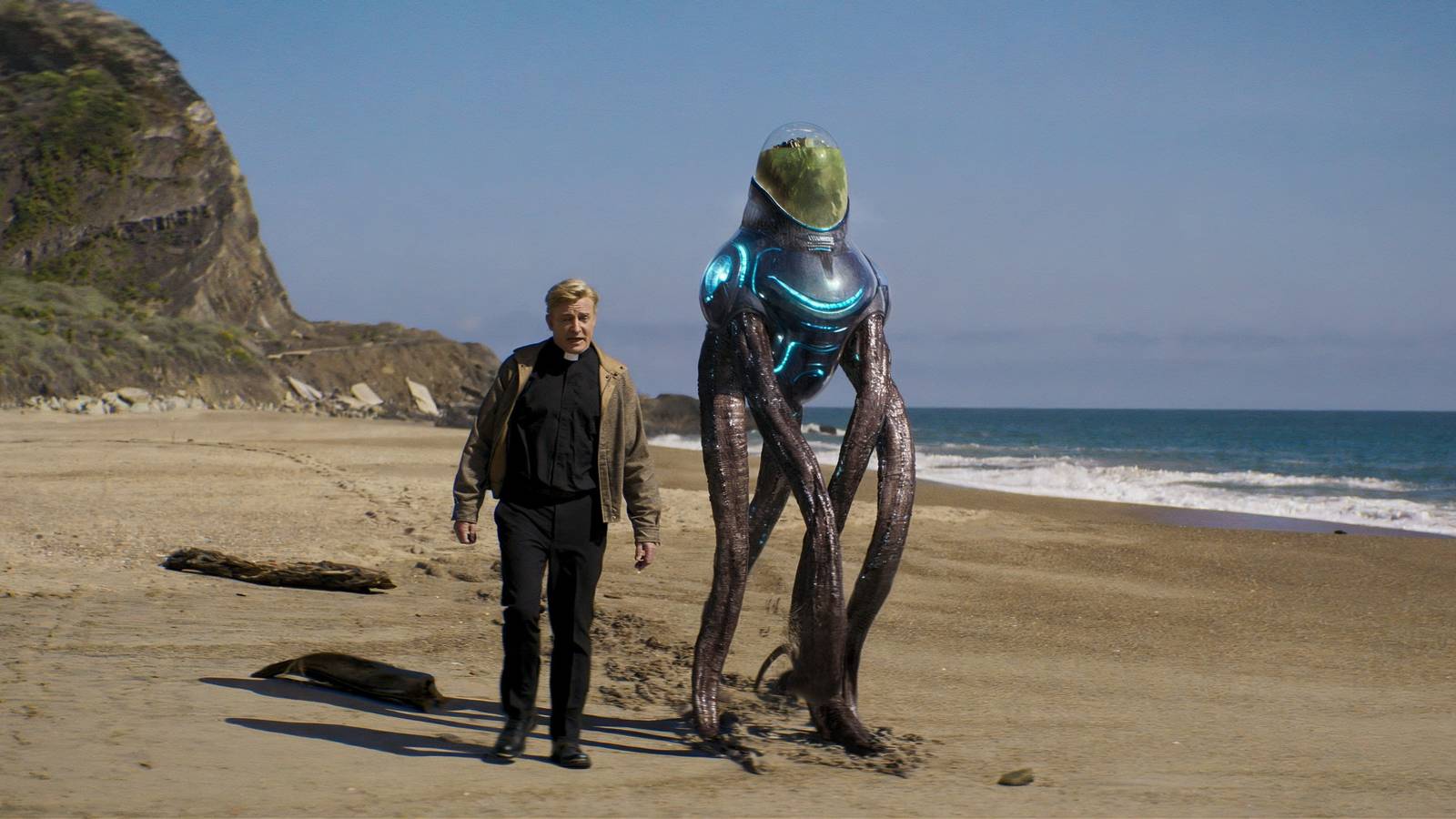
Published Aug 28, 2026, 11:00 PM EDT Dhruv is a Lead Writer in Screen Rant's New TV division. He has been consistently contributing to the website for over two years and has written thousands of articles covering streaming trends, movie/TV analysis, and pop culture breakdowns. Before Screen Rant, he was a Senior Writer for The Cinemaholic, covering everything from anime to television, from reality TV to movies. After high school, he was on his way to become a Civil Engineer. However, he soon realized that writing was his true calling. As a result, he took a leap and never looked back. Sign in to your ScreenRant account Getting Lovecraftian horror right on the big and small screens is not an easy feat. In the past, many cosmic horror shows and movies have struggled to do justice to the horror subgenre because it dabbles with many abstract ideas and ambiguous story elements. However, one Netflix show stands as an exception because of how brilliantly it executes its Lovecraftian elements. The show in question, Love, Death & Robots, unfolds as an anthology. Each new episode in the series not only follows a standalone narrative but also features a unique animation style. Instead of sticking to one theme or storytelling device throughout its runtime, the Netflix sci-fi show also remains experimental from the beginning to the end. Owing to this, it comes off more as a mishmash of subgenres, where each episode enjoys the creative freedom to either riff on familiar sci-fi tropes or expand the boundaries of the genre's storytelling. Quite a few episodes in Love, Death & Robots feel conventional and predictable. However, a handful of others do not shy away from embracing Lovecraftian elements while giving them a thrilling sci-fi spin. A Handful Of Love, Death & Robots’ Episodes Are Incredibly Lovecraftian One can endlessly argue whether something is truly Lovecraftian or not. However, Love, Death & Robot volume 3's episode 8, "In Vaulted Halls Entombed," is perhaps one of the clearest examples of the show's ability to capture cosmic horror. The episode wears its Lovecraftian references on its sleeves. Even its central monster is a tentacled, multi-eyed behemoth of incomprehensible power who reminds one of Cthulhu or the Eldger Gods from Lovecraftian lore. From a thematic standpoint as well, the episode perfectly captures Lovecraftian dread. Like most H.P. Lovecraft stories, it ends on a bleak note and shows how its characters must completely lose their minds and destroy their senses to survive against something far beyond human comprehension. Volume 1's episode 7, "Beyond the Aquila Rift," also touches upon Lovecraftian and cosmic elements with its portrayal of the vastness of the uncaring universe. "The Secret War," which is volume 1's episode 18, also combines cosmicism with occult horror with its portrayal of forbidden rituals and monstrous creatures from another dimension. The abstract and horrifying nature of the storytelling in some episodes, like "The Swarm," "Bad Travelling," and "Fish Night," will also remind viewers of the ancient cosmic mysteries and dream-logic presented in Lovecraft's brand of horror. Love, Death & Robots Proves We Need More Animated Lovecraftian Horror Time and again, many Lovecraftian movies and shows have proven that the live-action medium has too many visual limitations to be able to perfectly capture the essence of cosmic horror. Movies and shows like Archive 81, Annihilation, The Endless, and The Thing are rare exceptions. However, most Lovecraftian movies or shows either go overboard with exposition or seem a little too abstract and experimental. As many episodes from Netflix's Love, Death & Robots establish, animation enjoys way more freedom as a visual language. With animation, filmmakers and showrunners do not have to pull back on the bizarre and incomprehensible elements of cosmic horror. Without fighting against the limitations of physical sets and practical/CGI constraints, they can easily capture the "indescribable," non-Euclidean, and mind-breaking entities from the author's stories on the screen. While it is unknown whether Love, Death & Robots will return to Netflix for another season, future Lovecraftian shows and movies can learn from it and consider using animation to bring cosmic horror to the screen. Love, Death & Robots Release Date March 15, 2019 Love, Death & Robots is an anthology series released in 2019, presenting a collection of animated stories curated by Tim Miller and David Fincher. Each episode explores diverse genres, featuring terrifying creatures, unexpected twists, and elements of dark comedy. Network Netflix Cast Bruce Thomas, Jane Leeves, John Oliver, Nika Futterman, Rhys Darby, Scott Whyte, Sumalee Montano, Feodor Chin, Rahul Kohli, Ronny Chieng, Josh Brener, Mary Elizabeth Winstead, Topher Grace, Helen Sadler, Hayley McLaughlin, Omid Abtahi, Christine Adams, Hakeem Kae-Kazim, Anastasia Foster, Neil Kaplan, G.K. Bowes, Courtenay Taylor, Tudi Roche, Michael Benyaer, Matthew Yang King Directors Víctor Maldonado, Patrick Osborne, Robert Valley, Alfredo Torres Martínez, Jerome Chen, Emily Dean, Rémi Kozyra, Léon Bérelle, Dominique Boidin, Alberto Mielgo, Maxime Luère, Andy Lyon, Robert Bisi, Dave Wilson, David Nicolas, Simon Otto, Damian Nenow, Laurent Nicolas, Kevin Van Der Meiren, Vitaliy Shushko, Owen Sullivan, István Zorkóczy, Javier Recio Gracia, Oliver Thomas Writers Tim Miller, Philip Gelatt Main Genre Animation Creator(s) Tim Miller Executive Producer(s) Aaron Sims, Al Shier, Andy Williams, Antonio Canobbio, Ben Kalina, Caleb Bouchard, Chris Prynoski, David Fincher, Jack Liang, Jason Taylor, Jake Aust, Jennifer Miller, Joshua Donen, Lauren Siller, Luisa Murray, Nathalie Bergeron, Shannon Prynoski, Shuzo John Shiota, Tim Miller Producers Elena Volk, Jessica Ambrose, Alex Dos Santos, Andrew Chan Gladstone, Artur Zicz, Bill E. Miller, David Guti Rosado, Dennis Beier, Ellen Collins, Jialiang Pan, Jordan Harkins, Meg Darcy Seasons 4 Where To Watch Netflix
Netflix’s 4-Part Sci-Fi Masterpiece Quietly Delivers The Best Lovecraftian Horror
Full Article
Original Source
Read the full article at Screenrant →KhanList aggregates and links to publicly available news content. We do not host full articles from third-party sources. Always verify important information with original sources.