
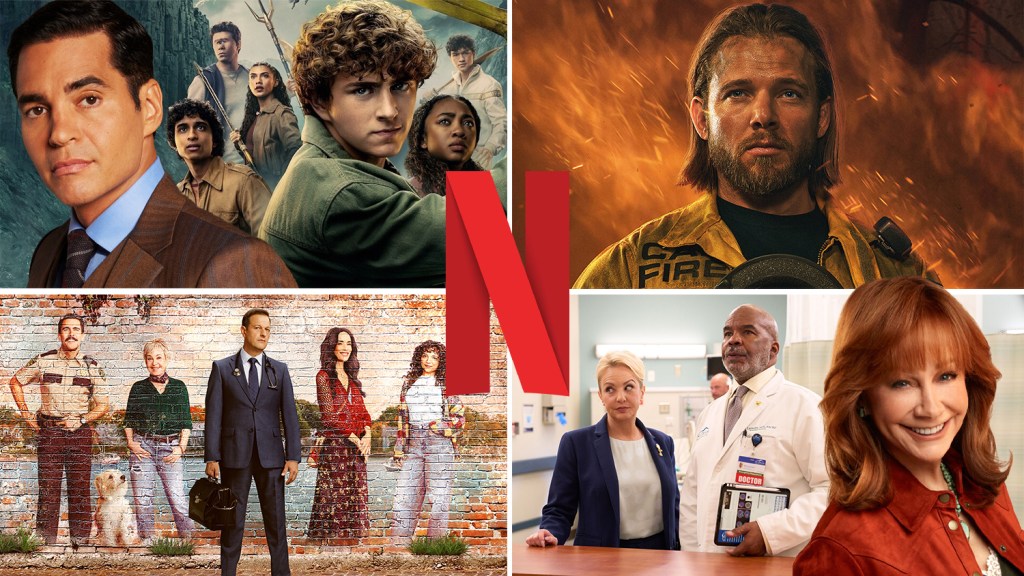
Initially welcomed by legacy media companies as an additional revenue stream for library content to offset the declines in DVD sales, third-party streamers, particularly Netflix, have evolved into a replacement for the depressed off-network syndication business and a viable promotional platform to drum up interest for new season launches on broadcast — and beyond. The latest example is the major film and TV licensing deal Netflix recently made with Disney. It includes multi-year agreements for drama Will Trent and comedy Shifting Gears, whose existing seasons are launching on the streamer weeks ahead of their upcoming season premieres on ABC. The latter debuted on Netflix earlier this month and is projected to crack the Nielsen Top 10 when the next ranking is released. Disney has first-hand experience how a streaming window on Netflix can help a broadcast series via its pioneering at the time pact for ABC drama Grey’s Anatomy, which made its debut on the platform in 2015. Making previous seasons available on the streamer has recruited a new generation of fans for the medical drama, extending the series’ life on ABC where it is currently airing its 23rd season. Watch on Deadline The breakthrough came four years prior when the success of AMC’s Breaking Bad on Netflix helped the series avoid cancellation and become an award-winning hit for the cable network, prompting creator Vince Gilligan to give the streamer credit for keeping Breaking Bad on the air following the first of two Outstanding Drama Series Emmy wins in 2013. Soon, there was a name for that — “the Riverdale phenomenon” — after the 2017 CW series which delivered OK, not spectacular ratings during its first season on the network before exploding on Netflix over the summer, leading to a ratings surge for the following season on the CW that fall. “After that, everyone was like, ‘Oh, I want my show on Netflix because then everyone will watch it,'” one industry veteran recalled. Patrick Dempsey, Ellen Pompeo, Sandra Oh, Justin Chambers, T.R. Knight and Katherine Heigl in ‘Grey’s Anatomy’ Frank Ockenfels/Disney General Entertainment Content via Getty Images Broadcast on Streaming Still, Netflix’s output with the CW that Riverdale was part of notwithstanding, major library streaming pacts for on-air broadcast/basic cable series made after their first season were not that common, with NBC’s The Blacklist and Blindspot, Fox’s New Girl, Gotham and Lucifer and TNT’s Animal Kingdom as notable examples, all selling in competitive situations. (Of the six, The Blacklist, New Girl and Gotham went to Netflix, Blindspot and Lucifer were acquired by Hulu before Lucifer became a Netflix original, Animal Kingdom by Prime Video.) NBC’s Good Girls was another streaming success story on Netflix. Licensed under an old co-production model Netflix employed in the late 2010s, its first season made its debut on Netflix in the U.S. on Jan. 1, 2019, just two months before the Season 2 launch on NBC. The series’ success on Netflix and the generous fees coming from the streamer helped keep Good Girls on the air for four seasons despite declining linear ratings. While lucrative for the studios, such third-party licensing agreements largely dried up when legacy media companies started launching their own streamers in 2019-20 and initially kept virtually of their series in a walled garden. That has gradually changed, with Netflix carrying more current ABC, NBC, CBS and Fox series than ever. (While Netflix has been dominating the field, there are rare exceptions with other third-party streamers, like CBS’ Ghosts being available on Prime Video.) What has evolved from the early-days exclusive SVOD pacts is that third-party deals now are largely not exclusive: the broadcast series are available on their sibling streamers which have both in-season (next day) and out-of-season (previous seasons) rights, while Netflix and other third-party streamers get the shows out-of-season, launching a season after it has finished its broadcast run. That is in line with how syndication worked, though the streamer is getting new broadcast series much faster than the traditional model where shows had to make it to four seasons and 100 episodes to launch in syndication, first on local broadcast stations and then on cable. “Then cable and local markets collapsed on top of each other, and eventually streaming essentially took the place of this syndication window. But not after four years, after one year,” one industry veteran said. Network series are now commonly sold to third-party platforms after their first season for an SVOD window that has two main entry points: a season dropping on the streamer 30 days after the season finale had been released, which shows such as Grey’s Anatomy and the the CW’s Sullivan’s Crossing adhere to on Netflix, or at the start of the next broadcast season. The latter was the case with New Girl and The Blacklist and is currently in play with NBC comedies Happy’s Place and St. Denis Medical as well as Fox drama Doc, all on Netflix. In many cases, the fall entry point has evolved into a streaming season launch 30 or so days prior to the start of the next season on broadcast, providing an opportunity for people to get back into a show by catching up and reengaging. That makes for strategic deployments like this fall’s Netflix premieres of ABC’s Will Trent and Shifting Gears timed to the next seasons’ debut on broadcast with a strong promotional purpose. (Will Trent dropped on Netflix two months ahead of the series’ return on ABC, for Shifting Gears, the lead-in is about 30 days.) Fox’s Best Medicine and Animal Control — both owned by the network — also launch their previous season on Netflix a month ahead of the new seasons debuting on Fox. Meanwhile, CBS’ Fire Country is adding a wrinkle by going back an extra season. Its first season released on Netflix about two months ahead of its Season 3 premiere on CBS in 2024, and Season 2 made its Netflix debut about two months ahead of Season 4 debut on CBS in 2025. Interestingly, Fire Country‘s presence on Netflix has been limited to these two seasons, with newer seasons only available on CBS sibling Paramount+. ‘Evil’ CBS One of the earliest examples of such use of Netflix after the broadcast networks already had streamers in the corporate family was a one-year non-exclusive licensing deal CBS Studios made in September 2020 to put the first seasons of drama Evil and comedy The Unicorn on Netflix ahead of the premiere of their second seasons on CBS. The stunt didn’t help the Walton Goggins comedy, which was canceled by after two seasons. (The same happened to NBC’s The Hunting Party despite a strong Season 1 launch on Netflix a little over a month into The Hunting Party‘s second season on NBC.) Meanwhile, Evil‘s strong sampling on Netflix helped inform the decision to move the supernatural drama from CBS to Paramount+. The series’ streaming performance also likely factored into the initial one-year non-exclusive licensing deal with Netflix getting extended to five years and the show’s first three seasons. The way streaming launches are plotted by series’ owners is in line with the function basic cable served in its heyday for shows sold in off-network syndication whose latest season would become available on cable in September, just before the next season starts airing on broadcast. To further promote a series’ return on broadcast, shows used to do marathons on cable. What is a TV marathon’s equivalent in the streaming era? Binging — or dropping the entire previous season on a platform like Netflix ahead of the new one’s network premiere. Show Me the Money Exposure is great but it doesn’t pay the bills — at least not directly — so the proliferation of Netflix licensing deals has been fueled by other motives too as networks and studios grapple with declines in linear ratings and the ad revenue attached to them. “There is enhanced promotion, but also economics are driving these things,” one industry insider said. “Studios are carrying deficits on these shows, they need to find revenue, so because because the four-year syndication window really is not there anymore, they have to find revenue.” For studios, the latter sometimes takes precedent. “From our standpoint, we’re going to look at the money first, and then the marketing aspect second,” one studio executive said. The decisions are made with many factors in mind, including profit participants who get a portion of off-network revenue. Talent agents who represent creatives have been lamenting the demise of the off-network syndication model, claiming that the money from streaming deals doesn’t come close to the syndication windfall in covering shows’ deficits and paying profit participants, with proceeds also down from the early days of the streaming wars when Netflix was paying premium for (predominantly exclusive) SVOD rights. Studio executives argue that money is still there for the taking, but instead of one syndication revenue stream, there are multiple steaming ones as the era of large audiences watching network shows in syndication five days a week is gone. Now viewership is fractured, and so are streaming deals, non-exclusive over a myriad of platforms. “Our business is not just streaming to the big ones, Netflix and Amazon; it’s also AVOD, it’s Roku and Tubi. There’s multiple ways you can now make money, which is great,” one TV executive said. “In the aggregate for individual shows probably will rarely get close to what a show could have made in its peak syndication days, so agents probably see that more than we do because they’re focusing on the individual performance of one show in its U.S. life cycle.” Meghan Markle and Patrick J. Adams in ‘Suits’ Christos Kalohoridis/USA Network/Courtesy Everett Collection Cable on Streaming Exactly six years after the Riverdale phenomenon, in the summer of 2023, we had the Suits phenomenon when an old USA Network series became the biggest show in America, breaking a slew of streaming ratings records and amassing eye-popping 57.7 billion minutes watched for the year despite only launching on Netflix U.S. in June. It showed that cable series, once thought to be of no off-network syndication value, can draw big numbers when exposed to a new, wide audience on streaming. That carried over to pay cable too, with Starz’s biggest series, Outlander and Power, and Showtime’s signature shows Dexter, Homeland, Shameless and Yellowjackets finding their way to Netflix, many of the deals driven by the series’ producing studios. With the dire state of the linear TV business, for basic cable networks that want to stay in the original scripted programming — and some pay cable ones too — a syndication-type deal with a major streamer is a do-or-die, a crucial revenue stream that allows them to afford scripted series. That explains the big new $500 million licensing deal AMC recently made with Netflix for the entire The Walking Dead universe. Ever since Breaking Bad‘s Netflix breakthrough, AMC has been licensing its biggest originals to the streamer, including The Walking Dead mothership for almost 15 years and Anne Rice’s Immortal Universe, the newer ones shared with its own platform AMC+. Meanwhile, Disney’s FX is essentially a streaming brand on Hulu, delivering some of the platform’s biggest hits, like American Horror Story, Love Story: John F. Kennedy Jr. & Carolyn Bessette, Shōgun, and The Bear. L-R: Jeremy Renner as Mike McLusky and Edie Falco as Nina Hobbs in Mayor of Kingstown season 5, streaming on Paramount+, 2027. Jeremy Parsons/Paramount+ Streaming on Streaming In January, Netflix announced a deal with Paramount for 20 series, which, surprisingly, included a Taylor Sheridan Paramount+ original, Mayor of Kingstown. HBO had previously licensed some of its originals to Netflix years after they had ended their run, including Sex and the City, Band of Brothers and Six Feet Under, with marquee series such as The Sopranos and Game of Thrones off limits. In contrast, Mayor of Kingstown is a current original on a rival streamer, part of Paramount+’s treasured Taylorverse. The other titles in the package are largely former CBS series, along with Matlock, licensed to Netflix only internationally. I hear Mayor of Kingstown was a late addition as Netflix was not willing to take the other titles without it. I hear the Mayor of Kingstown producers leveraged the series’ inclusion to get an extra season as Paramount+ had planned to end the show after Season 4. A renewal for an abbreviated fifth and final season was announced just days before the Netflix licensing deal, which includes the first four seasons of Mayor of Kingstown, was unveiled. In May, David Ellison, then-CEO of Paramount, now co-CEO of Skydance, told Wall Street analysts that the company will continue to license select programming to third parties “for the foreseeable future.” Amazon similarly made a Netflix deal for the first three seasons of MGM+’s acclaimed but not widely known sci-fi horror drama From, which has released four seasons and has been renewed for a fifth and final season. It has turned into a Suits/Riverdale-style phenomenon, amassing more than 5 billion minutes viewed in the U.S. in its first three weeks. As part of its Netflix licensing deal, Disney took a step further by lending a top Disney+ original series in its prime, Percy Jackson and the Olympians, for an unprecedented short, three-month window, along with the Ice Age movie franchise. The stunt is timed to the release of the new season of Percy Jackson on Disney+ on Nov. 20 and the new Ice Age movie, Boiling Point, on Feb. 5, 2027. Touting the mutual benefits of the deal for Disney and Netflix, the latter’s co-CEO Ted Sarandos joked about plugging rival Disney’s Ice Age: Boiling Point on the streamer’s earnings call last month, name-checking his Disney counterpart Josh D’Amaro by quipping, “You’re welcome, Josh.” “We expect to have opportunities throughout for the best series and the best films with all the suppliers,” Sarandos said about the Netflix licensing strategy. “It’s a little complicated because all of our suppliers are also our competitors. Our deals bring in much needed revenue. They certainly build awareness, and the benefit of that awareness transfers back to them because it helps grow the value of their IP. So these deals really are win-win.”
Netflix As The New Cable: From Friend To Foe To Friend Again, How Streamer Became Go-To Source Of Off-Network Revenue & Tune-In Promotion
Full Article
Original Source
Read the full article at Deadline →KhanList aggregates and links to publicly available news content. We do not host full articles from third-party sources. Always verify important information with original sources.