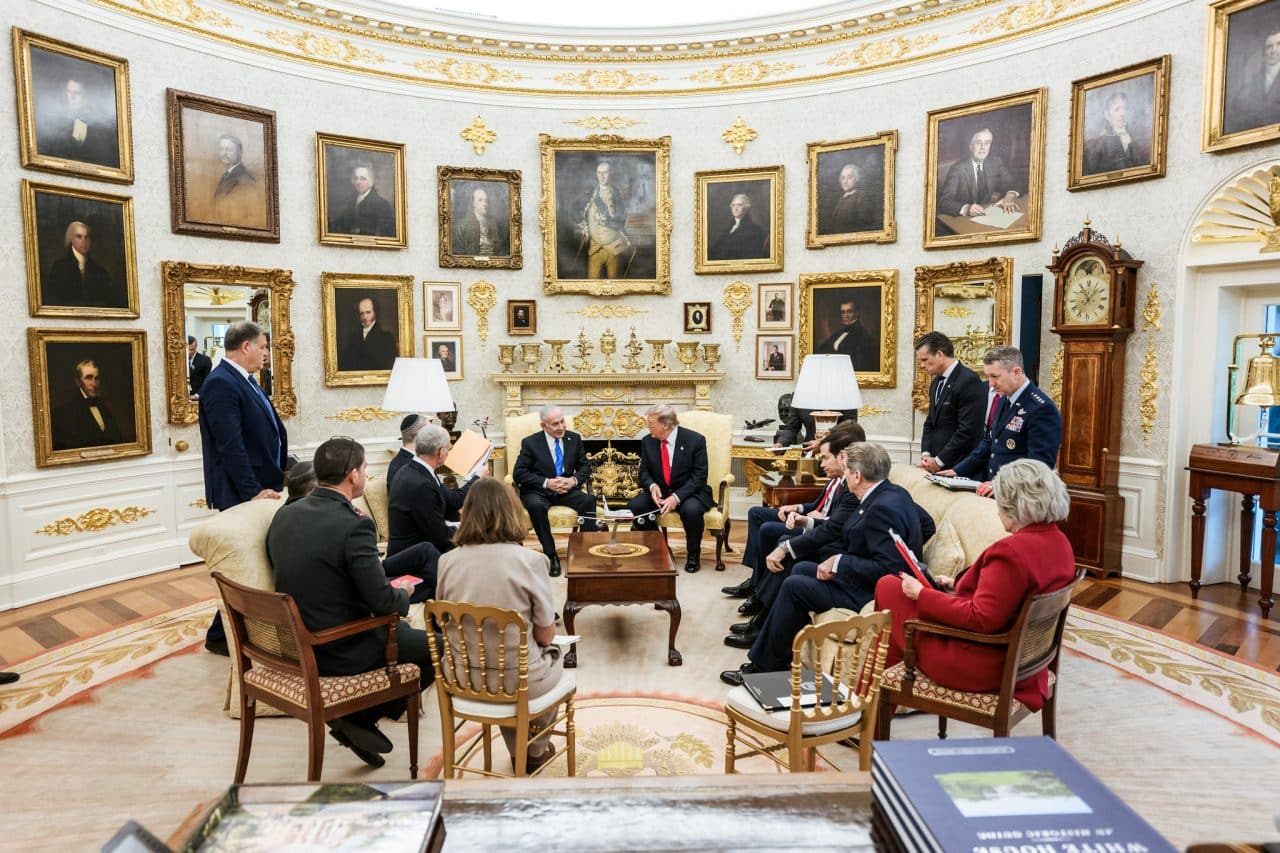
Israeli Prime Minister Benjamin Netanyahu arrived in Washington on Tuesday to attend the funeral of devoted Israel loyalist hawk, Lindsey Graham, and to meet once again with U.S. President Donald Trump. Before Graham’s funeral, Netanyahu met with Trump for about 90 minutes. Both leaders had their entourages with them, so it was a formal meeting but also one that was less likely to have as profound an impact on decisions as others the two men have had, which have often been one-on-one discussions. Vice President JD Vance, the most Israel-skeptical of Trump’s senior advisers, was present, among others, so any plans Netanyahu had of pushing new propaganda on Trump were not going to materialize. Neither Trump nor Netanyahu held a press briefing, and the White House offered little about the meeting, simply calling it “productive.” Netanyahu later gushed in broad terms about the meeting, calling it “one of the best conversations I’ve ever had with our good friend, President Donald Trump.” But the only specific point he cited was that they agreed that Iran should not obtain a nuclear weapon, a talking point that has become almost as banal and meaningless as a “peace process.” The meeting was notable more for what was not said than what was. According to what little information did leak out of the meeting, the two sides did not discuss a potential attack on Iran’s Pickaxe Mountain. Nor did the subject of any Israeli withdrawals from areas they currently occupy outside their internationally recognized borders (borders Israel has never formally declared or acknowledged) come up. Targeting Iranian nuclear facilities Israel has been peddling intelligence claiming that Iran has begun work on developing a nuclear weapon in the highly fortified mountain. Trump was informed of it and started threatening to attack the site. As usual, Trump was inconsistent about the attack, sometimes doubling down on it, other times backing off from it. But any ideas Netanyahu had about pressing him on it were shot down mere hours before he arrived in Washington. Speaking to Fox News, Trump said, “I don’t need Bibi to tell me that,” in reference to Pickaxe Mountain, indicating he was not pleased with the Israeli PM talking about the idea publicly before discussing it with Trump. It was thus a subject better avoided for Netanyahu. The fact that Trump has gone back to constantly repeating the mantra about not allowing Iran to have a nuclear weapon is telling, as is the fact that this was the only substantive point that Netanyahu repeated. Both speak to an ongoing dearth of strategic thinking about the war. This war has not been about Iranian nuclear capacity for quite some time, if it ever really was. It has become focused on the Strait of Hormuz, a point of conflict where the greatest possible upside for the U.S. and even Israel is a return to the status quo ante before the war started. It is impossible for conditions around the Strait to be any better than they were at the beginning of the war, and now, even restoring those conditions has become practically impossible. Both leaders, especially Trump, therefore, want to shift the focus back to the Iranian nuclear program. But even that is less advantageous than it once was. The U.S. and Israel, much to the joy of the unlamented Senator Graham, bombed Iran rather than agreeing to a deal which would have seen Iran submit to unprecedentedly intrusive inspections and commit to enriching only as much uranium as needed for specific, civilian purposes. In addition to all the death, destruction, and economic and political problems that caused, it also changed Iran’s calculus. Now, Iran has far more incentive to pursue a nuclear weapon. Further, even if, as I have suggested, they still perceive control of the Strait as a greater and safer deterrent than a nuclear weapon, they are far less likely to agree to any compromise on inspections with the United States, which has proven over and over that it will not keep its word. So, it would make sense for Iran to move significant nuclear equipment to the much less vulnerable Pickaxe Mountain. That doesn’t necessarily mean that they are pursuing a nuclear weapon now, but it is certainly possible. But we have no way of knowing whether Iran is really ramping up its nuclear program to weapons-grade. Under the JCPOA, we would have, and we had the opportunity right before the war to get that insight back. We decided to slaughter people instead. Iran’s response In what appears to be a change in tactics, Iran broke the period of relative calm by launching attacks on American bases in Jordan. This appears to have been a preemptive strike aimed at ensuring that the U.S. does not get to control the tempo of the fighting. It is likely that Iran decided to launch the attacks because it believed that, in the wake of Netanyahu’s meeting with Trump, an attack against its forces or territory was imminent. Trump has been threatening to launch a massive attack on Iran, but this seems like an escalatory step he is not likely to take. He halted the nightly bombing of Iran because his military advisors convinced him that it would lead nowhere and, given the United States’ depleted resources in the Gulf, it would lead to more American casualties. While Trump can often discard the advice of his own staff, this is an instance where he’s likely to heed their counsel for now. As time goes on and Iran maintains its closure of the Strait of Hormuz while Ansar Allah in Yemen continues to block Saudi ships in the Bab al-Mandab, Trump may turn again to the bombing that seems to be the only option he is willing to consider. This is another area where Netanyahu got less than he hoped from this “best conversation he ever had.” Israel is content to see the U.S. hit Iran and for Iran to lash out against its Gulf neighbors, especially while it continues to occupy Lebanon and Syria and maintain a free hand in the West Bank and Gaza. But right now, the U.S. is not really hitting Iran. Even after Iran and Ansar Allah attacked Saudi Arabia and American positions in Jordan, the response from the American military, targeting Iranian allies in Iraq, was not escalatory but more of a calculated response. That is a long-range concern for Netanyahu, who is having a tough time selling the current standoff in the Strait and the surrounding region to the Israeli public as a success. And that is reflected in polls that consistently show Netanyahu has little hope of forming a governing coalition after the October election, while his opposition is much closer. No Israeli withdrawal Netanyahu has maintained both a lower level of killing in Lebanon and the charade of talks with the Lebanese government in Washington. In return, Trump has allowed him to run rampant in the West Bank and push Palestinians farther into an ever-shrinking slice of Gaza while allowing Israeli troops to continue killing Palestinian civilians there on a near-daily basis. The report that the two of them did not discuss an Israeli withdrawal reinforces the American scheme to separate the issue of Israel’s invasion of Lebanon from the Iran war. They’re pursuing that goal, with the indispensable help of Lebanese President Joseph Aoun, through the mechanism of Israeli-Lebanese direct talks, brokered by Washington. Although there is no hope that these talks can possibly reach a durable, or even implementable, agreement, they have the effect of turning the Lebanese government against part of itself, in Hezbollah, and have effectively made it much harder for Iran to force an Israeli withdrawal. Tehran has had to settle instead for getting the U.S. to rein in Israel from the massive bombardment of the country and forced evacuations of the southern part of Lebanon. Even further off the agenda is Israel’s ongoing campaigns in Gaza and the West Bank. Iran has not, since the beginning of the war, felt it had the leverage to bring the question of Palestine into its list of demands in anything but the most indirect way. That position may not last, however. The current Iranian stance reflects the belief that the United States is not only untrustworthy but also incapable of sticking to a deal. That is a sensible conclusion from the many times an agreement seems to be close or even reached, only to fall apart because of an American action or sudden change of position. Iran also did not miss the fact that the MOU that Trump agreed to and so quickly abandoned was assailed by politicians and pundits from both the Democratic and Republican camps. This has led Iran from searching for a party that could deliver Trump and keep him on track to concluding that, regardless of who is in the White House, there is little hope of a sustainable, diplomatic agreement with Washington. That changes the strategy. Where Iran once was trying to inflict as much pain as possible in the hope of getting the U.S. to agree to the terms that Tehran is demanding, it is now in a place where Iran must try to minimize the amount of harm it will experience. This is why, among other reasons, it remains imperative that anyone who opposes the war support the MOU, not as a penalty for the U.S. having started the war, but as the only sensible way forward, as I have argued. In the meantime, however, if Iran does not feel a diplomatic resolution is realistic, they are in a position to bring Israel’s actions in the West Bank and, especially, in Gaza into the discourse. Right now, there is untapped potential in combining the two causes. Most advocates for Palestinian freedom are also protesting the war. Often, they talk about both together, but the issues are not completely wedded together in the broader political discourse. In part, this is due to Israel having stayed out of the latest round of fighting with Iran, but the biggest reason has been that Iran has not wanted to further complicate its own diplomacy with an effort that stands little chance of near-term success. But if Tehran no longer pursues a deal with the U.S., it will be much freer to incorporate the question of Palestine into the public statements about the war. This would breathe even more energy into an already healthy global anti-war movement, and, over time, could bring more countries into more active advocacy for ending the war and connecting Palestine to that ending. The downside is that Iran would experience even more extreme hardship with no end in sight. But the potential is not only a popular movement that fully merges Palestinian rights with opposition to this war but holds hope of forcing the international community to come together to act before calamity strikes. Mitchell PlitnickMitchell Plitnick is the president of ReThinking Foreign Policy. He is the co-author of Except for Palestine: The Limits of Progressive Politics and maintains the Cutting Through newsletter.
Netanyahu’s meeting with Trump was not nearly as successful as he claims
Full Article
Original Source
Read the full article at Mondoweiss →KhanList aggregates and links to publicly available news content. We do not host full articles from third-party sources. Always verify important information with original sources.