
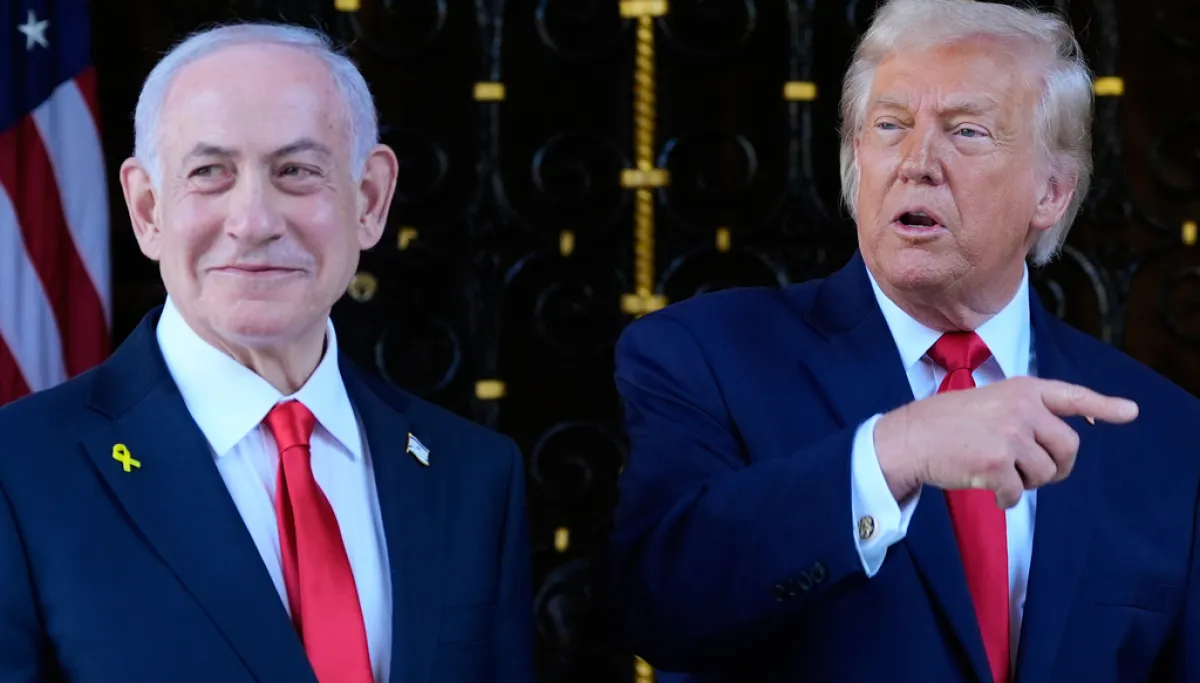
Israeli Prime Minister Benjamin Netanyahu characterized the end of U.S. military aid to the Jewish state as a mutual agreement between allies, as officials wait to see who stands to benefit from the new era of “partnership and mutual investment.”Netanyahu’s office reacted Friday to President Donald Trump’s cut to U.S. military aid, a dramatic policy change that caught government leaders in the United States and Israel off-guard. The prime minister’s team affirmed Trump’s assessment that financial support was no longer necessary because “today, Israel has a strong and stable economy.”“U.S. military aid to Israel has always been a cross-the-aisle agreement. Israel has used it both to defend itself and to confront enemies who threaten America and the West,” Netanyahu’s office said. “The move by PM Netanyahu and President Trump from aid to partnership shows the strength and sophistication of our relationship, and its ability to adapt and stand strong over time.” President Donald Trump speaks to reporters as he greets Israel’s Prime Minister Benjamin Netanyahu at his Mar-a-Lago club, Monday, Dec. 29, 2025, in Palm Beach, Florida. (Alex Brandon/AP Photo) Separately, a spokesman for Netanyahu’s office sat down for an interview Friday morning in which he emphasized that Israeli citizens are “greatly appreciative to the American people” for the “decades” of financial support. He once again characterized the end of aid as a decision made with mutual agreement amid Israel’s “thriving economy.”“We have a very strong military and defense industry, and while this aid has been incredibly important, the prime minister has been working with President Trump to make the correct transition now from aid to partnership and mutual investment,” the spokesman said.Trump announced the aid cuts on Tuesday, the day of the 2026 midterm elections. The decision seemed to confirm months of rumors and speculation that the White House was shutting off the taps when it came to funding the Jewish state’s defense, but defense experts question whether the change is actually forthcoming amid widespread confusion.The two countries are approaching the termination of a memorandum of understanding signed a decade ago by President Barack Obama. That deal allocates $3.8 billion to the Israeli military annually while requiring that the majority of those funds be spent on U.S.-manufactured weaponry and defense technology. Changes or cancellation of that direct military aid is typically under the purview of the State Department and subject to congressional oversight.Not only did Israel’s highest officials, including President Isaac Herzog, say they were caught off guard by the announcement, but even U.S. Ambassador to Israel Mike Huckabee said he had been warned. Asked about the aid cut timeline, he said he was not aware.“I’m not sure. I don’t know that we know the answer to that just yet,” Huckabee said. “We’re asking for some clarity on that. I’m sure the Israelis are as well.”Others question whether the aid is really being “cut” at all — or if it will just be laundered through other, less scrutinized avenues.“It is all up in the air as to whether this continues for at least the next two years, as stipulated in the previous MOU, or whether there is a new understanding between the two countries,” Jonathan Schanzer, executive director at the Foundation for Defense of Democracies, told the Washington Examiner.He continued, “It happened very quickly on Election Day, and I think there are reasonable questions right now about whether this is a definitive line of approach or whether this is the beginning of a new round of negotiations.”The National Defense Authorization Act for Fiscal Year 2027, still pending in the Senate, is set to include a piece of legislation called the United States-Israel FUTURES Act, which would transfer management of U.S. military relations with Israel from the State Department to the Pentagon.That act will empower the Department of War to accelerate “cooperative efforts between the U.S. and Israel, including bilateral defense technology research, development, testing, evaluation, integration, and industrial cooperation” without the red tape and congressional oversight currently placed on the State Department.A woman walks past a Likud party campaign billboard featuring President Donald Trump and Israeli Prime Minister Benjamin Netanyahu, with a Hebrew message reading, “We have one opportunity to win,” in Tel Aviv, Monday, Oct. 26, 2026. (Oded Balilty/AP Photo) In a report published earlier this year, the Quincy Institute for Responsible Statecraft warned that the FUTURES Act would not “operate through identified, accountable institutional channels” typical of international cooperative programs.“The initiative may make U.S. military aid to Israel more opaque by transforming assistance into cooperation, thereby sheltering the security relationship from regular congressional votes and oversight,” the report claimed.It remains to be seen if Netanyahu will be in the driver’s seat when the future of U.S.-Israeli military relations is ironed out. The prime minister failed to rally the necessary endorsements to form a government following last month’s elections.ISRAEL’S ARAB PARTIES CHOOSE BETWEEN ‘BAD AND EVEN WORSE’ AS THEY BACK GADI EISENKOT OVER NETANYAHU TO FORM GOVERNMENTHerzog is expected to appoint opposition leader Gadi Eisenkot to attempt forming a government in the coming days, with the Yashar party chairman having received a firm mandate of endorsements that even included the Arab parties.If Eisenkot is unable to negotiate a working coalition, the task would likely be given back to Netanyahu.
Netanyahu says US aid cut makes way for ‘mutual investment’ amid unclear plans for military cooperation
Full Article
Original Source
Read the full article at Washingtonexaminer →KhanList aggregates and links to publicly available news content. We do not host full articles from third-party sources. Always verify important information with original sources.