
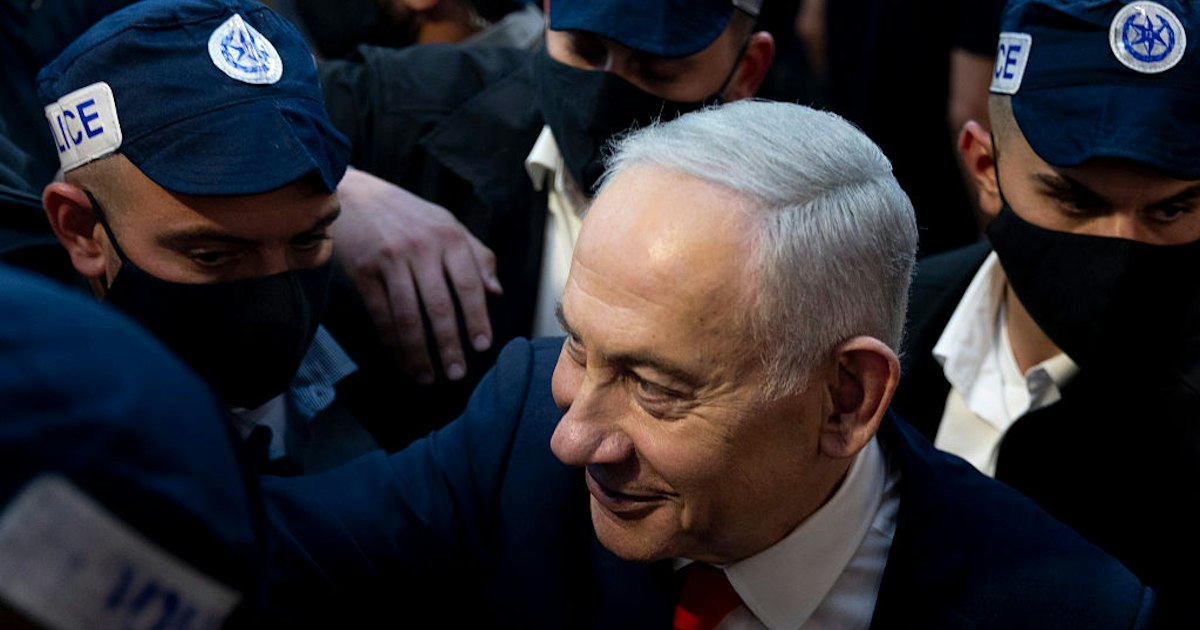
The Iran War The White House should be on guard against an intensified Israeli push for war. Photo by Amir Levy/Getty Images What does the Israeli election mean for America First? Benjamin Netanyahu, who first became prime minister in 1996, lost his governing majority on Tuesday in Israeli legislative elections. Yet the opposition coalition, led by the former military chief Gadi Eisenkot, didn’t win enough seats to secure a majority in the next parliament. Thus, Netanyahu finds himself backed into a corner but not thrown out of power. That’s a very dangerous place for Netanyahu to be—for the Middle East, the United States, and the presidency of Donald Trump. Not that Trump would agree, though oddly, he does seem to see the basic problem without recognizing it as such. In a Truth Social post endorsing Netanyahu—or “Bibi,” as he is known—Trump presented the Israeli premier as a trusted partner in the fight against Iran. “If Israel has the wrong Leader, which would be anyone other than Bibi, America will have to do this work ourselves,” Trump wrote, “and I am not inclined to do so.” It’s a strange warning for Trump to issue publicly, given the deep unpopularity of the Iran War among Americans, the price inflation it has unleashed, and the widespread perception that the U.S. was dragged into it by Israel. Trump’s insinuation that he won’t renew hostilities unless Netanyahu wins reelection is, for most Americans, a good argument that Netanyahu needs to go. But Trump’s endorsement landed differently in Israel, where Netanyahu has touted his close relationship with the U.S. president and made the Iran War central to his campaign pitch. In Netanyahu’s telling, Trump is the first and last U.S. president willing to “finally, finally remove the Iranian threat”—but only if Netanyahu is around for the remaining two years of his term to help “finish the job.” Ahead of the Israeli election, as polls showed a tight race if not a narrow lead for the Eisenkot bloc, Netanyahu urged Trump to attack Iran, claiming that another round of devastating strikes could topple the Islamic Republic, but Trump hesitated to restart the war before America’s upcoming midterm elections. When that push failed, Netanyahu sought to initiate a new round of fighting but met resistance from Israeli military officials. Analysts discerned that Netanyahu, unable to persuade Trump and constrained in his own ability to launch an attack, aimed to provoke a preemptive Iranian strike to justify another round of fighting, as when dozens of Israeli fighter jets flew a power-projection sortie near the Iranian border, more than 800 miles from Israel. “Some U.S. sources said they had the impression that Israel was hoping the Iranians would fire at the aircraft, providing a justification for launching strikes against Iran,” Axios reported. As I warned in March 2025, Netanyahu plays hardball, fomenting crises that constrain the foreign-policy options of U.S. presidents, and for decades he has tried to engineer a U.S. war on Iran. Judging by the commentary of some leading Israeli analysts, the political deadlock generated by the Tuesday elections will only inflame Bibi’s hardball tendencies. “A renewed military confrontation, which I believe is a serious possibility, could fundamentally change the political equation,” wrote Danny Citrinowicz, a former Israeli intelligence official. “Such an escalation could give Netanyahu an opportunity to push for a national unity government, potentially allowing him to remain in power despite losing his parliamentary majority.” Leaving aside the grotesquerie of that cynical calculation, a new round of war would be devastating for the Middle East. The Islamic Republic has already demonstrated the kind of damage it can do. And Tehran has warned it can climb even higher up the escalation ladder if attacked again, expanding its target set to include digital infrastructure like internet cables and data centers. In the worst case, it could take out water desalination plants, on which several Gulf states rely for most of their fresh drinking water. Another round of hostilities would also be devastating for Trump’s presidency, which has become consumed by the Iran War. At the beginning of his second term, Trump aimed to make a deal, not a war, with Iran, and while he deserves blame for failing to do so, he was outmaneuvered at every turn by Netanyahu. Subscribe Today Get daily emails in your inbox In 2025, leading up to the 12-day war in June, the Israelis effectively sabotaged U.S. diplomatic efforts, pushing hardline demands that Tehran would not accept, as former counterintelligence chief Joe Kent told The American Conservative after resigning in March from the Trump administration. Today, with a diplomatic off-ramp still on the table, Netanyahu insists no Iran deal is possible—a point he has pressed upon Trump. What comes next in Israeli politics is anyone’s guess. And Trump may be planning to attack Iran after the midterms regardless. But one thing is clear: Netanyahu is a political survivor, and more than perhaps ever before, his political survival depends on his waging a catastrophic war alongside the U.S. against Iran, Israel’s chief adversary. Patriotic Trump officials who oppose this outrageous war—be on guard.
Netanyahu Is Down but Not Out. That’s Dangerous
Full Article
Original Source
Read the full article at Theamericanconservative →KhanList aggregates and links to publicly available news content. We do not host full articles from third-party sources. Always verify important information with original sources.