
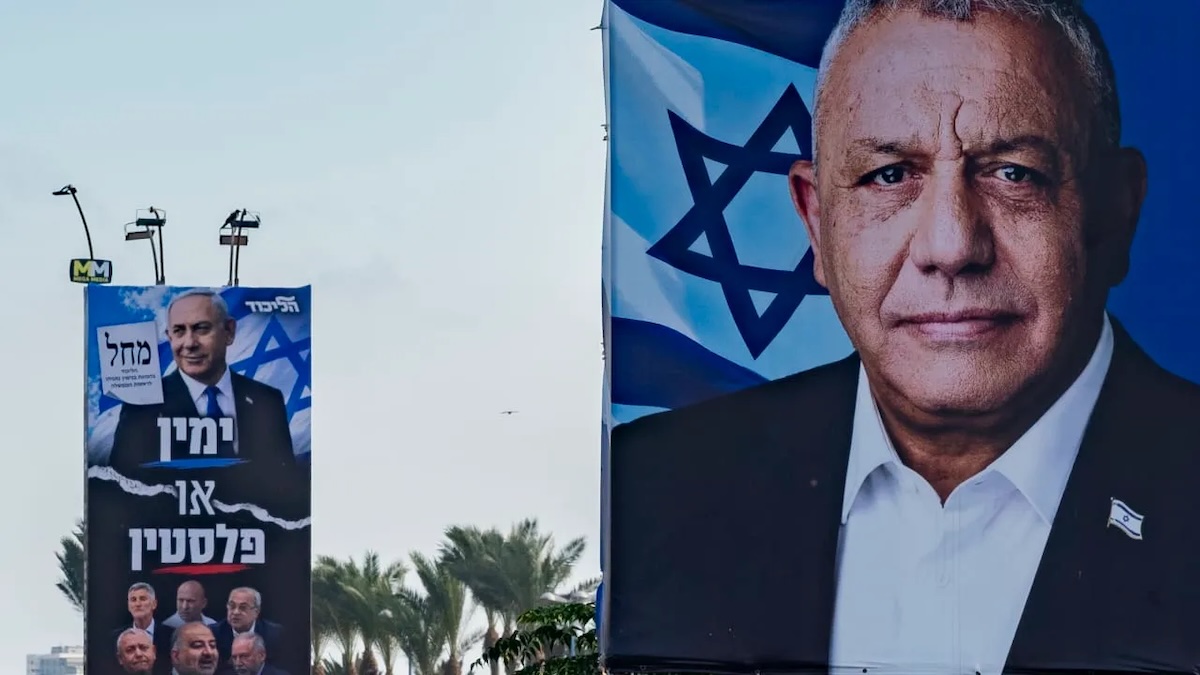
In 1996, Israel’s then-Prime Minister Simon Peres appeared to be on his way to victory in parliamentary elections that would keep him and his center-left Labor Party in power. On the key issue of peace, he had pledged to provide West Bank and Gaza Strip territory to the Palestinians for a sovereign state. The “land for peace” deal would end eight decades of Arab-Israeli hostility. His opponent, Benjamin Netanyahu, the youthful leader of the Likud Party, was making the first of what turn out to be 11campaigns, six of which got him into office as prime minister. Netanyahu rejected Palestinian statehood and offered instead “peace for peace,” in which Arabs would reside in the West Bank and Gaza as tenants under Israeli control. Or, better yet, migrate elsewhere in the Middle East. Netanyahu’s ideas gained little traction among voters. January polls showed Peres with a 20% lead. But as the May vote drew near, members of Hamas, a Palestinian terrorist group, cast their own version of a ballot: They blew up a pair of public buses, a bus stop and a Tel Aviv nightclub, killing a total of 59 people. Peres’s peace offerings suddenly seemed naive to many, even dangerous. He quickly ordered a military-led retaliation campaign, but the show of force failed to soothe an outraged and fearful public. Netanyahu offered a peace through strength program. His margin of victory was a single percentage point. Fast forward thirty years and Netanyahu is again on the ballot, but this time as an incumbent. And under fire. Detractors blame him for failing to protect Israeli citizens from the worst single crime against Jews since the Holocaust: The October 7, 2023, killing of more than 1,200 people, including women and children. The perpetrators were again Hamas, whose raiders infiltrated southern Israeli communities via hand gliders. Critics blame Netanyahu for lax security preparations and failure to pay attention to Hamas’s capacity to attack. Netanyahu has acknowledged no shortcomings. He quickly launched a military campaign that dwarfs any other strike against Palestinians in Israel’s history: a ground, air and artillery assault that flattened businesses and residences throughout the Gaza Strip. Hamas officials say the attacks killed at least 70,000 people. The Hamas raid and Israel’s response have, in turn, engendered moves that have involved several countries in a wider war: Iran and allied militias Hezbollah in Lebanon and the Houthi movement in Yemen mobilized to attack Israel by missile and drone attacks. In return, Israel invaded and partially occupied Lebanon in order to weaken Hezbollah. A joint American-Israeli aerial assault on Iran got under way with the goal of either crippling Iran’s suspected development of nuclear weapons or ending Islamic rule in Tehran or opening the Persian Gulf and Red Sea trade routes that carry fossil fuel – or achieving whatever goal US President Donald Trump might announce from one day to the next. Iran attacked American allies in the Persian Gulf. Houthis attacked Saudi Arabia. Some Gulf Arab nations hit back at Iran with rockets. The Saudis bombed Yemen. On the side, but related to chronic Middle East mayhem, is Israel’s move to expand control over the West Bank via conventional military action and unorthodox support for civilian gangs that harass Palestinian rural communities. Despite the tumult, it is unclear whether voters will punish Netanyahu in Tuesday’s election. On the one hand, 90% of Israelis surveyed in public opinion polls support Netanyahu’s war on Iran. On the other, 72% of Israelis think he ought to take responsibility for the October 7 massacre and resign, according to a survey carried out by the Israel Democracy Institute, a Tel Aviv think tank. Political surveys show Netanyahu’s campaign is in a neck and neck battle with his main opponent, Gadi Eisenkot, a former army general whose Yashar Party slightly leads in the polls. Eisenkot is a kind of Netanyahu Lite whose positions on foreign policy and defense issues differ little from Netanyahu’s. He wants to dismantle and disarm Hamas; to continue development of West Bank settlements and contain Iran via economic block creation of a Palestinian state; and to isolate rather than bomb Iran. In one area, a public persona of honesty, Eisenkot has worked hard to differentiate himself from his opponent. In that, he doesn’t have to try very hard: Netanyahu has been battling accusations of corruption for years. Even the name of Eisenkot’s party make the pitch: Yashar means “straight” in Hebrew, a kind of synonym for honesty. He’ll soon see whether that self-description carries him straight to high office.
Netanyahu hopes voters forget October 7, 2023
Full Article
Original Source
Read the full article at Asiatimes →KhanList aggregates and links to publicly available news content. We do not host full articles from third-party sources. Always verify important information with original sources.