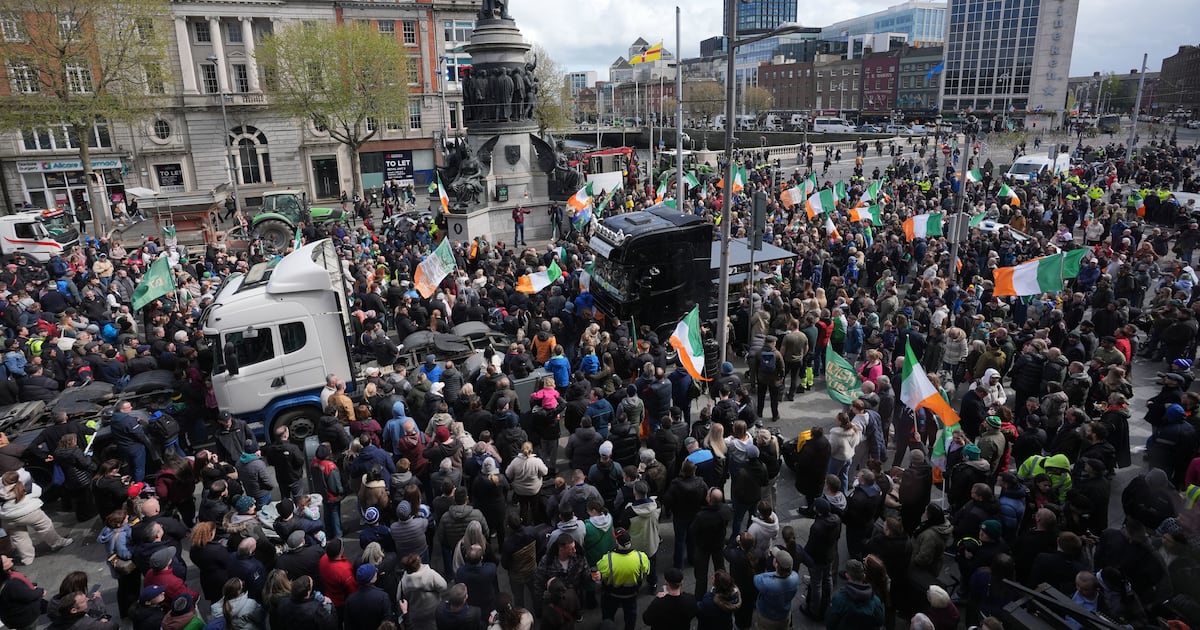
With prices inching closer to the dreaded €2-per-litre mark, political nerves are jangling amid dark mutterings that reversing excise cuts would be ‘political suicide’Protesters listen to speeches on O'Connell Street in Dublin on the fifth day of fuel price protests in April. Photograph: Niall Carson/PA Wire Just four short months ago, farming contractor Christopher Duffy stood on O’Connell Bridge proclaiming victory over the Government after a week of disruption caused by fuel price protests. Duffy, who had become one of the de facto leaders of the protests, defiantly told a crowd: “We have the country by the balls.” In the face of protests, the Coalition had just decided to increaseits spending on fuel and cost-of-living supports to €750 million. Since then, approved spending has risen to about €1 billion after cuts to excise on fuel were extended at the end of June. But with the tax due to begin reverting to its normal level from September 1st, Duffy last weekend harangued the Taoiseach at the Tullamore Show.With the political system still in its late summer slumber, the planned reversion to higher rates of excise on petrol and diesel is looming as the first big challenge facing the Coalition – and it invites a reckoning with the most dramatic political moment of the year so far. READ MOREChristopher Duffy with tractors and trucks blocking O’Connell Street in Dublin during the spring protests. Photograph: Chris Maddaloni In June, Coalition leaders agreed to stall the planned restoration of fuel excise cuts, which had been due to expire on July 31st, instead gradually restoring them through monthly tapering until December. The first increment – of 9 cents per litre on petrol, 10 cents on diesel – is due on September 1st. Just as these increases hover into view, forecourt prices have begun to drift back up, driven by ongoing volatility and disruption in the Middle East. On Monday, the AA said diesel was on average €1.92 per litre in August, up 19 cents on July, with petrol up to €1.84 from €1.75.If those prices hold, or climb, tapering the excise cuts will bring forecourt prices close to – or over – the psychologically important €2 a litre mark – seen as entering the danger zone for public backlash. [ Cutting excise duties on petrol and diesel is the wrong approach, EU commissioner warnsOpens in new window ]Meanwhile, according to figures released to the Irish Independent this week, tens of millions of the €220 million allocated to fuel support packages for hauliers and farmers announced in April remain unspent. While senior sources are insistent that for the hauliers scheme at least, almost all the money will end up being paid out, it is likely that much will remain unspent from schemes to support farmers, fishers and contractors. Representative groups have complained of members being bogged down in red tape. Much focus – and political pressure – is likely to build in the weeks ahead. In fact, it has already begun to.Opposition parties this week called for the Government to pause its plan to reverse the excise cuts, while lobby groups have also turned up the volume. Both the Irish Farmers Association and Irish Road Haulage Association have said moves to reverse the excise cuts should be stalled. Kevin McPartlan, chief executive of fuel industry lobbyist Fuels for Ireland, says it would be “political suicide” to reverse excise cuts with prices where they are. Fuels for Ireland chief executive Kevin McPartlan. Photograph: Sam Boal/Collins Photos Publicly, the Government is in a holding pattern, saying it is continuing to monitor the situation closely and reserves the right to adjust its response as required. “The Government will continue to act in a way that protects the most vulnerable and sustains our economic stability.”Given the money involved, guardedness is to be expected – not to mention the volatility in the market. It is possible that the price at the pump may soften before the end of the month. However, the abiding fear among Ministers who speak about the matter privately is that is not likely – giving the Coalition a decision to make. Those involved in that call believe there are roughly three options: proceeding as planned, changing the pace of tapering or throwing the plan out and keeping the excise low with no drop-dead date. The last of those is seen as ruinous to the Government’s fiscal credibility, meaning it is highly unlikely – but there are clear nerves about proceeding as planned.“If we’re at the kind of levels we’re at now, it’s going to be very hard to start unwinding it,” says one Cabinet source. “If a Government tax brings that over €2 [per litre], as opposed to market movements, that’s just politically stupid.”A second Cabinet source said they believed the first increase could well be delayed until after September 1st, a view shared by another Government source earlier this week. [ Why are fuel prices climbing again and how much more will I be paying?Opens in new window ]A third senior Minister agrees there is a “definite consideration” of revisiting what was agreed in June – which is now seen as “unlikely to hold”: “The chances of what we agreed in June holding over a four-month period is slim,” the Minister says, arguing that two increases before the budget are unlikely and “some stay or pause” would be likely in order to create space around the budget. “The run-in to the budget shouldn’t be dominated by a big increase happening just before.” One issue is that stalling the September increase would almost certainly mean recalling the Dáil, a move that senior sources say would look skittish – so in the absence of a surge in prices on the forecourt towards the end of the month, a more likely path is to allow the first increase but to revisit plans to put an 8-cent increase on both petrol and diesel on October 1st. It is unsurprising that the budget rides high in political considerations of fuel prices: while billions in spending increases and tax cuts are expected, there is also a widespread acceptance among Ministers that rising prices and rapidly multiplying demands for service improvements will leave a lot of voters disappointed. The experience of the fuel protests still spooks the political classes – and it is not hard to see why. Documents released under Freedom of Information laws show the signals that were being sent to the Department of Enterprise during the protest by agencies involved in key sectors of the economy. A paper given to senior officials in that department showed that while upheaval on international fuel markets was manageable, domestic volatility “dominated” a discussion with IDA Ireland, Enterprise Ireland and tourism agencies. Of the protests, inward investment agency IDA Ireland told the department that “ongoing operational disruptions [are] harmful to Ireland’s reputation for reliability and supply-chain resilience”, while tourism chiefs warned that “domestic volatility [is] causing reputational harm [and] receiving international media coverage”.This week, social media and messaging platforms have seen plans for another protest shared – although predicting just how widespread any action could be is hard. Sonny Boyd, a tow truck operator who is an administrator for one of the most popular Facebook pages involved in organising protests in the spring, says something could gather steam if increases go ahead; but his current judgment is that “it’s not expensive enough for people to protest”. Security sources – badly burned by the chaos unleashed in April – acknowledge there is discontent but say a second iteration of the spring protests is “not a significant concern at the moment”. Among the politicians approached by fuel protesters at the Tullamore Show was Midlands North West MEP Barry Cowen. The Fianna Fáil MEP believes the original plan to taper the excise cuts was a good one. However, he adds: “Now [prices] are going back up again, so they’re in a bit of a dilemma.” Amid ongoing turmoil, his advice to colleagues in domestic politics is that “it’s a time for cool heads and a bit of reason here, because it could get a lot worse before it gets better.”IN THIS SECTION
Nerves in Government about potential protests as fuel prices inch closer to €2-per-litre again
Full Article
Original Source
Read the full article at Irishtimes →KhanList aggregates and links to publicly available news content. We do not host full articles from third-party sources. Always verify important information with original sources.