
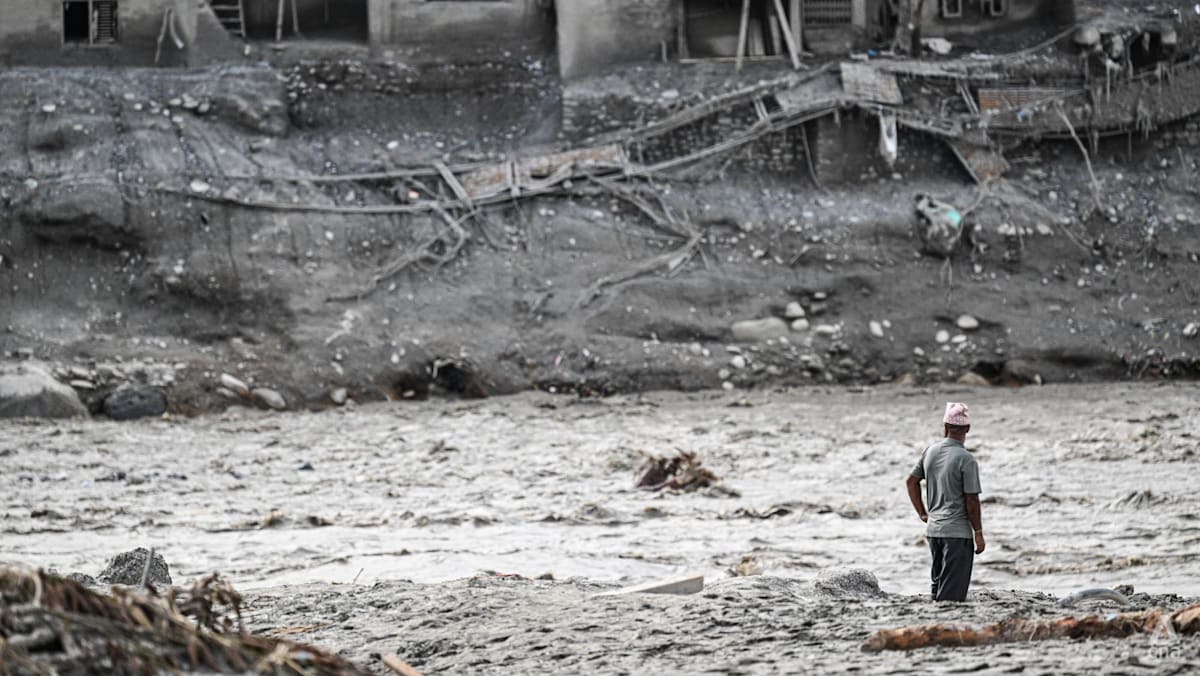
Asia A week after a catastrophic flood tore through Nepal’s Himalayan valleys, thousands remain missing and rescue teams are still searching for survivors. CNA meets families waiting desperately for news and residents confronting the destruction of their communities. A man walks along the banks of the Trishuli River amid widespread destruction caused by the flood in Devighat, Nepal. (Photo: CNA/Jack Board) New: You can now listen to articles. This audio is generated by an AI tool. 02 Sep 2026 06:00AM (Updated: 02 Sep 2026 07:12AM) DEVIGHAT, Nepal: From elevated ground in Bidur, the scale of destruction from Nepal’s deadly mountain flood becomes clear.Below lies a scar of devastation snaking its way from the high mountains. The riverbanks through Nuwakot district - 60km south of Nepal’s border with China - have been stripped raw. Houses that once stood here are gone without a trace. “It is like a mud apocalypse,” a local man remarks, walking through the mire.Just over a week ago, this was a lush Himalayan foothill valley, a landscape of terraced fields, riverside towns and steep green hills. Now, through its core, dark water continues to race along the Trishuli River, sullied by rock and debris. The flood began far upstream in Tibet on Aug 26, where a catastrophic collapse of rock and glacial ice sent water and debris surging through narrow valleys towards Nepal. The torrent entered the country through Rasuwa district before tearing south along the Bhote Koshi and Trishuli river systems.Its force transformed a river corridor connecting mountain communities into the path of the disaster. Roads and bridges were swept away, hydropower projects were inundated and settlements downstream were buried. Residents make their way through flood debris in Devighat, Nuwakot district, after the Trishuli River tore through riverside communities in Nepal. (Photo: CNA/Jack Board) One week on and the region is gripped by pain and loss, while authorities deal with a complex, multi-faceted response across largely impenetrable terrain. Nepal's National Disaster Risk Reduction and Management Authority said 987 bodies had been recovered and 3,916 people remained missing as of Tuesday (Sep 1) morning, with 11,814 rescued.Still, this remains both a rescue and recovery operation. Rescuers have not abandoned hope of finding more survivors.The greatest hope for rescue teams may lie beneath the mountains. More than 600 hydropower workers are feared trapped underground in tunnels highly concentrated north of Bidur.The disaster struck one of the centres of Nepal's rapidly expanding hydropower industry. A chain of power stations and projects under construction runs along these steep river valleys. Several were damaged by the deluge. Throughout recent days, rescuers have been blasting and digging their way into the tunnels, hoping workers survived the initial flood by sheltering inside underground powerhouses.Engineers have reportedly been pumping air into these tunnels, and while a team had managed to gain entry into one, it withdrew after not finding anyone at the site. At an army base in Bidur, which has become mission control for air operations into the disaster zone further north, crowds wait, clinging onto hope of news of missing relatives from across the wider disaster zone.Beyond this town, road and bridge infrastructure has been completely wiped out.Paarvati Shrestha, from Kathmandu, is missing her husband - a trader - who she has not heard from since the flood hit the border area where he was working. He had been travelling to China that morning, she believed, but is hopeful he may have escaped the floodwaters in time.“A cousin from Bidur who had recognised my husband from his tattoos said he had managed to flee along with others to the jungle,” she said.The 45-year-old said she has been told by the army to keep checking lists of names and photos to know whether he has been found, dead or alive.“We have been waiting unable to eat or sleep for days and so we demand the rescue team try their best,” she said. A woman looks through barbed wire by an army base in Bidur, Nepal, waiting for news of missing people in the deadly August flood. (Photo: CNA/Jack Board) Mobile networks have been disrupted across parts of the disaster zone and access to some communities still remains difficult.Shyam Kumar Pun is desperate for news of his lost brother, who was working as a machine operator at the border port of Rasuwagadhi.Pun, 33, flew from Pokhara to Bidur and has been waiting for days for any news.“If he was alive he would contact us on the phone,” he said. “We think he might have died but sometimes we wonder if he is out of phone network or his phone has died. We are somewhat hopeful that he is alive.”As he speaks, the air buzzes with more helicopters dropping aid and bringing back survivors.For those waiting for their loved ones, it’s a cycle of hope turned to anguish on repeat.MORE BODIES IN THE MUDIn the small nearby town of Devighat, a digger starts to work around one of the collapsed houses close to the river. A rescue team is on hand with sniffer dogs.After some time, there is a breakthrough. But the outcome is yet another dead body: another victim in a rising death toll. Locals tell CNA of seeing bodies on rooftops in the immediate aftermath of the flood. Days on, the smell of death hangs heavily in the air here. Heavy lift drones move overhead carrying stretchers, and later more body bags, across terrain that vehicles can no longer easily traverse.The life of this riverside community appears frozen in time, and in the mire. Motorcycles stand abandoned, caked in muck. Personal belongings lie strewn.Still, some locals have begun returning to their homes to salvage what little might be left.Two men on the first floor of an engulfed home take a break from shovelling mud and debris, to ponder what has been lost here, staring into the distance. Devighat faces a long recovery. Families who lost their homes are now confronting a more protracted question: where they will live once the immediate relief operation ends.Throughout the entire disaster-struck region, it is estimated more than 93,000 people have been affected, according to the Red Cross.At a local school, hundreds of people are being housed and provided with food and daily provisions. As temperatures hover around 35°C and the monsoon humidity bites, people appear physically uncomfortable perched on railings and under awnings.The conditions bring new risks. Health services have been disrupted across affected areas, while medicine shortages and crowded temporary shelters are raising concerns about illness among people already exhausted.Local officials say they do not have a plan yet for what to do once school needs to restart or a more sustainable plan for those who have been displaced. Discussions were already underway with the local government to find a solution, said Prachanda Babu Rai, who was coordinating the makeshift camp at Shree Chandrajyoti Secondary School.“I would like to appeal to the donors that we need tin roofs, tents and other equipment that we could use to make shelters,” he said. Niru Neupane, 51, a local resident, is one of those now left homeless.“First our house started trembling and then I saw giant boulders gushing downstream and I ran from our roof towards the upper neighbour’s building and climbed to the road,” she said. At the river’s edge, nothing remains of where her house once stood, only a thick expanse of unstable mud that makes the area difficult to access.“After I escaped, I saw my house get carried away by the river and all of a sudden my vision went blank after realising I had nothing left.”Her husband had died just six weeks before the flood. Confronted now with the loss of her home and the shattering of her community, she said her grief was so overwhelming that she wished the floodwaters had taken her too.“I have nothing anymore,” she said. “We have nowhere to go, not much to eat and no clothes to change, what can I say?”
Nepal’s riverside communities cling to hope with loved ones missing after deadly flood
Full Article
Original Source
Read the full article at Channelnewsasia →KhanList aggregates and links to publicly available news content. We do not host full articles from third-party sources. Always verify important information with original sources.