
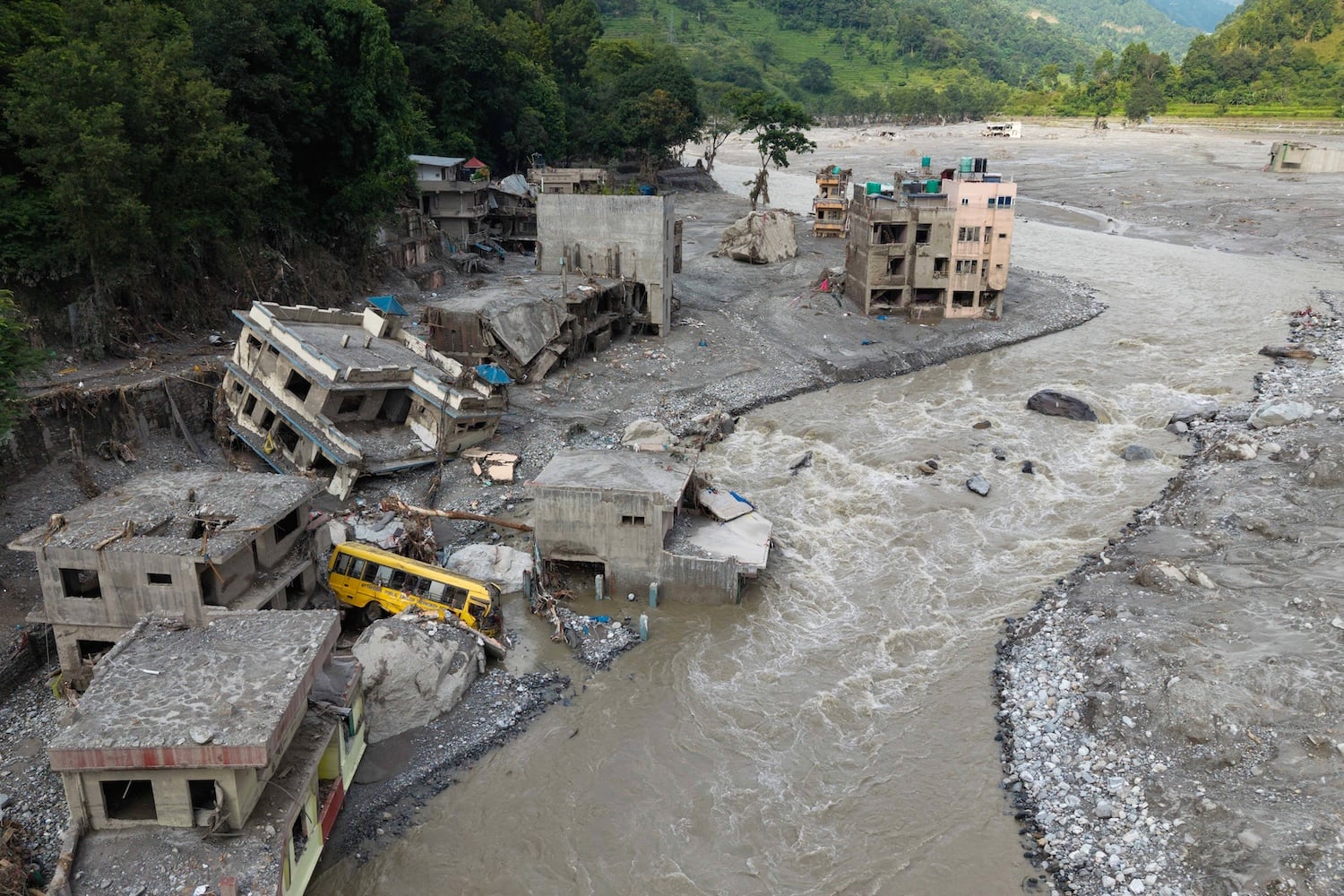
Welcome to Foreign Policy’s South Asia Brief. The highlights this week: Nepal’s catastrophic flooding underscores the need for regional cooperation, Chinese President Xi Jinping plans a trip to India with a delegation of 400, and an international court of arbitration rules against India on the Indus Waters Treaty. Flood Disaster Should Spur Cooperation A week after catastrophic flooding in Nepal along the border with Tibet, the death toll continues to mount. More than 1,100 people have died, according to government figures, with nearly 4,000 still missing. The floods, triggered by a glacier collapse and landslide, are to this point Nepal’s deadliest natural disaster since the 2015 earthquake that killed nearly 9,000 people. Even as Nepal’s government conducts rescue and recovery operations and other countries send aid, it’s worth considering how the tragedy might shape future national and regional policy. These floods will no doubt provide strong incentives for Nepal to work more closely with its neighbors to try to reduce future threats. Admittedly, this might seem unrealistic. Nepal and its neighbors are no stranger to deadly natural disasters, and none has spurred more regional cooperation to reduce their destructive effects. South Asia is notoriously uncooperative, with governments often contending with diplomatic tensions and disputed borders. This is why trade and connectivity are in short supply. But two factors give cause for hope. One is that an effective regional organization that can provide an institutional mechanism for such cooperation already exists. Nepal is home to the International Centre for Integrated Mountain Development (ICIMOD), which comprises the eight states of the Hindu Kush Himalaya region and focuses on developing and sharing research among its members. The ICIMOD has a solid track record, despite a fractious membership that includes India, Pakistan, and China, along with Nepal. The organization recently initiated a regional strategy for coordinated monitoring of glaciers, and it has developed community-level warning systems across the region. There is also a regional success story that Nepal can look to: the Indus Waters Treaty (IWT) between India and Pakistan, widely regarded as a case study for effective transboundary water management. (India suspended its participation in the treaty last year as a punitive step against Pakistan, not for any reason related to its efficacy.) Among the successes of the IWT is its information-sharing model, in which commissioners from each country meet periodically to exchange hydrological data. The template could be adapted by Nepal, China, India, and other Himalayan neighbors to facilitate monitoring of warning signs for the type of disaster that befell Nepal last week. As Stimson Center senior fellow Austin Lord, who has closely studied Nepal’s natural disasters, recently emphasized, “greater communication, information sharing, and collaborative analysis of transboundary risks between Nepal and China are sorely needed.” Nepal’s reformist administration, which took office in March after the ouster of the previous government, has at times taken an unconventional approach to diplomacy in its zeal to do things differently from its predecessors. Kathmandu initially declined offers of assistance from foreign search-and-rescue teams in the wake of last week’s disaster but quickly reversed course. This perhaps indicates that in the coming months, after the acute emergency of the recent floods has passed, Nepal will seek to reach out to its neighbors to discuss how to reduce the future risks posed by these disasters. With the effects of climate change—including glacial melt, which likely contributed to the current disaster—only becoming stronger in an especially vulnerable region, the chances of a similar disaster will only increase. What We’re Following Xi to visit India with 400-strong delegation. Chinese President Xi Jinping will soon visit India for the first time since 2019, participating in a BRICS summit on Sept. 12 and 13. According to Indian officials cited in local media, Xi will be accompanied by a delegation of around 400 people—which would be twice as large as the 2019 delegation. The massive delegation speaks to how India’s relationship with China has evolved in recent years. Ties plunged into deep crisis after a deadly border clash in Ladakh in 2020, shortly after Xi’s last visit to India. But the two sides have bounced back, with tensions beginning to subside in 2024 following a new border agreement and pledges to strengthen commercial cooperation. India and China have additional incentives to bolster their commercial partnership in U.S. President Donald Trump’s second term, with both countries looking to hedge against his tariff policies and unpredictability. To that end, many of the Chinese delegates in India will likely be scouting trade and investment opportunities. A ruling against India on the IWT. On Monday, the Permanent Court of Arbitration in The Hague, Netherlands, ruled against India’s decision to suspend its participation in the IWT last year. The court declared that India must uphold its obligations to the accord, including those related to two dam-building projects that are disputed by Pakistan. India pulled out of the IWT soon after the April 2025 terrorist attack that killed 26 people in Indian-administered Kashmir, which it blamed on Pakistan. (Islamabad denies involvement.) The move was part of a campaign of nonmilitary punitive actions directed at Pakistan, but the decision was dramatic because the IWT is seen as a rare bilateral success story. India rejected the court’s decision this week, underscoring how fundamentally stressed the IWT now is. A key reason for the treaty’s longevity is its dispute resolution rules, which both sides always accepted. Under the IWT’s three-step process, the dispute goes to international arbitration if bilateral negotiations and then neutral mediation fail. In this case, India claims that since a neutral expert was already reviewing the two dam-building cases, there was no need for the court to weigh in. The situation is further complicated by the fact that the World Bank, which co-signed the treaty, simultaneously appointed a neutral expert and a chair for an international court of arbitration. RSS chief attends event in New York. Mohan Bhagwat, the head of the powerful hard-line Hindu nationalist organization Rashtriya Swayamsevak Sangh (RSS), participated in a large event at Madison Square Garden in New York City over the weekend. The RSS is closely associated with India’s ruling Bharatiya Janata Party (BJP). The RSS described the event as an “interfaith gathering,” and in a speech, Bhagwat professed his support for religious tolerance, saying, “if any Hindu thinks that there should be no Muslims in India, he will not remain Hindu.” Critics of the RSS, however, were not impressed by Bhagwat’s comments, and hundreds of people protested the event. New York City Mayor Zohran Mamdani slammed the RSS as “exclusionary.” In fact, the RSS has looked to rehabilitate its image in the United States for some time; it recently hired lobbyists in Washington. This may be part of a broader RSS effort to repair its global image and project itself as a more mainstream entity. FP’s Most Read This Week Trump Has Peaked by Ravi Agrawal A Cabinet Full of Roy Cohns by Michael Hirsh China’s Success Is Forcing a U.S. AI Rethink by Robert A. Manning and Giulia Neaher Under the Radar It’s perhaps a sign of the times that a major milestone in South Asia came and went last weekend with relatively little attention: Aug. 30 marked the five-year anniversary of the U.S. withdrawal from Afghanistan. Discussion about Afghanistan in Washington has been rare since U.S. troops left the country. Initially, this was for political reasons: The Biden administration likely didn’t want to bring additional attention to the botched and chaotic exit, which included a terrorist attack outside the Kabul airport. More recently, it’s been about policy. The Trump administration has very limited objectives in Afghanistan aside from working for the release of U.S. captives in the country. In recent days, Taliban leaders have made pitches to the United States to consider investing in Afghanistan, emphasizing its critical minerals. In general, pitches like this often amount to pushing on an open door, given the Trump administration’s affinity for commercial opportunities overseas. But in this case, with Washington wanting to keep a distance from the country’s sanctioned leadership, the Taliban’s pitch will be a very hard sell.
Nepal’s Disaster Demands a Regional Response
Full Article
Original Source
Read the full article at Foreignpolicy →KhanList aggregates and links to publicly available news content. We do not host full articles from third-party sources. Always verify important information with original sources.