
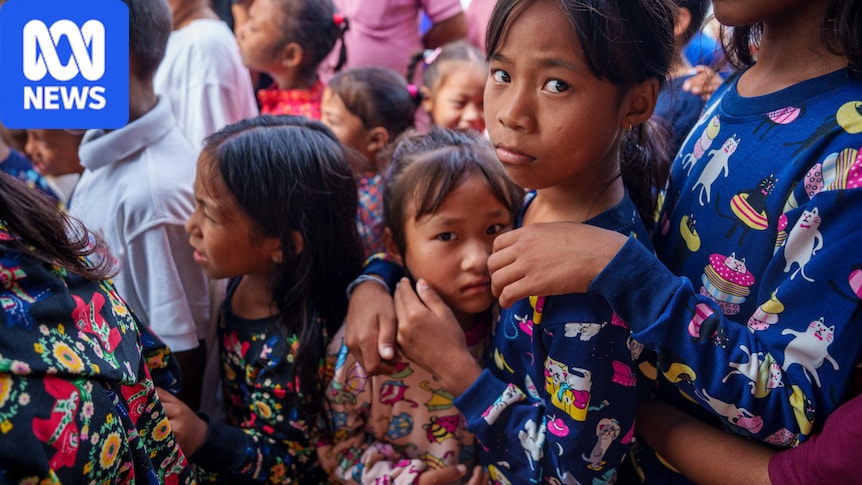
The Bhotekoshi River is angry.Raging brown water cascades past the remnants of Devighat, a community south of Bidur in Newakot District, ravaged by the catastrophic flash flooding that struck north and central Nepal last week. Residents have slowly returned, shovelling ceiling-high mud from their homes, salvaging what they can.Homes, trucks, animals, and people, are entombed in the mud that has settled here.The heat of the monsoon season means most wear masks to shield themselves from the smell of decay.Close to the riverbank, past what used to be a bridge and down a narrow street where sticks and branches guide people towards stable ground, Suntali Shrestha can do little but assess the damage to her home and business. Suntali Shrestha's home and business has been badly damaged.(ABC News: Haidarr Jones) A destroyed building in Nepal's Nuwakot district.(ABC News: Haidarr Jones) A woman walks through a damaged house in Nepal's Nuwakot district.(ABC News: Haidarr Jones) A woman is surrounded by destroyed buildings in Nuwakot.(ABC News: Haidarr Jones)"I lost everything, all my maize and rice are gone," the 60-year-old said.Memories of the death she witnessed are unlikely to fade."One of our neighbours who lived right next to us died. She was an old woman who lived alone. We told her to come outside, but she couldn't get out, and the flood swept her far away."As Suntali explained the impossibility of moving on from this disaster, men began shouting warnings of a second."It's coming!"Panic cut across the faces of residents, rescue workers, and journalists; even dogs joined the crowd that began to run for their lives.Some fell in the mud; others jumped on motorbikes and scooters, tearing down the flat road towards the rise. A man walks along a road buried under mud and debris in Nepal.(ABC News: Haidarr Jones) A man escorts a baby on his motorbike in Nepal's Nuwakot district after a massive flooding event.(ABC News: Haidarr Jones) A group of shocked locals assess at their destroyed village in Nepal in the wake of catastrophic flooding.(ABC News: Haidarr Jones) A home buried in mud in Nepal's Nuwakot district.(ABC News: Haidarr Jones) A building partially buried in mud in Nepal's Nuwakot district.(ABC News: Haidarr Jones) A flood-damaged section of settlement in Nepal's Nuwakot district.(ABC News: Haidarr Jones) A man carries a bag through a mud-covered settlement in Nepal's Nuwakot district.(ABC News: Haidarr Jones)It has been a week since what some people describe as a tsunami of water that sounded like an earthquake struck the north-central river regions of Nepal, and the true scale of the disaster has only just begun to unfold.Whether or not the call was a false alarm is unclear. Nothing like what occurred last week hit the community, but Nepal's government has continued to warn of rising waters. A woman walks with her two children along a street in Nepal.(ABC News: Haidarr Jones)But it pulls into sharp focus the looming threat facing residents and rescue teams.High in the Himalayas, where the glacier originally collapsed, at least two new barrier lakes have formed, trapped by the debris brought downhill in the first flood.Chinese authorities have been warning for days that there is a chance those lakes will breach. That threat appears to be subsiding, with Chinese state media reporting the lakes are slowly draining.But without a reliable warning system, residents near rivers take no chances.When someone says run. They run. Two rescue workers at a disaster site in Nepal's Nuwakot district.(ABC News: Haidarr Jones)Locals no longer recognise their villages As rescue crews and aid workers carve paths through mud to reach those in need, the toll of the dead and the missing climbs higher.On Tuesday, Nepali authorities said at least 950 people had died, and 4,700 are missing. At least 43 Australians are among the missing. The border between China and Nepal is complicating the search for some of those missing after the catastrophic floods that hit the region.(ABC News: Haidarr Jones)On the Chinese side of the border, according to state media CCTV, 16 people have been killed in Gyirong County, and 546 are missing.In regions 200 kilometres from where the flood began, mass graves have been dug to bury hundreds of bodies that have become unrecognisable after being washed downstream.Survivors who were lucky enough to be close to higher ground have told the ABC they watched their parents, their school friends, and even their children, disappear under the torrent.They now return to places they do not recognise. Some cannot even say where their house used to be. The floods destroyed bridges, and left towns partially buried in mud.(ABC News: Haidarr Jones) Buildings overlook a road buried in mud and debris in Nepal's Nuwakot district.(ABC News: Haidarr Jones) Floodwaters move through a settlement in Nepal's Nuwakot district.(ABC News: Haidarr Jones) Destroyed buildings and flooding in Nepal's Nuwakot district.(ABC News: Haidarr Jones)Desperate search for missing loved ones continuesIn Bidur, a two-to-three-hour drive from Kathmandu over winding mountain passes, an army base has become the epicentre of the disaster response.The whirr of helicopters barely ceases as rescue teams ferry medical supplies, food and water to those trapped upstream, and bring back survivors, and the dead. Nepali soldiers walk through Nepal's Nuwakot district.(ABC News: Haidarr Jones) Two men carry a stretcher near a helicopter in Nepal.(ABC News: Haidarr Jones) Nepali soldiers unload supplies in Nepal's Nuwakot district.(ABC News: Haidarr Jones)Outside the barbed-wire fences of the base, people desperate for answers scan lists of those brought back alive.Many are disappointed.Printed photos of the missing are glued to walls in the hope someone will have news about where they are. A girl comforts her friend in Nepal.(ABC News: Haidarr Jones)Dinesh Kayastha knows there is a slim chance his brother, Prakash Kayashta, is still alive.Prakash was working on the Upper Trishuli hydropower project in Rasuwa district for the Korean Doosan company.Almost a dozen hydropower project sites have become a major focus for Nepal's rescue crews. It is estimated more than 900 people could be trapped, including many in underground tunnels."If my brother only cared about himself, he would have survived, but he took a vehicle to rescue other people," Dinesh said.He hopes to find his body, but that too may be unlikely."The bodies may be in the river, buried under the mud, or swept toward India."Every day, rescued trekkers arrive in helicopters, largely unscathed, and are steered into buses to Kathmandu.Others aren't so lucky. Kinga Lama was told his family had been killed after he was rescued.(ABC News: Haidarr Jones)Kinga Lama was rescued from Syaphrubesi in Rasuwa District. When he landed at the army base, he was told his family was killed."When the flood came, they had gone outside to have a cup of tea. That was when the flood swept away his entire family and home, everything," his cousin Tula Ram Gurung said."Now, he has no father, mother, sisters, or anyone else left. He is completely alone, with no-one to support him. He is staying with me now. He has no-one else, and he is in a lot of pain."Survivors take refuge in hall with no running water A Nepali woman with her son on her hip.(ABC News: Haidarr Jones) Two Nepali women look at flood damage in Nepal's Nuwakot district.(ABC News: Haidarr Jones) A woman hold the head of her baby in an emergency centre in Nepal.(ABC News: Haidarr Jones) A woman sits on the floor in a centre in Nepal.(ABC News: Haidarr Jones) A Nepali child recovering from the Nepal flooding.(ABC News: Haidarr Jones) Two Nepali children take shelter at an emergency centre in Nepal.(ABC News: Haidarr Jones) A toddler walks in an emergency centre in Nepal's Nuwakot district.(ABC News: Haidarr Jones)Up a dusty dirt road in Nuwakot, a sports hall with no running water and just a few toilets is lined with thin mats to house those with nowhere else to go.Outside, doctors sit at tables recording medical information to prescribe medications as cries of grief echo around them.Women huddle around an inconsolable mother who arrived from Malaysia to be told her husband and daughter were killed in the flood.Parents soothe children who are afraid another flood is coming.Prakriti Tamang arrived at the refuge a few days ago. Her memories are still raw."I didn't understand what was happening at all," the 17-year-old said."We were at school. Our morning class was on, and it felt like an earthquake." Prakriti Tamang has been at an emergency centre in Nepal's Nuwakot district for a few days.(ABC News: Haidarr Jones)Prakriti said her school friends initially believed the roaring sound of the water was a helicopter landing."When we went outside and looked, the flood was coming. There were a lot of people … who couldn't run. The river swept them away in such a terrible way."The teenager said her teacher shouted at everyone to run as high as they could."Go up, go up," she said.Her family survived, but two of her best friends did not.She walked for almost four hours, helping carry small children, to reach a municipality called Suryagadhi, where trucks were waiting to transport survivors to Bidur.Gyan Nurbu Tamang managed to save his wife and children. But he lost his mother, brothers, and his sister's family. His home, he says, is now a river.The 57-year-old said flashbacks of the water hit hardest at night, but when he wakes all he worries about is the future."We don't have anywhere to go now. We don't have clothes to wear. We have nothing. Where will we stay?"'Race against time' to stop disease spreadThe relief effort is being bolstered by hundreds of personnel across dozens of aid organisations.The flooding hit while many students were on their way to school and there are local estimates that about 70 per cent of the children in the worst-affected areas have lost at least one parent.Save the Children was one of the first non-government organisations on the ground, bringing trucks packed with hygiene kits, clothing, blankets, tents, and toys to children in need of distraction. Save the Children coordinator Rabin Dahalat in Nepal's Nuwakot district.(ABC News: Haidarr Jones)Usually it would take 45 minutes by car to reach some of these places, coordinator Rabin Dahal said."Now it takes a minimum of five to six hours."The heart of the destruction in Rasuwa takes even longer. A one-way route has recently been carved out by the army to help get more aid in.As days stretch into weeks, NGOs say combating disease will be the next challenge. A group of aid workers work with children in Nepal.(ABC News: Haidarr Jones) A man looks through the rear window of a car in Nepal's Nuwakot district.(ABC News: Haidarr Jones) A group of four boys sit waiting as aid is distributed in Nepal's Nuwakot district.(ABC News: Haidarr Jones)"Clean water systems are damaged, and sanitation has been disrupted," said Roslyn Hanson Gabriel, the national director of World Vision International Nepal."We are in a race against time to prevent outbreaks of water-borne diseases, particularly among children. "We urgently need to scale up safe water, hygiene and child protection support so this disaster does not turn into a secondary health crisis."
Nepali survivors return to unrecognisable villages entombed in mud
Full Article
Original Source
Read the full article at Abc →KhanList aggregates and links to publicly available news content. We do not host full articles from third-party sources. Always verify important information with original sources.