
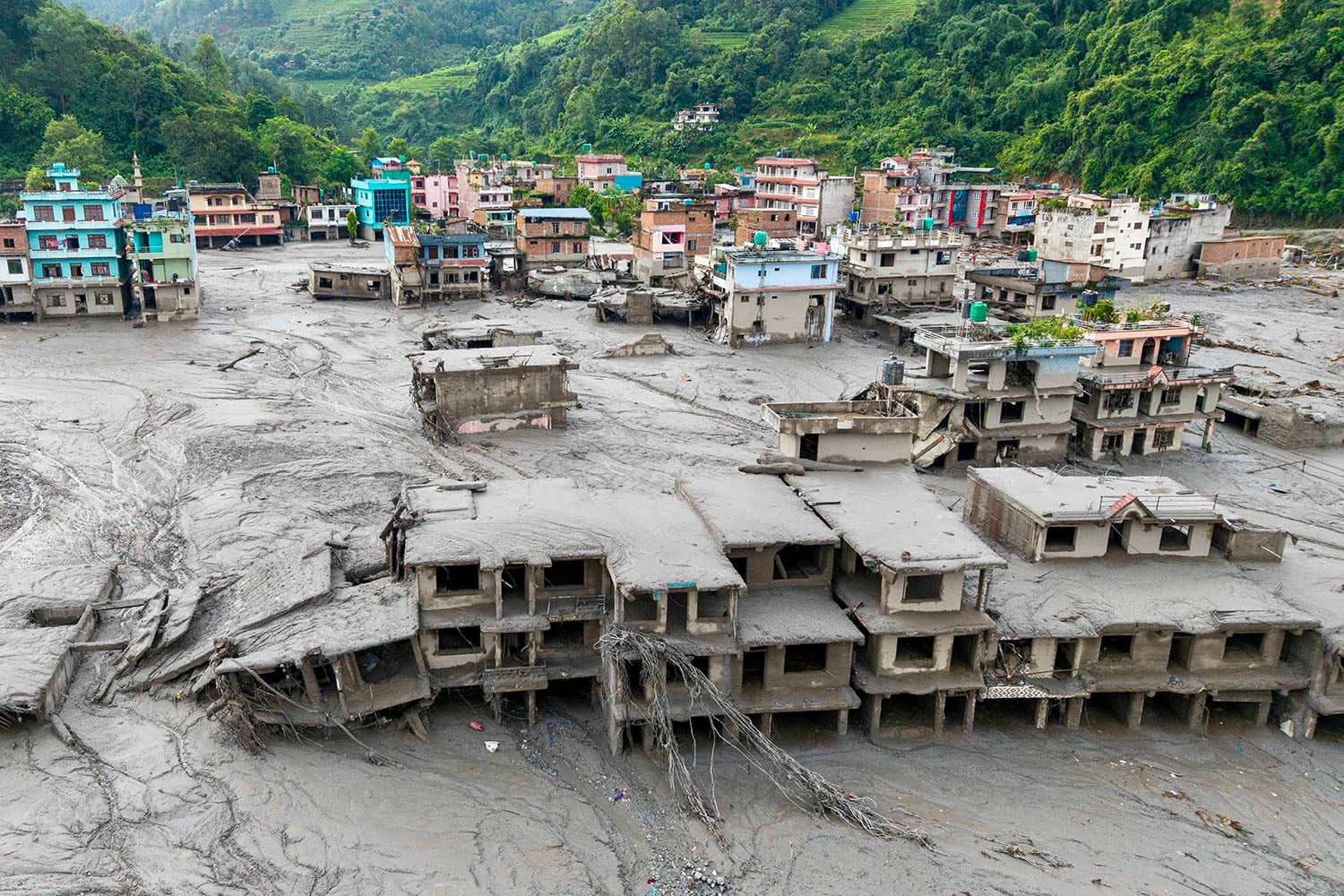
KATHMANDU—The rains had briefly quelled, and beneath a bright mid-morning sky, 43-year-old Subash Tamang was working along the banks of the monsoon-swollen Trishuli River with his family. They were extracting sand, as they had done before, when the river suddenly rose to consume them. Some 45 miles north, high in the Himalayas along the Nepal-Tibet border, a large section of a glacier had collapsed, sending a torrent of water, sediments, and boulders and swallowing downstream settlements. It took the flood barely 30 minutes to reach Tamang’s village in Nuwakot district, hitting with the terrible speed of a tsunami. Tamang survived by holding on to a patch of weed. But it swept away his wife, his two brothers and their wives, and his elder sister. The body of one of his brothers has been retrieved, while the five other family members remain missing. Tamang was ferried to Kathmandu for treatment two days later. “I’ve lost everything,” he said from a hospital bed. “We didn’t receive any warning and weren’t expecting the water to rise that high. One moment I was hanging by the weeds, and the next moment when I looked, none of my family members were there. I now have a hole in my leg and my heart.” A crowd of people standing on a muddy slope watching rescuers, with a fallen concrete pole in the midground and a rescue worker in a yellow helmet and bright orange vest in the foreground. Residents survey the damage following flash floods in Trishuli, Nepal, on Aug. 27.Ezra Acayan/Getty Images The Aug. 26 flood has obliterated parts of three districts—Rasuwa, Dhading, and Nuwakot—in north and central Nepal, but the shock has reverberated throughout the country. The death toll from the flood has climbed to more than 1,000, with nearly 4,000 people still missing, of which nearly 600 are foreign nationals, many of them pilgrims to Tibet’s Mount Kailash, revered by both Hindus and Buddhists. As quickly as disaster hit, such cataclysmic events have been decades in the making. Carbon emissions have steadily warmed the Himalayas and destabilized its glaciers. A February study shows that the temperatures in Nepal’s glacier collapse area have increased 4.7 degrees Fahrenheit since 1940, twice the average global warming rate. Low-income countries in the Hindu Kush—which stretches roughly 2,100 miles across eight countries, including Nepal—are paying a grim price for a climate crisis they did little to create. Floods and landslides have become routine and largely normalized despite significant loss of life and economic damage, but a disaster on this scale poses harder questions. “The ecosystem and landscapes have evolved over geological time, but carbon emissions are changing them so quickly that they’re adapting on a human-dominated time scale,” Simon Cook, a geoscientist and senior lecturer at Scotland’s University of Dundee, told Foreign Policy. High-angle landscape view showing severe soil erosion, steep mudbanks, and a wide river flowing through a mountain valley near a small settlement. Image 4: Back view of a person carrying a young child on their shoulder while standing in a crowd of people looking at photos posted on a closed shop shutter. Image 5: An elderly woman covered in mud sitting in the metal bucket of an excavator, being assisted by two men, one wearing an orange life jacket and another in a blue uniform. Image 6: A damaged concrete bridge ending abruptly over a wide, muddy riverbed, with a motorcyclist parked near the broken edge and onlookers standing along the sides. Image 7: Close-up of two women crying and embracing each other on a street, with one covering her face with her hand and wearing a black face mask. Image 8: Two people viewed from behind standing on a rocky riverbank, looking out over a wide, turbulent river under a dark sky with sun rays breaking through clouds. An aerial view shows a torrent of muddy water surging past houses and through the Trishuli River in the aftermath of flash floods, near the Nepal-China border in the village of Syabrubesi in Nepal’s Rasuwa district on Aug. 31. Prabin Ranabhat/AFP via Getty Images Almost a week after the event, scientists, including three Foreign Policy spoke with, have determined what caused the Aug. 26 disaster: a rock-ice avalanche. The glacial collapse and landslide occurred on the northern face of the Langtang Lirung peak—the 99th highest peak in the world—on the Nepali side bordering Tibet at around 8:37 a.m. Satellite images show that a 2,000-foot-wide mass of rock and ice fell from an elevation of 17,000 feet to around 4,000 feet in the valley below. Basanta Raj Adhikari, director at the Centre for Disaster Studies at Kathmandu’s Institute of Engineering, told Foreign Policy that his estimates show it took about nine minutes for the water and debris from the landslide to reach the Rasuwa border checkpoint, about 12.5 miles from the site of the glacier collapse. That is where waves—potentially as high as 1,500 feet in some places—crashed into the border buildings, hotels, and houses in Gyirong Port on the Chinese side and Rasuwa, crushing people running for their lives—all captured in unsettling CCTV footage. “The rock is holding the ice, and when it fell both the rock and ice mass broke off, triggering a rock-ice avalanche,” Adhikari said. “Its mass could be over 300 million cubic meters—the size of nearly 120,000 Olympic-sized swimming pools—from our estimate. The energy it created is more than the atom bomb that fell in Hiroshima.” The thud was so immense that it created a 5.2 magnitude tremor—which the U.S. Geological Survey initially believed to be a 4.4 magnitude earthquake—with the debris blocking the Lhende Khola, a tributary of the Bhote Koshi river, flowing through villages such as Timure and Syabrubesi, before merging into the Trishuli river system. When it burst, an enormous volume of water was released, roaring past the trading posts and villages, which Adhikari said could have been flowing at about 100 miles per hour downstream. Cook said the potential energy stored in the substantial block of ice gets converted into kinetic energy when it falls, with “all that material being pulverized and broken into smaller pieces of ice slush and water.” “There were possibly dead and decaying glaciers, too, downstream, which could have been pulverized into the flowing mix of ice, rock, boulders, and so on,” he said. “Some sort of snowmelt or water within the glaciers we didn’t see—it’s common for glaciers to contain pockets of water—could also have resulted in the water flow. Also, the narrow constriction created a funneling effect, resulting in huge waves enveloping buildings.” An elderly woman covered in mud sitting in the metal bucket of an excavator, being assisted by two men, one wearing an orange life jacket and another in a blue uniform. Rescuers transport a flood survivor in Devghat on Aug. 26. Prakash Mathema/AFP via Getty Images By the time the ferocious waves reached downstream districts, they had turned into a muddy slush, swallowing person after person and house after house. Bhakta Bhandari from Devighat in Nuwakot—one of the worst-hit communities—was working on his farm that morning when a neighbor sounded the alarm. He had just started running when the waves violently tossed him into the air before he landed in neck-deep muddy water, injuring his back. I visited him at a Kathmandu hospital, while his wife lay in a bed beside him with severe arm and neck wounds. One of his relatives, he suspects, is missing, with another one dead. “In all my lifetime, I’ve never seen anything like this,” he told Foreign Policy. “We didn’t even imagine the flood would be this intense. We thought it would be like the previous year. But it was like a tsunami, just like in other countries.” A damaged concrete bridge ending abruptly over a wide, muddy riverbed, with a motorcyclist parked near the broken edge and onlookers standing along the sides. A local resident rides a motorcycle on the remains of a bridge swept away by floodwaters in the Nuwakot district on Aug. 26.Sunil Pradhan/Anadolu via Getty Images Studies have shown links between climate change and extreme weather events, with a Carbon Brief analysis from March showing that 71 percent of 504 such episodes globally were “found to be made more likely or more severe by human-caused climate change.” Nepal has also been at the forefront of such events, with erratic and intense monsoon rains triggering flash floods and landslides almost every year. Last year, an outburst of a supraglacial lake on the Purugu Glacier in Tibet caused widespread devastation in the same area as last week’s disaster. In 2024, the Kathmandu Valley suffered one of the country’s most severe urban floodings ever, and the 2021 flooding of Melamchi River inundated the Melamchi Bazaar. Other mountain countries are facing similar disasters. From the 2023 glacial lake outburst flood in Sikkim, India, to the 2025 rock-ice avalanche that flattened the Swiss village of Blatten, thousands of people have been killed in such disasters, with economic losses mounting in the billions of dollars just over the past few years. Miriam Jackson, a research scientist at Norway’s hydrology department who has worked extensively in Nepal and Bhutan, told Foreign Policy that the recent incident in Nepal has similarities to the 2021 Chamoli disaster in India’s Uttarakhand state, where a hanging glacier broke off, releasing energy approximately equal to 15 times the bomb dropped on Hiroshima. She added that the powerful 2015 earthquake also destabilized mountain slopes across Nepal, increasing the risk of landslides and rockfalls. “Some 25 years ago, you barely heard about glaciers detaching, but there have [been] a few similar incidents in the past two decades,” Jackson said. “Before they were unusual, and now we’re seeing more and more of them—perhaps we’re becoming better at attributing them through satellite images and advanced technology. But these events are huge, and they come suddenly and are hard to predict.” Back view of a person carrying a young child on their shoulder while standing in a crowd of people looking at photos posted on a closed shop shutter. People view photos of bodies recovered after the floods, displayed outside Maharajgunj Medical Campus in Kathmandu, where unidentified bodies are being taken, on Aug. 29.Ezra Acayan/Getty Images On the ground, thousands of people are still waiting to hear if their relatives or friends survived. Outside Kathmandu’s Tribhuvan University Teaching Hospital, a steady stream of people stops by every day. Their desperate eyes scan the wall where photos of the dead bodies, many of them muddy and naked, are plastered. Dev Bahadur Rana has been visiting one hospital after another, hoping to trace his nephew, Dil Bahadur Magar, a police officer stationed in Rasuwa. Another man, Risan Tamang, looked away from the photos and called family with no answers. Two of his in-laws, both truck drivers, are missing. “Once the videos of the floods surfaced, we have been calling, but the phone is now switched off,” Risan said. “We haven’t been able to eat. Their mother and wives have fainted multiple times.” Close-up of two women crying and embracing each other on a street, with one covering her face with her hand and wearing a black face mask. People cry as they view photos of bodies recovered after the floods, displayed outside a medical campus in Kathmandu on Aug. 29.Ezra Acayan/Getty Images Nearby, Rabin Lama, who was checking updates on his phone, said that his niece, nephew, and brother-in-law are missing, along with 25 others from his village of Gatlang in Rasuwa. “I’m sending photos because not everyone can come to Kathmandu, so we want to send them to others with missing family members and relatives for identification,” he said. A few miles away at the National Trauma Center, people gathered at a temporary information booth set up by the Nepal Police, where Devi Sapkota came looking for his cousin Laxman’s whereabouts. Laxman worked for a Chinese road construction firm on the Syabrubesi-Rasuwagadhi road stretch along the border. The family does not even know the company’s name. “He had gone on leave three days before the flood and was coming home on Thursday (the day after the disaster),” Sapkota said. “He was going to Timure on Wednesday and taking a bus for Sindhuli. He has been out of contact since then. His wife and 5-year-old son are waiting.” Families of more than 600 people who are trapped inside the tunnels of as many as 11 hydropower stations are also waiting. They are angry and urging the government to expedite the search for people who may be buried in remote areas near the Chinese border. Nepal Army personnel have been seen navigating waist-deep muddy slush inside the tunnels, while India and Chinese tunnel rescue workers have also joined the search since Saturday. But many are already questioning the government’s initial reluctance to accept foreign help before accepting “specialized” support only on the third day. Two people viewed from behind standing on a rocky riverbank, looking out over a wide, turbulent river under a dark sky with sun rays breaking through clouds. People view the widened channel of the Trishuli River following flash floods in Devighat on Aug. 29.Ezra Acayan/Getty Images Nepal ranks sixth globally among countries most affected by climate change, according to development organization Germanwatch’s 2026 Climate Risk Index. As the intensity of such extreme weather events rises, the country is inadequately prepared to face them. Adhikari, the disaster risk reduction expert, said that Nepal has a disaster strategy, but it’s highly focused on rescue and response, calling for more investment in preparedness and risk assessment, including mapping, monitoring, and early-warning systems. “There should be risk-sensitive landscape planning that would identify suitable areas for settlements and infrastructure construction, as well as identify risk areas, which Nepal hasn’t done yet,” he said. Nepal’s foreign minister, Shisir Khanal, said during a press conference Saturday that the country is “one of the major victims of climate change and its impacts,” despite its negligible contribution to carbon emissions responsible for global warming. Amid growing calls for transboundary collaborations on an early-warning system, he said Nepal and China have been “actively working” to establish such mechanisms. “Since this disaster, we are in very close coordination, cooperation, and communication with the Chinese authority, and they have been very forthcoming with sharing information and data,” Khanal added. But climate activists and policy analysts say that narratives around disasters should go beyond devastation to address climate justice. Sneha Pandey, a climate diplomacy and policy analyst at Climate Analytics, an international climate science and policy institute, told Foreign Policy that the cost incurred by emissions from the richest nations must not overburden poor countries and communities on the front lines. She added that the Fund for responding to Loss and Damage—a global climate finance mechanism—financing “must be scaled up substantially to meet the scale of climate-imposed disasters.” “At COP31, pressure must be built at the high level to mobilize more finance for loss and damage and adaptation and resilience-building, and to reduce global emissions in line with the Paris Agreement,” Pandey said, referring to the 2026 U.N. Climate Change Conference being held in Turkey later this year. “Nepal must continue to push for dedicated negotiations space for mountain-related concerns so that cryospheric risks are more firmly anchored in the United Nations Framework Convention on Climate Change process.” Nepal has fallen, risen, and rebuilt only to be shaken again over the past decades. The end of the decade-long Maoist insurgency in 2006 brought a push for new development, which was shattered by the devastating 2015 earthquake. And as Nepal rebuilt again, the 2025 Gen Z uprising shook the country, leaving behind widespread arson, destruction, and economic losses. But just as a young government took office in March, the floods have now washed away hopes of a fresh start for many. And once again, those with the least are likely to pay the highest price. Survivors like Bhandari and Subash Tamang, who relied on marginal and climate-sensitive industries like agriculture and sand extraction, respectively, survived the floods, but they feel living with the uncertainty that comes next could be worse. “We don’t know what sort of help we’ll get from the government, and we don’t know if we are going to be displaced from our home,” Bhandari said. “We’ve lost everything. We only have a pair of clothes now. Everything is gone.” “After being discharged, I have nowhere else to go,” Tamang added. “I don’t know what to do.”
Nepal Pays the Price for Climate Change
Full Article
Original Source
Read the full article at Foreignpolicy →KhanList aggregates and links to publicly available news content. We do not host full articles from third-party sources. Always verify important information with original sources.