
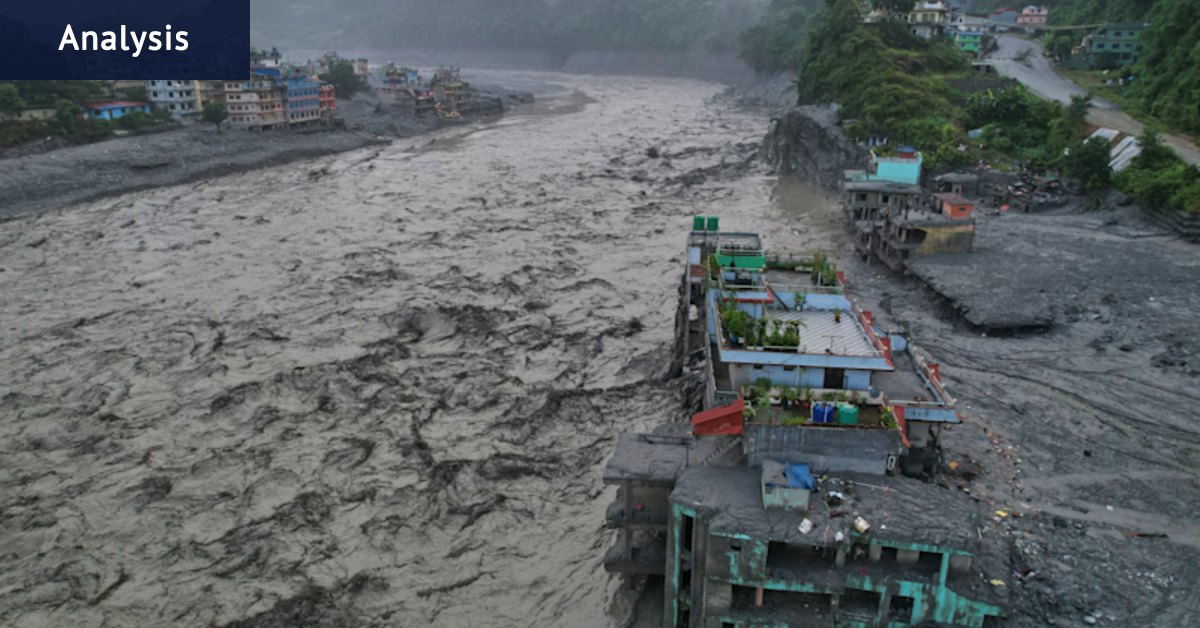
September 1, 2026 — 6:17pmWhen Anthony Albanese was asked on Tuesday whether the world shared collective responsibility for the tragedy that befell Nepal last week due to its failure to tackle climate change, he ducked fast.“Look, I think on Nepal there will be time to examine the science and what has occurred here,” he began. “My thoughts are solely focused at this point in time on the families and on the extraordinarily difficult time that we’re going through,” he said during a press conference in Palau, where he is attending a Pacific Island Forum meeting focused on regional security and climate change.The Nepali prime minister showed no such hesitation. “The flood in the Bhote Koshi River in Rasuwa was not an ordinary flood,” said Balendra Shah in a social media post late on Monday. “It was one of the region’s major disasters, triggered by an avalanche of snow and ice in the Himalayan region.”A drone view of the aftermath of flash flooding along the Trishuli River.AP Photo/Rajesh Kumar Singh“The people of Nepal are one of the major victims of the changing climate and its impact,” he said, even though they contribute less than 0.01 per cent of the carbon pollution that is causing the warming.Whatever Albanese might say, the scientific evidence is long-established. It is even long predicted. Nepal’s glaciers have lost almost a third of their volume in the past 30 years due to global warming, the United Nations reported in 2023. “The rooftops of the world are caving in,” said UN chief Antonio Guterres at the time.Anthony Albanese at the Pacific Islands Forum in Palau with Climate Change Minister Chris Bowen, left, and Defence Industries Minister Pat Conroy.AAPIn March, the International Centre for Integrated Mountain Development reported that the Hindu Kush Himalaya glaciers have been losing ice at double the historical rate since 2000.Nor are the impacts limited to those villagers who live in the valleys beneath. The region’s glaciers are known as the world’s third pole for the mass of frozen ice and snow they hold frozen on their peaks. Nearly 2 billion people across Asia rely on the annual summer melt from these glaciers to sustain agriculture and generate power.Dr Neera Shrestha Pradhan, who leads ICIMD’s water program, told this masthead in the hours after the disaster that over the coming 25 years, destabilisation from flood and landslide will increase until in around 2050 the region will hit a period of “peak water”. The shortages will follow from 2050, and are expected to lead not only to immediate human and economic suffering, but political upheaval caused by mass migration.What is also clear, not just for South Asia, but for the rest of the world, is that the impacts of climate change are already hitting hard. Now entering autumn, Western Europe has just been struck by its fifth heatwave of the season. Over 300,000 people were displaced by fire, crucial river trade has been curtailed, and nuclear power production reduced for the lack of cooling water over summer. Fires are burning more land each year in the Americas, polar sea ice is at historical lows and an intensifying El Nino is expected to drive global temperatures to yet new record highs over the coming 18 months.Temperature rises will not stabilise until emissions reach net zero, and there is no sign the world is on track to achieving that goal. On Wednesday, the United Nations Environment Program will release an updated report on the world’s progress towards holding warming to 1.5 degrees, the goal we agreed to in the Paris Treaty in 2016. The news is not expected to be good.In the face of these compounding disasters, global climate action is receding rather than accelerating. Five years after the Paris Agreement world leaders gathered again in Glasgow and reaffirmed the pact, this time with the financial sector cheering them on. In Glasgow, 450 firms controlling over $US130 trillion in assets vowed to align their businesses with net zero goals.Fast forward another five years and as climate chaos accelerates, governments are in retreat and the private sector silent. Larry Fink, the chief executive of BlackRock, the global behemoth with $US15 trillion worth of assets under management, who declared before Glasgow that “every government, company, and shareholder must confront climate change,” now speaks of what he calls “energy pragmatism”.In a destabilised world, government and business leaders are grappling with energy crises caused by Vladimir Putin’s assault on Ukraine and more recently by the US and Israel attack on Iran. Soaring energy costs are in turn fuelling political populism, which is spurring conservative politicians to abandon climate action.The rejection of net zero by Trump’s MAGA movement that seemed extreme just two years ago is now echoed around the world, not least by the Coalition and One Nation in Australia, with practical impacts. As Richie Merzian, chief executive of the Clean Energy Investor Group, explains, Australia is competing for capital to build the hardware required for a transition to clean energy, but that global capital is seeking safe harbour.“The lack of bipartisanship drives up the risk and so it drives up the cost,” he says, as do delays caused by increasing political protest against clean energy projects.Back in Palau, the compounding crises of climate change and global instability could not have been more stark. Albanese and Energy and Climate Change Minister Chris Bowen have made Australia’s vow to champion the Pacific island nations’ global warming concerns on the world stage central to the government’s foreign policy effort to keep China’s regional influence at bay.China, in turn, is thought to have been using its influence to sow discord among members of the forum.Whatever the case, none of the present, nor those who declined to attend, can negotiate away the impact of the world’s warming.Perhaps Nepal’s foreign minister, Shisir Khanal, put it during his press conference on Monday in Kathmandu.“Whatever melts in the Himalayas rises in the sea,” he said.Get to the heart of what’s happening with climate change and the environment. Sign up for our fortnightly Environment newsletter.From our partners
Nepal knows only too well the devastating dangers of climate change
Full Article
Original Source
Read the full article at Smh →KhanList aggregates and links to publicly available news content. We do not host full articles from third-party sources. Always verify important information with original sources.