
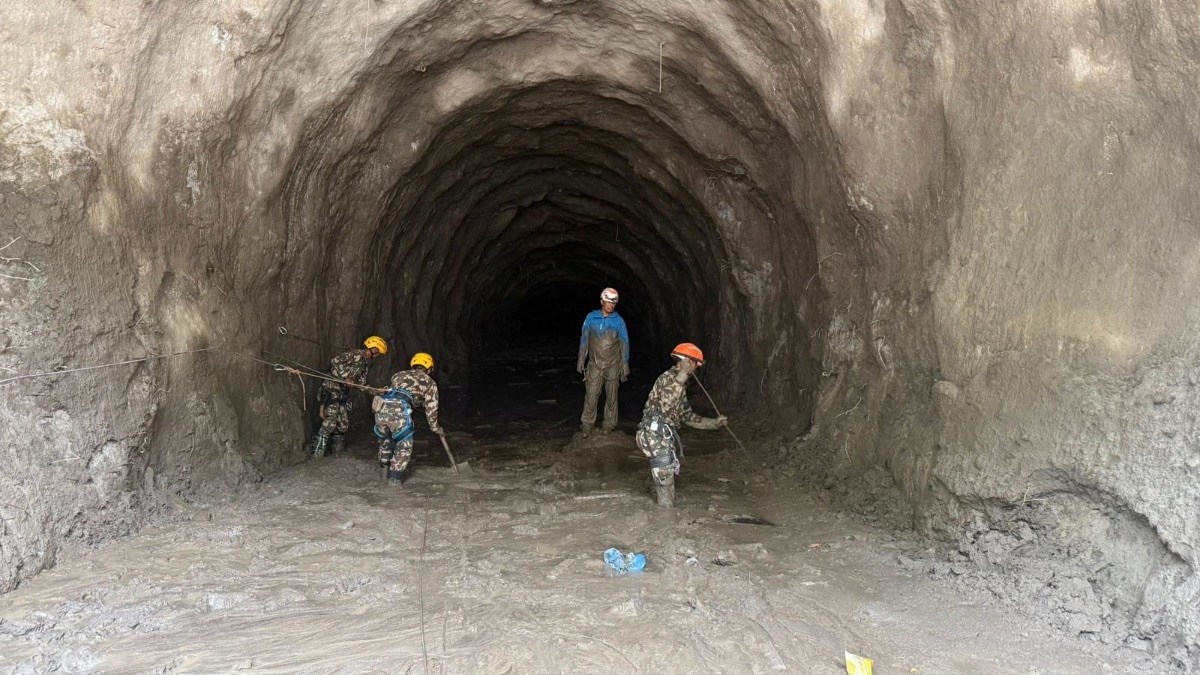
A person who survives the initial wall of water can still face several threats as the hours underground stretch on. The many stuck in Nepal's tunnels are proof of the things and situations that have to be endured to survive.Rescue personnel work at a hydropower tunnel site, after the deadly flash floods in Nepal. (Photo: Reuters)Imagine being inside a tunnel when a wall of water, mud and debris suddenly rushes in.The entrance disappears and darkness engulfs everything. You do not know how much water is coming, whether the tunnel is still stable or how long it will take for rescuers to reach you. A house stands amid debris after surviving flash floods. (Photo: Reuters) That is the nightmare confronting workers caught up in Nepal's devastating flash floods, which buried hydropower projects under mud and debris on August 26.Hundreds of workers remain missing or out of contact, with rescue teams searching tunnels and underground facilities for those who may still be alive. The situation raises a question no one would want to answer through experience: what happens to the human body when someone is trapped underground for hours or even days?It is not simply a question of oxygen. Water, temperature, injuries, air quality, dehydration and the psychological effects of prolonged confinement can all become part of the survival equation. A FLOOD AND WHAT MAY FOLLOWWhen floodwater enters a tunnel, survival can become a matter of minutes.Fast-moving water can knock people off their feet, cause serious injuries and carry rocks, machinery, mud and debris into confined spaces.Those who escape the initial surge may then find their way out blocked. A rescuer works at the entrance of a tunnel in Nepal. (Photo: Reuters) If they reach a relatively dry section, another clock begins ticking: the air.A tunnel is not automatically an airtight chamber. Its size, ventilation systems, shafts and other openings determine how quickly the air inside changes.But if a section becomes sealed or poorly ventilated, people continue consuming oxygen and releasing carbon dioxide with every breath.As oxygen falls and carbon dioxide accumulates, people can develop headaches, dizziness, confusion and breathing difficulties.Severe oxygen deprivation or carbon-dioxide poisoning can eventually cause unconsciousness and death.There is, however, no universal oxygen countdown. An aerial view shows buildings and a car damaged after the flash floods. (Photo: Reuters) A large tunnel with air circulation could remain breathable far longer than a small, sealed chamber containing several people.WHEN WATER MEETS DEHYDRATIONOnce the immediate danger passes, water can become one of the biggest threats to survival.The body can survive without food for considerably longer than it can without adequate water.Dehydration affects blood circulation, temperature regulation and brain function, eventually causing weakness, confusion and potentially organ failure.Floodwater, meanwhile, may contain mud, sewage, chemicals, fuel and microorganisms, making it unsafe to drink.A trapped worker could therefore be surrounded by water and still be desperately thirsty.That is why, during prolonged tunnel rescues, getting clean drinking water and other essential supplies to survivors can be nearly as important as creating an escape route. Nepali soldiers conduct an operation inside a tunnel to rescue workers after flash floods. (Photo: AFP) SURROUNDED BY COLD AND DARKFlooding can leave people soaked, while underground environments may remain cold for long periods. If the body loses heat faster than it can produce it, hypothermia can develop.Shivering, exhaustion, confusion and poor coordination can progress to increasingly serious problems as core body temperature falls.India has seen this danger before. During the 2021 Uttarakhand flash floods, workers trapped inside the Tapovan hydropower tunnel spent hours underground in cold, wet conditions. Several were eventually rescued suffering from hypothermia.Then there is the mind.Darkness, isolation and uncertainty can trigger intense fear and panic.Rapid breathing and physical exertion also consume more energy, making it important for survivors to conserve strength and remain as calm as possible. A screengrab shows Nepali soldiers conducting an operation inside a tunnel. (Photo: AFP) WHY RESCUE TAKES TIMEFinding people underground is only half the challenge. Reaching them safely can be even harder.Rescuers must establish where survivors could be, whether the tunnel remains structurally stable and whether removing a blockage could trigger another collapse or allow more water to rush in.They may also need to create a route for fresh air, drinking water, communication equipment and eventually the survivors themselves.That is why there is no single answer to how long someone can survive inside a tunnel. A Nepal army official during a rescue operation for the people trapped inside a tunnel. (Photo: PTI) For one person, the critical threat could be drowning; for another, a lack of breathable air. Someone else could succumb first to dehydration, hypothermia or serious injuries.Inside a flooded tunnel, survival is not governed by one ticking clock. Several clocks may be running at once, and rescuers are racing against all of them.- EndsPublished On: Sep 1, 2026 13:00 IST
Nepal floods: How does the body and brain react when trapped inside a tunnel?
Full Article
Original Source
Read the full article at Indiatoday →KhanList aggregates and links to publicly available news content. We do not host full articles from third-party sources. Always verify important information with original sources.