
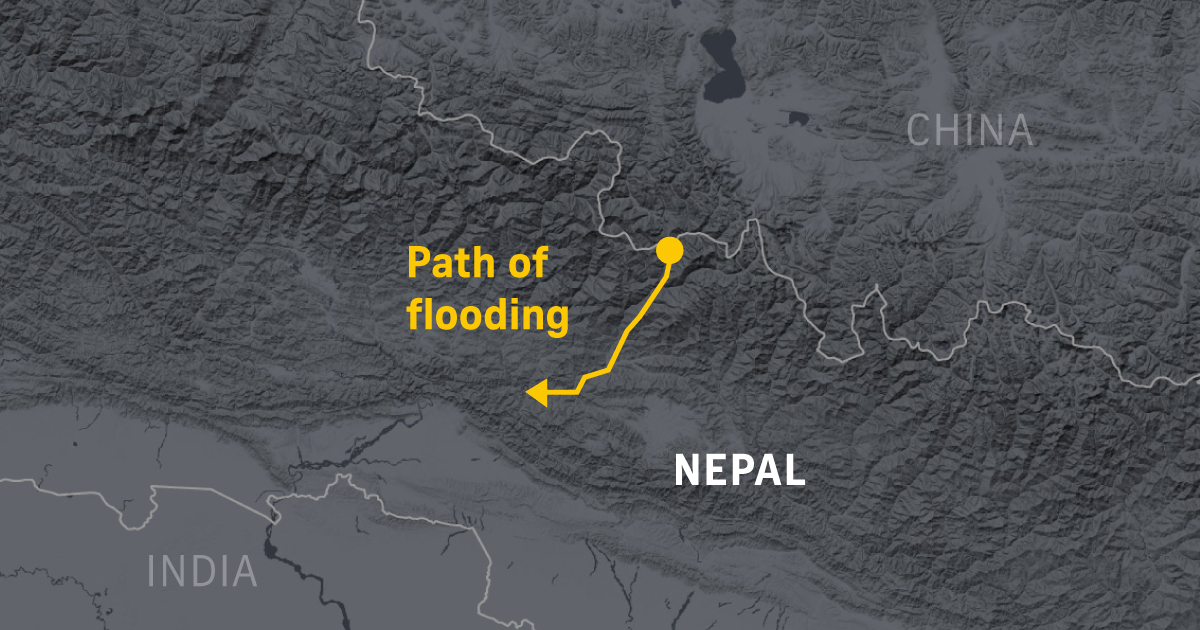
More than 1,500 people are missing following a flash flood that started on the border between Nepal and Tibet on Aug 26. At least 350 people were killed after a devastating flash flood on Aug 26 on the border between Nepal and Tibet. The flood destroyed buildings and structures, sweeping away entire villages.Official figures suggested that more than 1,500 people, including at least 800 foreigners, were among the missing.Nine Singaporeans were also reported missing as at noon on Aug 27.The flooding started on the border of Nepal and Tibet.A map showing where the flood happened on the border of Nepal and Tibet. According to an official situation update posted on the Nepal Tourism Board’s website on Aug 27, a preliminary record from trekking and travel companies identified 644 travellers reported missing from affected areas.“The information is being verified and cross-checked with travel agencies, guides, local authorities and security agencies,” the statement said.The board added that the local authorities are working to verify the whereabouts and safety status of the missing tourists.“All efforts are under way to rescue/evacuate the injured and stranded people,” it said. Flood was caused by a glacial collapseThe deadly flash flood may have been triggered when the lower part of a glacier broke off and crashed onto the valley floor hundreds of metres below, experts said, citing satellite imagery from Planet Labs. The phenomenon is known as an ice avalanche.The flood affected many areas, including several places downstream of the Bhote Koshi river.A map showing the areas affected by the Nepal flood. Source: Google Earth The reason for the collapse was previously reported as a magnitude-4.4 earthquake, but the US Geological Survey (USGS) confirmed that it was instead a “glacial collapse and debris flow” that “caused subsequent catastrophic impact downstream”.“Additional analysis of nearby seismic stations, long-period seismic waves and satellite imagery led to the determination that the seismic event was instead a glacial collapse and debris flow, and that no earthquake had occurred,” the USGS said on the morning of Aug 27.Satellite imagery shows the glacier before and after it collapsedTwo satellite images that show the area on the Nepal-Tibet border where the glacier collapsed. One shows before the collapse and one shows after the collapse. The glacier was located near Lantang Lirung. Source: Reuters Climate change is causing glaciers to melt worldwide, increasing the risks of glacial lake floods and glacial collapses.The International Centre for Integrated Mountain Development (ICIMOD) released a detailed assessment on Aug 26, which warns that debris temporarily washed into the river systems can create a secondary potential flooding event.Satellite images from Planet Labs show rivers in the affected areas widening because of the flood damage.A map showing the area of Syabur Bensi, which is one of the places affected by the Nepal flood. A map showing the area of Khadga Bhanjyang, which is one of the places affected by the Nepal flood. Source: Planet Labs The experts cited in the ICIMOD report are assessing whether narrow sections of the Trishuli River have been temporarily blocked. If so, the blockage could create a landslide dam, potentially triggering a second flooding event.“With a blockage still lodged upstream on the Nepal-China border river, the authorities warn a second flood may occur,” said Qianggong Zhang, head of climate and environmental risks at the Kathmandu-based ICIMOD. Search and rescue efforts are under way for more than 1,000 missing peopleRescuers waded through mud and sludge to look for survivors after flood waters buried the lower floors of multi-storey buildings.Many of the missing are foreign tourists, officials said.Singapore’s Ministry of Foreign Affairs (MFA) is in touch with the Nepali and Chinese authorities to provide consular assistance to affected Singaporeans in the deadly Nepal flash flood, Prime Minister Lawrence Wong said in a Facebook post on Aug 27.MFA is also in touch with the affected Singaporeans’ next of kin, PM Wong said, adding that he was deeply saddened by the loss of lives and devastation caused by the floods.“My deepest condolences to the families who have lost loved ones, and to all those affected by this tragedy,” he said.“Our thoughts are with the people of Nepal and China during this difficult time, and with the authorities and emergency personnel working tirelessly on rescue and recovery efforts. We hope for the safe return of those still missing.”
Nepal flood: What we know so far
Full Article
Original Source
Read the full article at Straitstimes →KhanList aggregates and links to publicly available news content. We do not host full articles from third-party sources. Always verify important information with original sources.