
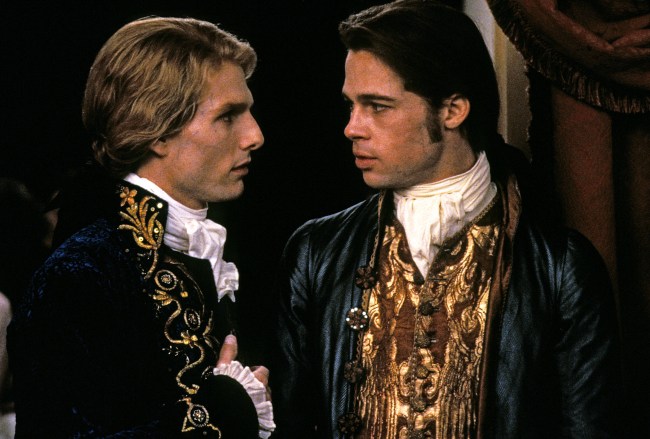
When Neil Jordan made “We’re No Angels” for a Hollywood studio in the late 1980s, he found he had to deal with far more interference than he had on earlier films like “Mona Lisa” and “The Company of Wolves.” Jordan assumed that was simply the price of doing business in Hollywood and wasn’t sure if it was for him, but when producer David Geffen offered Jordan “Interview with the Vampire” after the success of “The Crying Game” had made Jordan a hot commodity, the director decided to take a chance. “I said, ‘Look, I’ll make this movie if you set it up so I can make it the way I make independent movies,” Jordan told IndieWire. Jordan was eager to adapt Anne Rice’s novel about vampires (played by Tom Cruise and Brad Pitt in the movie) and its dysfunctional homoerotic relationship, so he was happy when Geffen made it possible for him to operate with full creative freedom. “He had an arrangement with Warner Bros. where he was strong enough to enable me to do that.” Jordan was attracted to “Interview with the Vampire” because he was “looking to live in the same world as when I made ‘Company of Wolves.’ I love the fantasy landscape, and the great thing about the horror genre is that you can create imaginary worlds.” For “Interview,” which followed vampires Lestat (Cruise) and Louis (Pitt) over around 200 years, Jordan luxuriated in creating detailed New Orleans, London, and Paris milieus that became both sensual and haunting in the director’s hands. For collaborators like production designer Dante Ferretti and cinematographer Philippe Rousselot, Jordan had a clear directive. “We just wanted to turn the whole world into a tomb,” Jordan said, explaining that the decision to shoot the entire film at night, while hard on the actors, allowed him to impose a precision on the style that he really enjoyed. “The minute you make the decision to shoot everything at night, you’re in a happy place, because every element that goes into the frame can be decided by you. Every piece of light that hits something can be part of that choice — it’s why I love fantasy movies.” Shooting nights and on studio sets also helped keep the paparazzi away, a necessity given the furor that arose over Tom Cruise’s casting as Lestat. Die-hard fans of Rice’s book were not pleased, especially when Rice herself criticized the casting (she changed her tune once she saw the finished film). Jordan said he and the actors just tried to put a bubble around them and get on with the work, as Jordan rolled the dice and assumed that Cruise’s “eerie sense of control” would work for Lestat. An even trickier casting was Kirsten Dunst as Claudia, a young girl Lestat turns into a vampire to get Louis to stay with him. “If you work with a kid, it can mess them up forever, because fame is a tricky thing,” Jordan said. “But it was immediately obvious to me with Kirsten that she was an actress, and that she’d be doing this for the rest of her life. I didn’t have the same qualms that you normally have casting a child, and she’s gone on to do great stuff. I just rewatched ‘Melancholia’ last night, in fact, and went, ‘Whoa.’ Lars Von Trier saw in her the same thing I did, that sense of intelligence and sadness at the same time.” ‘Interview with the Vampire’©Warner Bros/Courtesy Everett Collection Viewed today, the sensuality and homoeroticism that permeate the movie are even more impressive and compelling than they were when “Interview with the Vampire” came out in 1994; it’s hard to imagine movie stars of Cruise, Pitt, and Antonio Banderas’ stature now making such a film within the studio system. Jordan says the actors were all more than game, however, with zero trepidation. “They had read the book, and Antonio had worked with Almodóvar and played the object of desire for many lustful men. Brad had played the object of desire for a bunch of lustful women. And Tom is Tom. He exists in his own universe.” Looking back, however, Jordan knows how special it was to make such a personal, idiosyncratic film for a major studio with big stars, especially since the story — in which the vampires were the protagonists — made it hard to generate conventional suspense or jump scares. “The biggest challenge was satisfying the demands of a big studio movie with quite complicated material,” Jordan said. “It’s about a kind of gay relationship where one man creates a child vampire so another man won’t leave him. That’s eccentric shit for a studio, isn’t it?” “Interview with the Vampire” is now available in a new 4K UHD edition from Warner Home Video.
Neil Jordan on Making His Homoerotic ‘Interview with the Vampire’ for a Major Studio with A-List Stars
Full Article
Original Source
Read the full article at Indiewire →KhanList aggregates and links to publicly available news content. We do not host full articles from third-party sources. Always verify important information with original sources.