
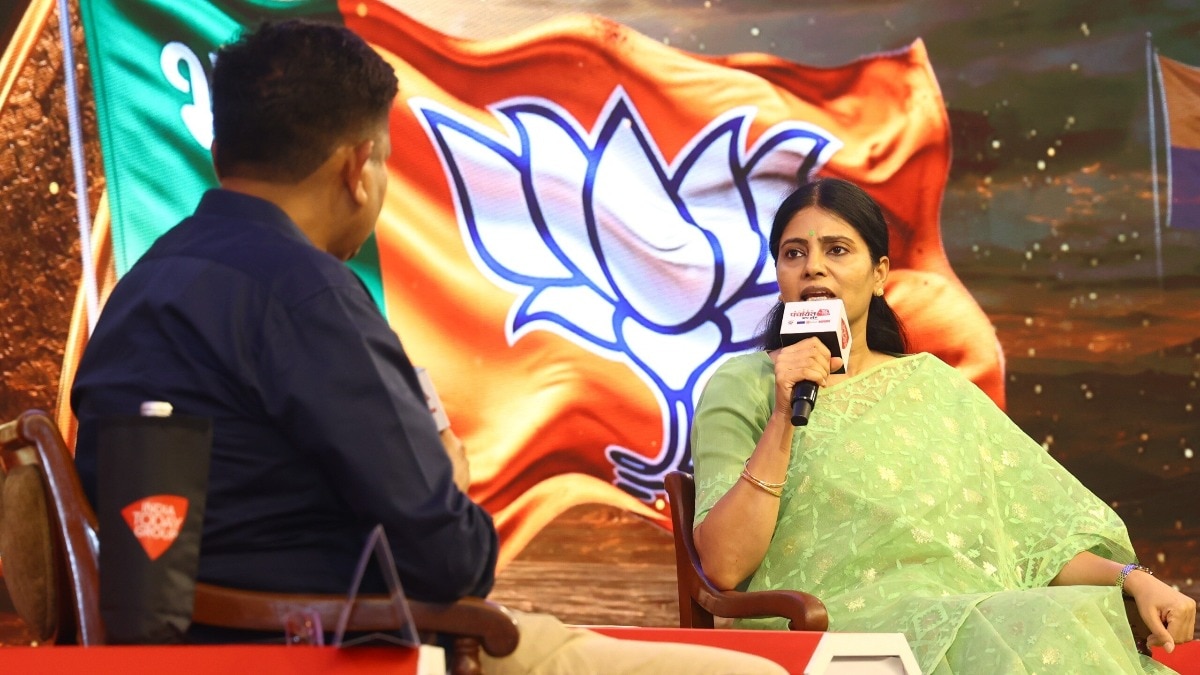
The Union minister said population growth and parliamentary representation had to be addressed together as the government works towards operationalising the Women's Reservation Act.Union Minister Anupriya Patel. (Photo-ITG)Union Minister Anupriya Patel on Saturday said the implementation of the 33 per cent women's reservation in Parliament must go hand in hand with an increase in the number of Lok Sabha seats, arguing that the existing strength of 543 does not provide enough room to accommodate the quota without displacing sitting male MPs.Speaking to India Today TV’s Marya Shakil at the India Today Women Summit 2026, the Minister of State (MoS) Health and Family Welfare said population growth and parliamentary representation had to be addressed together as the government works towards operationalising the Women's Reservation Act."Implementing the Women’s Reservation Bill is not just implementing it for the sake of it. We need to increase the number of seats in Parliament to accommodate 33 percent quota," Patel said.She acknowledged that the proposal has triggered apprehension among male MPs across parties, as some existing constituencies could be affected. "Lots of seats held by male MPs will go away. Their heart is pumping fast, across parties, that is the sentiment,” she said, adding that the number of seats should rise in line with the population.Patel, who is also MoS for Chemicals and Fertilisers, also argued that political parties themselves could do more to increase women's representation. "Who's stopping them from giving more tickets to women?” she asked, saying reluctance to field women candidates often stems from the perception that they are not "winning candidates". She said such hesitation was one reason the country needed a constitutional reservation in the first place.The Union minister’s remarks come amid the Centre’s efforts to fast-track the constitutional changes needed to operationalise the Nari Shakti Vandan Adhiniyam, which envisages 33 per cent reservation for women in the Lok Sabha and state assemblies.The proposed changes are closely linked to delimitation and the number of parliamentary seats, making the question of representation a politically sensitive issue.On women's economic participation, Patel said the government had moved from a women-centric approach to a broader “women-led development” model."This is a government which has shifted the focus from women-centric development to women-led development," she said, describing it as an approach encompassing the social, economic and political spheres.She cited initiatives including Jan Dhan Yojana, self-help groups and programmes such as Lakhpati Didi, Namo Drone Didi, Krishi Sakhi and Pashu Sakhi. She also mentioned Womania on the Government e-Marketplace, She-Marts, Mudra, Startup India, Stand-Up India and Sonavi. Infrastructure initiatives such as the Jal Jeevan Mission, household toilets and LPG connections, she said, have also freed up women's time for economic activity.Patel said the growing political influence of women was now evident in elections, with parties increasingly recognising women as an important electoral constituency.She also defended the government's response to the concerns raised by younger voters during recent Gen Z protests, saying democratic governments must listen when citizens express dissatisfaction."People should have a voice," Patel said, adding that the government had sought to address concerns through amendments and stricter provisions.On paper leaks and youth grievances, she said the problem was not confined to one government or political party and called for a national effort to tackle the nexus.Asked about Gen Alpha protests as well, Patel urged against politicising the issue. "We need to fix children’s concerns irrespective of parties and government or states," she said.The Apna Dal chief also spoke about the challenges of being a woman in politics."It brings additional challenges, acceptance is a challenge, you need to prove your worth, you don’t get a chance easily," she said, recalling how she had to establish her political credentials after entering politics following her father’s death.On the Women's Reservation Bill, Patel’s central argument was therefore twofold – women need greater representation, but Parliament’s overall capacity must also expand to reflect India’s population.With the government pushing for faster implementation and delimitation remaining a contentious issue, the debate over how and when the 33 per cent quota becomes operational is likely to remain a major political flashpoint.- EndsPublished On: Aug 22, 2026 20:43 IST
Need more seats in Parliament as per population: Anupriya Patel on women's quota
Full Article
Original Source
Read the full article at Indiatoday →KhanList aggregates and links to publicly available news content. We do not host full articles from third-party sources. Always verify important information with original sources.