
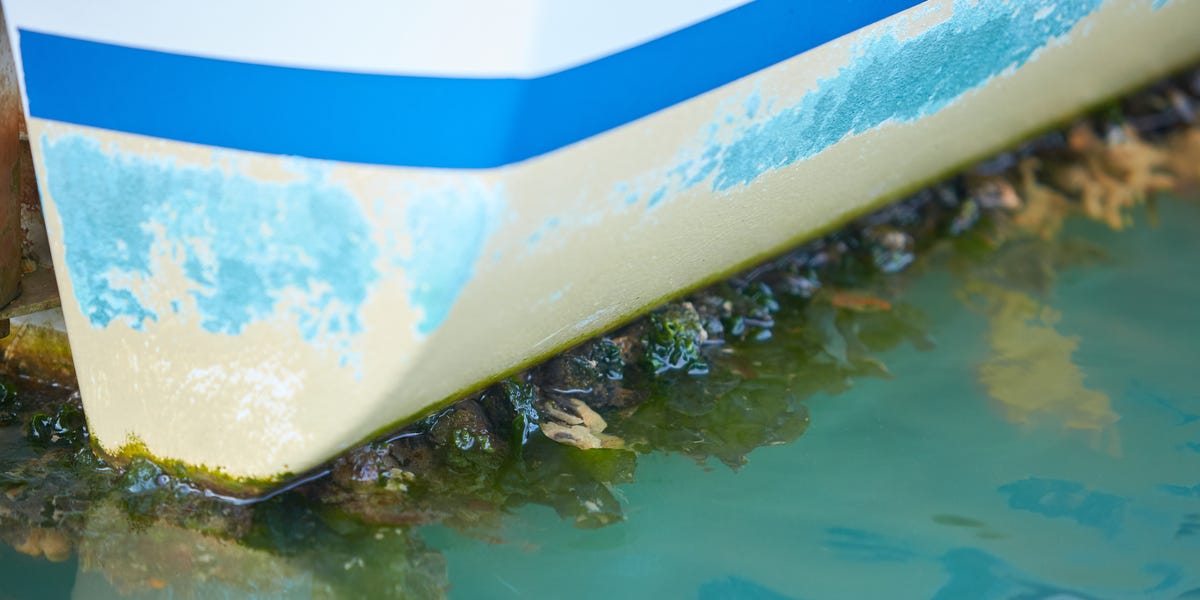
3 min readHere’s what you’ll learn when you read this story:Around 1,500 ships have been stuck in the Strait of Hormuz since it was shut down in February, and they’re accumulating biomasses of marine organisms despite protective anti-biofilm coatings. Once the ships resume traveling, they risk spreading those organisms through other ocean regions, where they could become invasive species. Properly cleaning hulls in water, gauging levels of biofouling, predicting routes, and early detection of possibly invasive (and even parasitic) species may prevent mass breakouts.As strife in the Middle East persists with no end in sight, the potential for another battle is festering underwater. Around 1,500 ships have been stalled in the Strait of Hormuz since it was shut down indefinitely on February 28, 2026, and hundreds more remain stranded in the Persian Gulf. Those stagnant waters are breeding grounds for biofilms and other organisms, and when those ships are eventually released, they could spread invasive species throughout Earth’s oceans.Biofouling may result in a massive marine super-spreader event if preventative measures prove inadequate. Algae, microbes, and invertebrates (such as barnacles and mussels) spawn remarkably fast, colonizing the submerged sides and bottoms of ships after only ten days. They can even take over surfaces that have been pretreated with antifouling coatings, which can begin to degrade after being exposed for long periods to ocean water and the organisms swarming in it.An international team of marine researchers, led by the University of Maryland Center for Environmental Science (UMCES), has recently sounded the alarm about commercial vessels hauling unwanted cargo with them. “Ships in the Gulf region had remained idle there for at least 40 times longer than an average stay,” the researchers wrote in a study published in Biological Invasions. “The routine presence of a considerable number of very large ships […] from around the world amplifies their exposure to diverse biofouling communities.”This exposure could turn into a biological apocalypse. Endemic organisms in the shallow and hypersaline Persian Gulf have evolved to tolerate not only industrial and urban stresses, but surface temperatures of over 100 °F (38 °C). Those adaptations make them more likely to survive the grueling conditions of transport and colonize other parts of the planet.Most biofouling culprits depend on reproduction to spread, and higher temperatures create ideal breeding grounds, which is why ships that have continued stalling in the Gulf through the spring and summer of 2026 are prone to accumulating dense colonies of invasive species. Millions, if not billions, of larvae might have been released by organisms such as Amphibalanus improvisus, a prolific barnacle that thrives in waters at around 86 °F (30 °C). Larvae that hatch into the water eventually find a surface they can cling to in order to mature and produce more offspring. With close to two thousand ships unable to move, it doesn’t take long to find a suitable hull. And on top of all that, some species notorious for biofouling can also become parasitic to native species, which can then cause outbreaks of disease that threaten many host species and (depending on the parasite) could possibly infect humans.When disturbances in industrial ports like those of the Persian Gulf decrease the chances of survival for native organisms, it gives opportunists a chance to invade, become established, and deplete resources. In-water cleaning of hulls and other niche areas on ships is one solution, but some stubborn invasive species—along with microplastics and biocides for protective films—may not be eliminated unless debris is properly disposed of.Researchers suggest gauging levels of biofouling on ships before they depart, forecasting their routes (and any other ports where they may be temporarily idle), emphasizing early detection, and putting fast-response plans into action at ports already swarming with invasive species. While detecting underwater levels of biofouling is ideal, sampling parts of the ship at the water’s surface can still be informative enough to guide effective action. And knowing which routes are experiencing increased levels of traffic from problem zones can help mitigate the inevitable bioinvasions. Ports at highest risk should monitor levels of invasive species before they spiral out of control.“The prolonged mass lay-up of vessels in the Gulf region, together with conditions favorable for biofouling development, represents a significant risk factor,” said the researchers. “Whether it becomes a global bioinvasion super-spreader event will now depend less on the biofouling communities already present on vessels than on the speed, coordination, and effectiveness of the responses that follow.”Elizabeth Rayne is a creature who writes. Her work has appeared in Popular Mechanics, Ars Technica, SYFY WIRE, Space.com, Live Science, Den of Geek, Forbidden Futures and Collective Tales. She lurks right outside New York City with her parrot, Lestat. When not writing, she can be found drawing, playing the piano or shapeshifting.
Nearly 1,500 Ships Are Stuck in the Strait of Hormuz—And Something Dangerous Is Growing on Them
Full Article
Original Source
Read the full article at Popularmechanics →KhanList aggregates and links to publicly available news content. We do not host full articles from third-party sources. Always verify important information with original sources.