
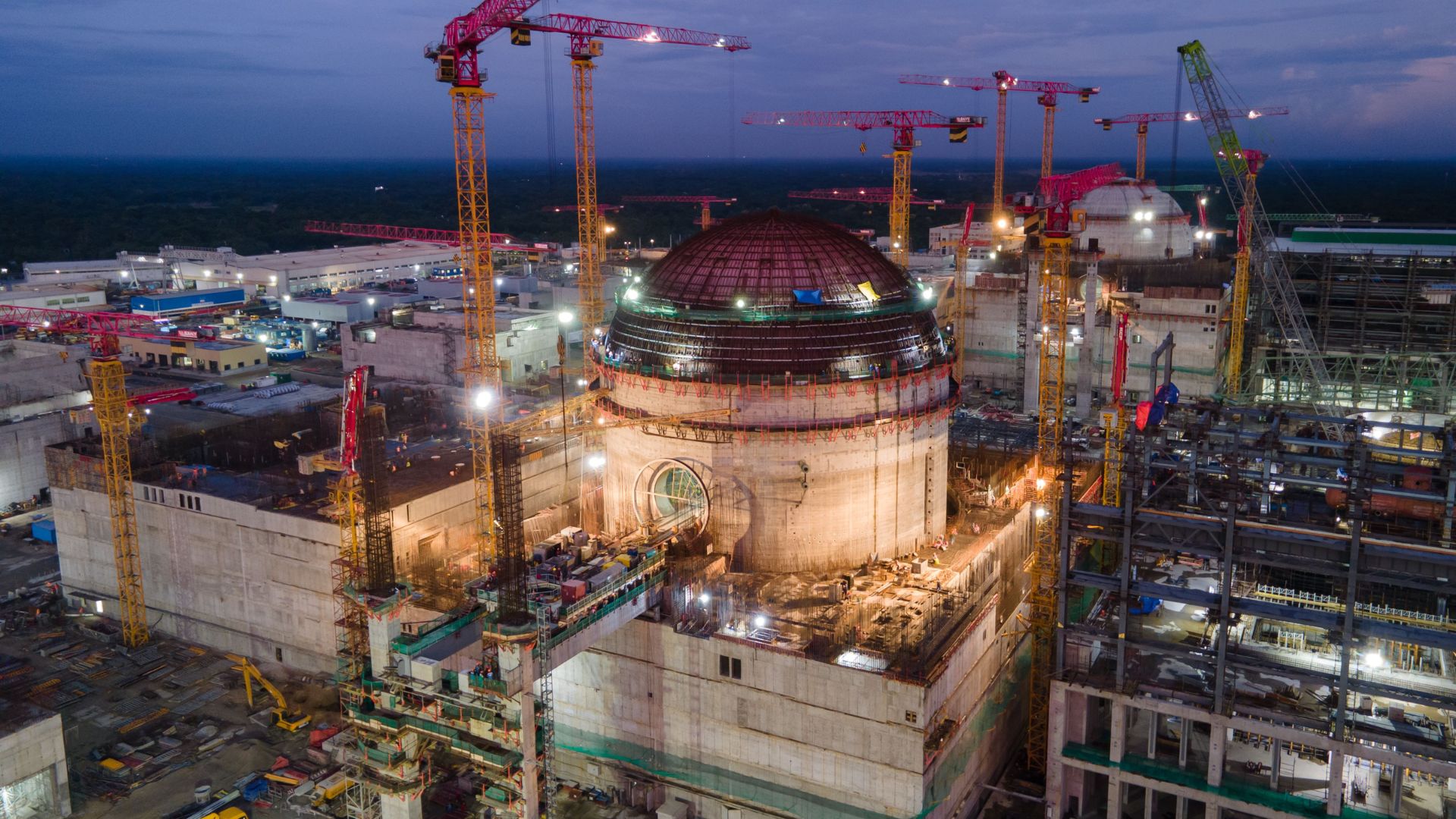
The International Atomic Energy Agency (IAEA) has increased its long-term nuclear power forecast for the sixth year in a row. In its latest projections, shared at the 70th General Conference in Vienna, the agency says global nuclear capacity could reach 1,284 GWe by 2060 if the most optimistic scenario plays out. This growth could involve building hundreds of small modular reactors (SMRs). The report, Energy, Electricity and Nuclear Power Estimates for the Period up to 2060, is the first time the IAEA has projected nuclear capacity out to 2060. In the high-case scenario, global nuclear capacity would be 3.4 times higher than it was at the end of 2025. Nuclear capacity set for long-term growth By the end of 2025, there were 413 nuclear reactors running around the world, generating 377.1 GWe of electricity. The IAEA now predicts that capacity could reach 1,045 GWe by 2050 in its high-case scenario, which is higher than its previous estimate of 992 GWe. By 2060, nuclear capacity could rise to 1,284 GWe. The low-case scenario is more cautious, predicting 641 GWe by 2050 and 696 GWe by 2060. Previously, the low-case forecast for 2050 was 561 GWe. These projections consider current reactors, possible license renewals, planned shutdowns, and construction projects that are likely in the next few decades. The high-case scenario assumes countries will make bigger commitments to nuclear energy, while the low-case scenario expects current trends to continue with few policy changes. “The IAEA projections show the increasing role of nuclear power in meeting the world’s growing electricity needs. To realize this potential, investment in new nuclear capacity and reactor lifetime extensions will be essential,” stated IAEA Director General Rafael Mariano Grossi. SMRs could add hundreds of reactors SMRs are expected to play a big role in this growth. The IAEA defines an SMR as a reactor with up to 300 MWe of capacity, and there are currently more than 100 designs in development. In the high-case scenario, SMRs could make up 28 percent of the 1,017 GWe of new nuclear capacity added by 2060, or about 284 GWe. If each SMR averages 300 MWe, that would mean about 946 reactors. If the average is 250 MWe, it would be around 1,136 reactors. SMRs could also play a big role in certain regions. In North America, about 60% of new nuclear capacity could come from SMRs. The IAEA expects a 40 percent share in both South-Eastern Asia and Latin America and the Caribbean. Older reactors remain important Extending the life of current reactors will also affect future capacity. Under the high case, about 70 percent of today’s operating nuclear capacity could remain online in 2060. The low case assumes almost two-thirds of current reactors are expected to retire. The IAEA says that “a lifetime extension for an existing reactor, if it is viable, is one of the most cost-effective baseload low-emission electricity sources and is of particular importance for regions with aging nuclear fleets.” Financing is another key factor. The agency notes that since energy crises began in 2022, concerns about energy security and interest in more diverse electricity sources have shifted focus to nuclear power. Global nuclear electricity generation went up by 1 percent in 2025 compared to 2024. But since total global electricity generation grew by 2.7 percent, nuclear’s share dropped from 8.7 percent to 8.4 percent. The IAEA said, “The upward revision of the projections reflects growing recognition of the role that nuclear power can play in supporting energy security and long-term economic growth. There has been renewed engagement with nuclear power by international financial institutions, such as the World Bank Group and the Asian Development Bank, signaling a broader shift that other international financial institutions have begun to follow. “Energy security and affordability concerns intensified following successive energy crises since 2022. Disruptions to oil and gas flows have major implications for both energy security and global energy markets. In response, interest in diversified electricity generation has grown, including interest in nuclear power.” The World Nuclear Association is even more optimistic, estimating that global nuclear capacity could reach 1,457 GWe by 2050 if countries meet their targets and current reactors keep running. Get the latest in engineering, tech, space & science - delivered daily to your inbox.A versatile writer, Sujita has worked with Mashable Middle East and News Daily 24. When she isn't writing, you can find her glued to the latest web series and movies.
Nearly 1,000 small nuclear reactors could exist by 2060, output to top 1,284 GWe: IAEA
Full Article
Original Source
Read the full article at Interestingengineering →KhanList aggregates and links to publicly available news content. We do not host full articles from third-party sources. Always verify important information with original sources.