
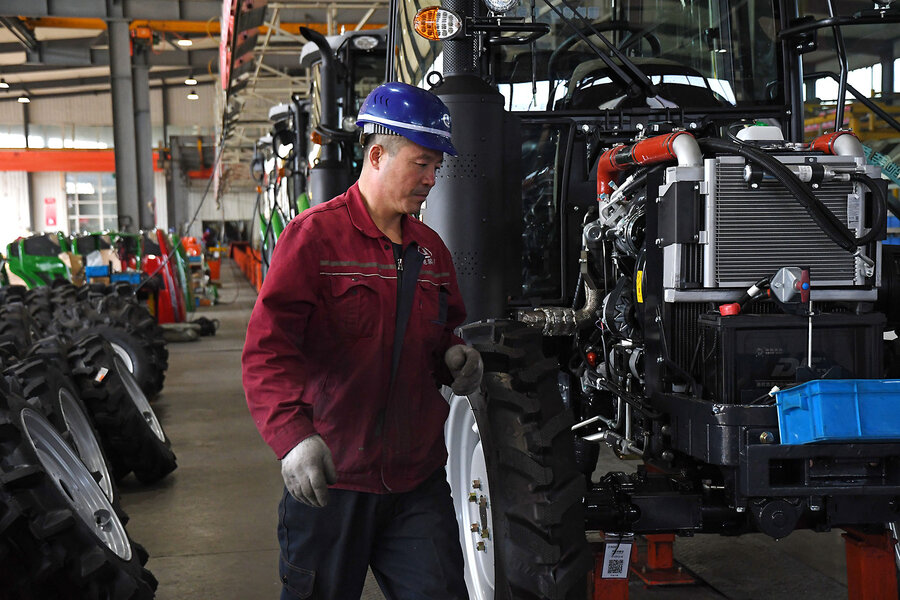
Jiamusi, China | Nov. 12, 2026, 3:02 p.m. ET | 3 min read Chinese workers in hard hats put finishing touches on shiny red and green tractors rolling down the assembly line at Jiamusi Jichi Tractor Manufacturing Co. Many are destined for big commercial grain farms here in China’s breadbasket.But since 2022, the tractor maker has opened up a new market.“Russia is our largest customer abroad,” says Yang Haiyan, the factory’s sales director. That’s true for many businesses across China’s northernmost province of Heilongjiang, which shares a 1,850-mile-long border with Russia, and has similar terrain and farmland.From 2021 to 2025, as ties between the two countries deepened, the province’s exports to Russia more than tripled, and imports rose by about 60%. This year, trade has already surged nearly 12%, according to Li Jigang, director of the provincial commerce department. Ann Scott Tyson/The Christian Science MonitorYang Haiyan, sales director at the Jiamusi Jichi Tractor Manufacturing Co. in China's Heilongjiang Province, says the company's largest customer abroad is Russia. New roads, rail crossings, bridges, and energy pipelines have fueled the rise in commerce. In 2022, shortly after Chinese leader Xi Jinping and Russian President Vladimir Putin declared a “no limits” partnership, Moscow launched its full-scale invasion of Ukraine, triggering Western sanctions. Since then, the Kremlin has relied more heavily on trade with China, especially as a market for oil and gas exports. In Heilongjiang, the bulk of its trade is imports from Russia.Heilongjiang’s frontier towns are key entry points for crude oil, gas, as well as logs and timber that flow into the rest of China. In the border city of Heihe, across the river from the Russian metropolis of Blagoveshchensk, a huge network of twisting pipes marks the beginning of China’s section of a cross-border gas pipeline. Fully connected in 2024, the 8,000-kilometer pipeline transports natural gas from Siberia through the province, as far south as Shanghai.Agricultural goods are another major, growing import from Russia.In Heihe’s pilot free-trade zone, mountains of golden Russian soybeans are inspected before processing. Heihe is boosting trade as well as local incomes by allowing each Chinese resident living in border areas to import 8,000 yuan (about $1,200) worth of goods from Russia per day tax-free. Ann Scott Tyson/The Christian Science MonitorChinese shoppers visit a Russian products store in Harbin, capital of China’s northeastern province of Heilongjiang. Russian imported goods such as dolls, chocolate, honey and snacks are popular in the province. Companies pay the residents to use their quotas to obtain the cheaper, tax-free soybean imports, then process the soybeans for sale.Heihe officials are seeking to expand this trade program to include frozen chicken feet from Russia, according to a report in the state-run China Daily newspaper.Suifenhe, another border town in eastern Heilongjiang, has opened an expedited trucking route to Moscow and streamlined the cross-border flow of goods. Kang Haopeng, the mayor, told the official Xinhua News Agency that inspections and customs clearance now take just 30 seconds, down from 10 minutes a few years ago. Across Heilongjiang, residents also welcome stores specializing in Russian goods such as traditional nesting dolls, sweets, cookies, and clothing.At Lin Linqi, a convenience store in the provincial capital of Harbin, the Russian toys sell really well – but the chocolate is the crowd favorite.“We really like [Russian] chocolate,” says Zhao Qi, an entrepreneur in Harbin. Growing up in a border town near the Suifen River, she could glimpse Russia on the other side of the water. Now, when family members visit nearby Vladivostok, they often bring back crabs and fish. Deepen your worldviewwith Monitor Highlights.Politics with respectGet political stories with respectful analysis.There‘s a world of new ideas in everyBooks newsletter.There‘s more to life, enrich yours withCulture & Learning weekly.Follow humanity‘s discoveries withScience & Nature stories in your inbox.Gain a spiritual perspectivefrom the stories in your inbox.Want to understand the deeper impact of critical events? Learn the Monitor‘s insight.Already a subscriber? Log in to hide ads. “Canned beef is quite popular,” too, she adds.As for Ms. Yang, the tractor factory employee, she prefers Russian honey. ALREADY A SUBSCRIBER? LoginReal news can be honest, hopeful, credible, constructive.The Christian Science Monitor was founded in 1908 to lift the standard of journalism and uplift humanity. We aim to “speak the truth in love.” Our goal is not to tell you what to think, but to give you the essential knowledge and understanding to come to your own intelligent conclusions. Join us in this mission by subscribing.
Near the Siberian border, a ‘no limits’ China-Russia partnership drives trade
Full Article
Original Source
Read the full article at Csmonitor →KhanList aggregates and links to publicly available news content. We do not host full articles from third-party sources. Always verify important information with original sources.