
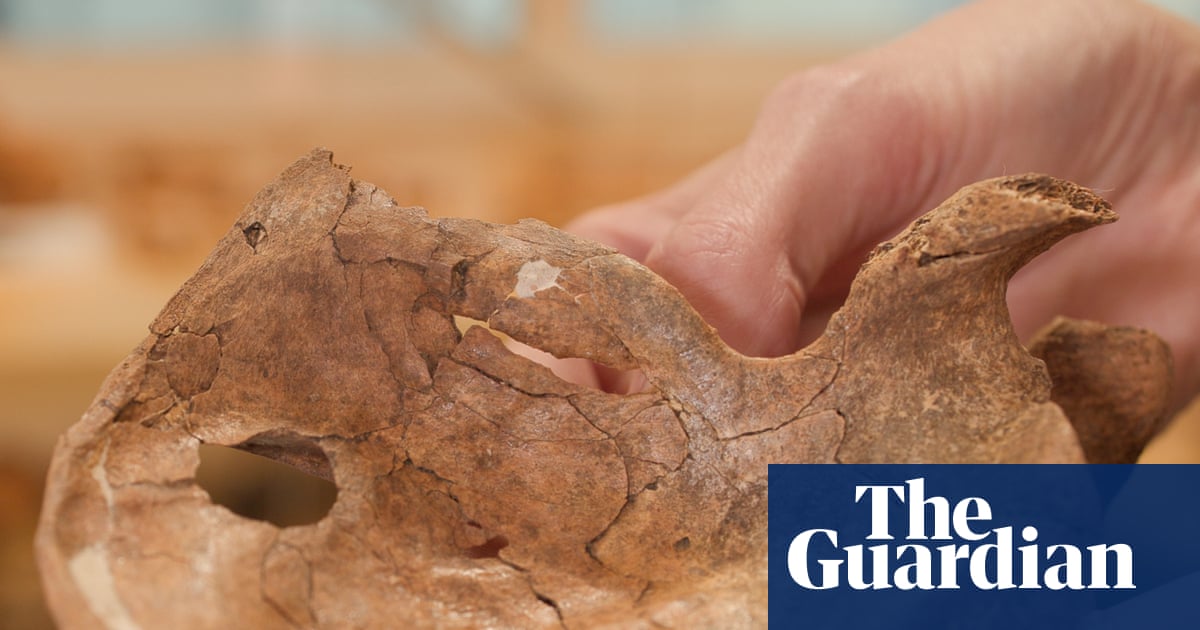
A smooth round hole in the shoulder blade of a Neanderthal who died more than 70,000 years ago may be the oldest evidence so far of a human ancestor being killed by a wooden spear.Archaeologists spotted the distinctive injury after excavating skeletal remains of the adult and other Neanderthals from under nearly 8 metres of rock and sediment in the Shanidar cave in Iraqi Kurdistan.At least five Neanderthals were buried at the same spot over several years, in a depression no larger that a fridge that ran behind a huge boulder near the entrance to the cave. Some of the bodies appear to have been laid on top of others that were still decomposing.“They’re coming back to the same spot to place bodies over a number of years or several decades and that’s really quite unusual in in the Neanderthal archaeological record,” said Dr Emma Pomeroy, a biological anthropologist at the University of Cambridge. “It suggests there’s some kind of meaningful behaviour in depositing the dead there.”Archaeologists spotted the distinctive injury after excavating skeletal remains of Neanderthals in Shanidar cave, Iraqi Kurdistan. Photograph: Prof Graeme BarkerResearchers found only partial remains of the injured Neanderthal, an adult aged about 45. The left shoulder blade that bears the wound was found with seven teeth, several ribs and fragments, and a near complete right hand that was leaning against the boulder.Close inspection of the shoulder blade revealed three fractures spreading out from the 1.5cm-wide hole and fragments of bone that filled the wound. The shards were probably punched out of the thin bone when the spear hit, the scientists said.The circular shape of the hole and the pattern of bone damage strongly suggest a wound inflicted by a wooden spear striking the body from the front.But whether it was a hunting accident or an intentional attack – a brutal jab from a foe, perhaps – is impossible to know.Pomeroy said the position of the wound and the force needed to push the spear through the chest, where it would have punctured the lung and probably severed arteries before punching out of the shoulder blade, pointed to a “kill shot” directed at the heart. “I don’t think that’s something you do accidentally,” she said.The spear wound was almost certainly lethal, but the individual was in bad shape before the fatal blow. Examination of the teeth revealed a lower incisor split vertically, leaving only half in place, its neighbours twisted inwards, according to details published in Scientific Reports.Examination found the Neanderthal had a split-tooth caked in hardened plaque. ‘You’d need quite a severe hit in the face to split a tooth like that,’ said Dr Emma Pomeroy from Cambridge University. Photograph: Dr Emma Pomeroy“You’d need quite a severe hit in the face to split a tooth like that and to rotate the others,” said Pomeroy. “They might well have needed help because they would have been in terrible pain.” The split tooth was caked in hardened plaque that would have taken at least a year to build up.Chris Hunt, the emeritus professor at Liverpool John Moores University, who co-authored the paper, said Neanderthals at Shanidar were taking ibex as their main prey and could have used wooden spears shaped like modern javelins to kill the animals.Because plant material decomposes so easily, very few wooden objects survive from prehistory, but timber spears from about 200,000 years ago have been discovered in Germany, preserved in waterlogged ground. The pointed end of a rounded wooden spear discovered in Clacton-on-Sea in 1911 is the oldest known at over 400,000 years old.Last week, scientists in Spain described hundreds of wooden imprints and artefacts that show Neanderthals embraced woodwork, making trays, plates, tripods, spears and other items. But proof of fatal skirmishes is harder to find in fossils: we may never know how the wounded Neanderthal at Shanidar died. “Conceivably it was a hunting accident,” Hunt said. “We can’t, however, rule out that purposeful interpersonal violence was involved.”
Neanderthal remains may be earliest human ancestor find killed by a spear
Full Article
Original Source
Read the full article at Theguardian →KhanList aggregates and links to publicly available news content. We do not host full articles from third-party sources. Always verify important information with original sources.