
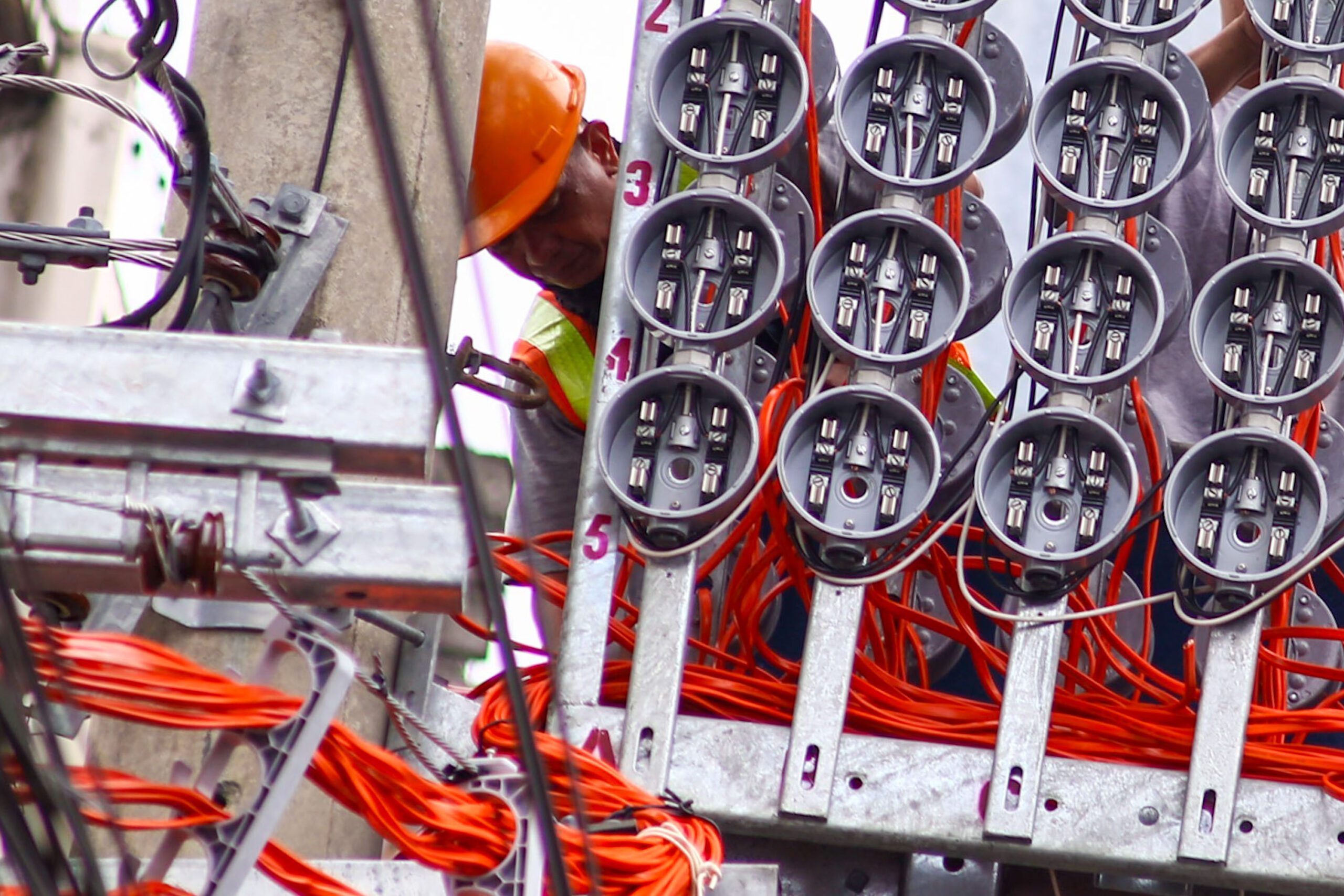
Electric company contractors install wires for newly installed electric meters on a utility pole along Jose Abad Santos Avenue in Manila on September 3, 2026. Rappler NEA says eliminating non-technical system losses will require a phased transition, with cooperatives needing billions in loans for metering and other upgrades before they can absorb the costs The National Electrification Administration (NEA) is requesting an additional P7 billion from Congress to help electric cooperatives address non-technical system losses, which is more than its proposed P6.49-billion budget for 2027. The P7 billion is not part of the National Expenditure Program and aims to support electric cooperatives in eliminating costs associated with unaccounted electricity due to issues like theft and inaccurate meters. NEA's proposed budget includes P850 million for loans to cooperatives, but additional funding is necessary to implement a four-stage program aimed at reducing non-technical losses, which could financially impact many cooperatives if not addressed. This is AI-generated. Read the article for full context. Report any errors. MANILA, Philippines – The National Electrification Administration (NEA) is asking Congress for an additional P7 billion to help electric cooperatives eliminate non-technical system losses, an amount larger than the agency’s entire P6.49-billion proposed budget for 2027. The P7 billion is not included in the National Expenditure Program (NEP) submitted by the executive branch to Congress. Under the proposed 2027 budget, NEA only has P850 million in national-government equity earmarked as loans to electric cooperatives, alongside P5.64 billion in subsidies and other funding under its National Rural Electrification Program. NEA Administrator Antonio Mariano Almeda told senators during deliberations on the Department of Energy’s proposed 2027 budget that the agency is now seeking the P7 billion in addition to its existing loan equity fund to cushion electric cooperatives from the financial impact of removing non-technical system losses from consumers’ electricity bills. “The P7 billion is a fund in addition to the loan equity fund of the National Electrification Administration to loan to the electric cooperatives,” Almeda said on Thursday, September 17. Under NEA’s proposed 2027 budget, the P850-million equity infusion is already intended to finance loans to electric cooperatives. The agency targets facilitating P850 million worth of loans to 18 cooperatives next year, up from P810 million targeted in 2026. There is no separate allocation in the NEP for system loss reduction. Non-technical system losses refer to electricity that goes unaccounted for because of factors such as pilferage, illegal connections, and inaccurate or missing meters. They differ from technical losses, which naturally occur as electricity travels through distribution lines and cannot be completely eliminated. System loss has become a hot policy issue after President Ferdinand Marcos Jr. used his July State of the Nation Address to call for an immediate amendment of the Electric Power Industry Reform Act in order to prohibit utilities from passing system loss charges, including the corresponding VAT, on to consumers. The directive has put pressure on energy agencies and regulators to work out how those charges can be reduced or removed without undermining the finances and operations of electric cooperatives and other distribution utilities. Why electric co-ops need these loans Almeda said electric cooperatives would have to spend heavily on metering as the government moves to stop passing non-technical losses on to consumers, including installing meters for currently unmetered connections and replacing meters as authorities crack down on electricity theft. NEA estimates its four-stage program would require around P7.5 billion in capital expenditures. Almeda said the first phase, which would reduce non-technical system losses to 25%, would require around P4 billion. Another P1 billion would be needed for each of the next two stages, followed by P1.5 billion for complete elimination. The proposed assistance would not be a subsidy. Instead, NEA would lend the money to electric cooperatives for investments needed to reduce their losses. At an earlier DOE press conference, Almeda said NEA estimated that 62 of the country’s 121 electric cooperatives could suffer financial losses if 25% of non-technical system losses could no longer be recovered from consumers. Almeda has pointed to the Zamboanga City Electric Cooperative as an example of what the program could achieve. He said its system loss rate fell from around 20% in January 2026 to roughly 13% by July following interventions that included additional metering, capital infusion, and management measures. – Rappler.com How does this make you feel? Loading
NEA seeks extra P7 billion to eliminate non-technical system losses
Full Article
Original Source
Read the full article at Rappler →KhanList aggregates and links to publicly available news content. We do not host full articles from third-party sources. Always verify important information with original sources.