
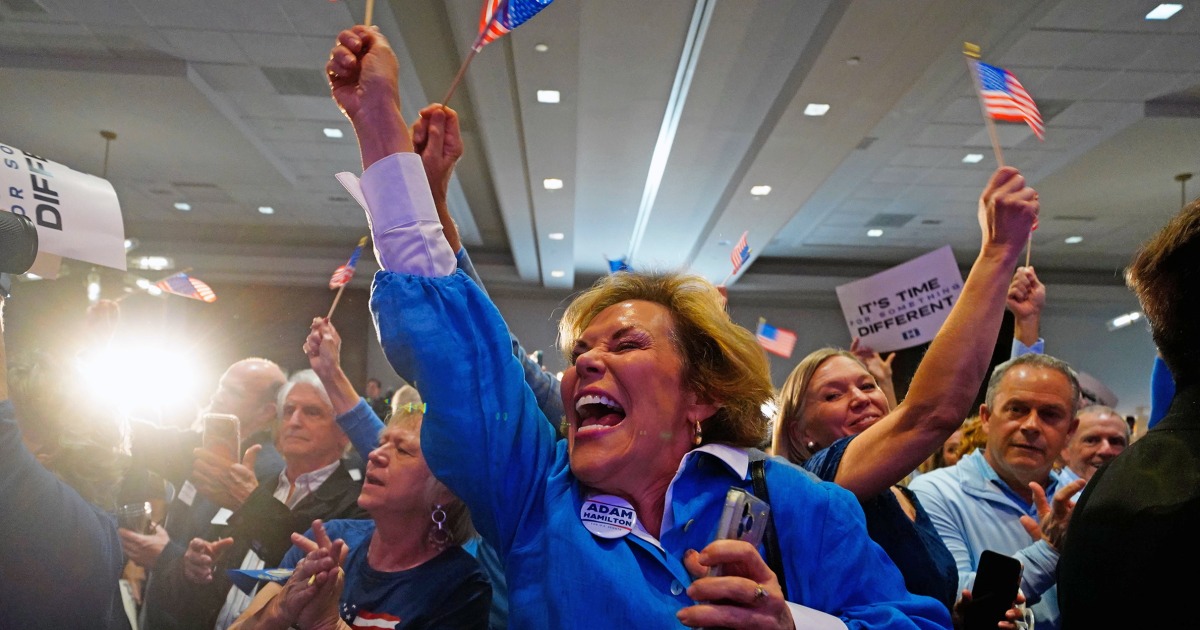
It was a historic blue tsunami: The Democratic Party captured both chambers of Congress, flipping as many as seven seats in the Senate and at least 29 in the House of Representatives. Just two years ago, the nation had been hit by a red wave. How did things turn around so dramatically? A cocktail of crucial factors: Voters feeling fed up with the economy, Democratic candidates emerging as more well-liked, key voting blocs — including Latinos and Black men — shifting blue, opinions of the Republican Party dropping and a resounding rejection of President Donald Trump himself, according to the NBC News Exit Poll.Here’s what we have gleaned about Tuesday’s stunning midterms analyzing data from the poll, which surveyed more than 79,000 voters nationwide.Follow live updates on the midterm electionsAmericans were deeply negative on the state of the economy and gloomy about the future of the country. An overwhelming majority of voters (75%) rated the nation’s economy as “not so good” or “poor,” the poll showed. And they soured on their trust in Republicans to handle it. Sixty-nine percent said the U.S. economic system favors the wealthy, and only 31% said it favors most Americans. This perception came at a time when the vast majority of voters expressed concerns about the cost of living. More than 80% of voters said they were worried about the price of necessities: gas and diesel fuel, food and groceries, utilities and healthcare. Thirty-seven percent of voters said they favored Republican control of the economy, while 43% favored Democrats — a flip in perspective from the 2024 election. Voters also blamed Trump: 65% said the president’s policies had made the economy worse. Just 27% said they had made the economy better.A David Crowley supporter at an election night event in Milwaukee on Tuesday.Nam Y. Huh / APSixty-two percent said higher-than-usual prices are more because of Trump’s policies than factors outside of his control, and 65% said his tariff policies hurt the national economy.Their frustration extended beyond the economy — and into a pessimistic view of the U.S. overall. Three in four voters said they were unhappy with how things are going in the U.S., and more than a third (38%) said they were angry about the state of the country. More than half of voters (57%) said that life for the next generation of Americans will be worse than today; just 22% said they believed it would be better.Democratic candidates enjoyed advantages on favorability, character and experience. In an overwhelmingly negative political environment, Democratic Senate candidates emerged as well-liked in races that looked tough for them at the beginning of the election cycle, according to the poll. Democrats above water on favorability included Jon Ossoff in Georgia, where a remarkable 59% of state voters said they viewed him favorably; James Talarico in Texas, where 52% of voters said they viewed him positively; and Josh Turek in Iowa, where 49% of voters said they viewed him favorably. All three candidates won their races.Republicans, meanwhile, struggled to win over voters.In two key Senate races, voters expressed negative opinions about Republican candidates’ personal character. A watch party for Democratic candidate for U.S. Senate Adam Hamilton in Overland Park, Kansas on Tuesday.Evert Nelson / USA TODAY Network via ReutersIn Kansas, 43% of voters said Republican Sen. Roger Marshall, an obstetrician-gynecologist who faced scrutiny after The New York Times reported that he sued hundreds of patients over unpaid bills, had the right character for the job. Marshall has described the story as a “hit job.”Voter opinions were worse about Ken Paxton’s personal character. Only 34% of Texas voters thought positively of the attorney general, who has battled scandals for years and was impeached in 2023 by the Republican controlled state House before the state Senate acquitted him. Both Paxton and Marshall lost their Senate bids.Candidates aligned with Trump also struggled. In North Carolina, Michael Whatley was seen as too supportive of Trump (60%), and in South Carolina, where the president endorsed Darline Graham, only 35% of voters said she had the right experience.After flirting with the GOP in 2024, big Democratic voting blocs swung back with a vengeance. By ignoring or denigrating many of the new voters who were key to Trump’s victory two years ago, Republicans squandered the opportunity to cement a new coalition of voters. Latinos, who notably gave Trump almost half (46%) of their votes in 2024, bounced back to the Democrats, who garnered 62% of Latino support in races for the House, the poll showed.One in five Black male voters went for Trump in 2024. That share shrunk to 13% for Republican House candidates this year.Trump narrowly won men under age 25 in 2024, getting 49% of their votes compared to 48% for Democrat Kamala Harris. But young men swung dramatically away from the GOP in House races this year: Democrats swept them by a 68% to 28% margin.On the whole, more Trump voters had buyer’s remorse (6% supported Democratic House candidates) than Harris voters (3% defected to the GOP). And Trump himself was soundly rejected by voters. Trump tried to energize his base by encouraging his supporters to vote like, “I’m on the ballot.” But the nation had largely soured on his presidency, according to the poll.Trump’s approval rating among voters, just 38%, was the lowest Election Day rating for any sitting president since 2008.Forty-three percent of voters said they cast their House ballot to express opposition to Trump. Just 16% said they voted to express support for him.Voters gave Trump overwhelmingly negative marks on key aspects of his presidency, saying that he prioritizes “his own personal interests” over the country’s (62%), that his war against Iran was the “wrong decision” (63%) and that his immigration actions had “gone too far” (57%).A key distinction: It’s a blue tsunami, not a progressive earthquake. Politicians and pundits alike mistook Trump’s 2024 victory as an endorsement of his deeply conservative plans. But the 2024 NBC Exit Poll found little evidence of an ideological shift to the right. The story is the same this year: On key issues, voters are no more progressive than they were two years ago.Among voters this year, 64% said abortion should be legal in most or all cases. That’s just a notch below the share of 65% in 2024.Twenty-three percent of the electorate considered themselves liberal in 2024, while 35% called themselves conservative. Those numbers hardly budged among voters in 2026, standing at 25% liberal, 34% conservative.Voters’ opinions of socialism remained largely negative, at 54% unfavorable and 33% favorable. Just one in five voters this year considered themselves democratic socialists. By contrast, capitalism remains relatively well-regarded in the minds of voters (57% favorable, 32% unfavorable).
NBC News Exit Poll: How the blue tsunami took shape
Full Article
Original Source
Read the full article at Nbcnews →KhanList aggregates and links to publicly available news content. We do not host full articles from third-party sources. Always verify important information with original sources.