
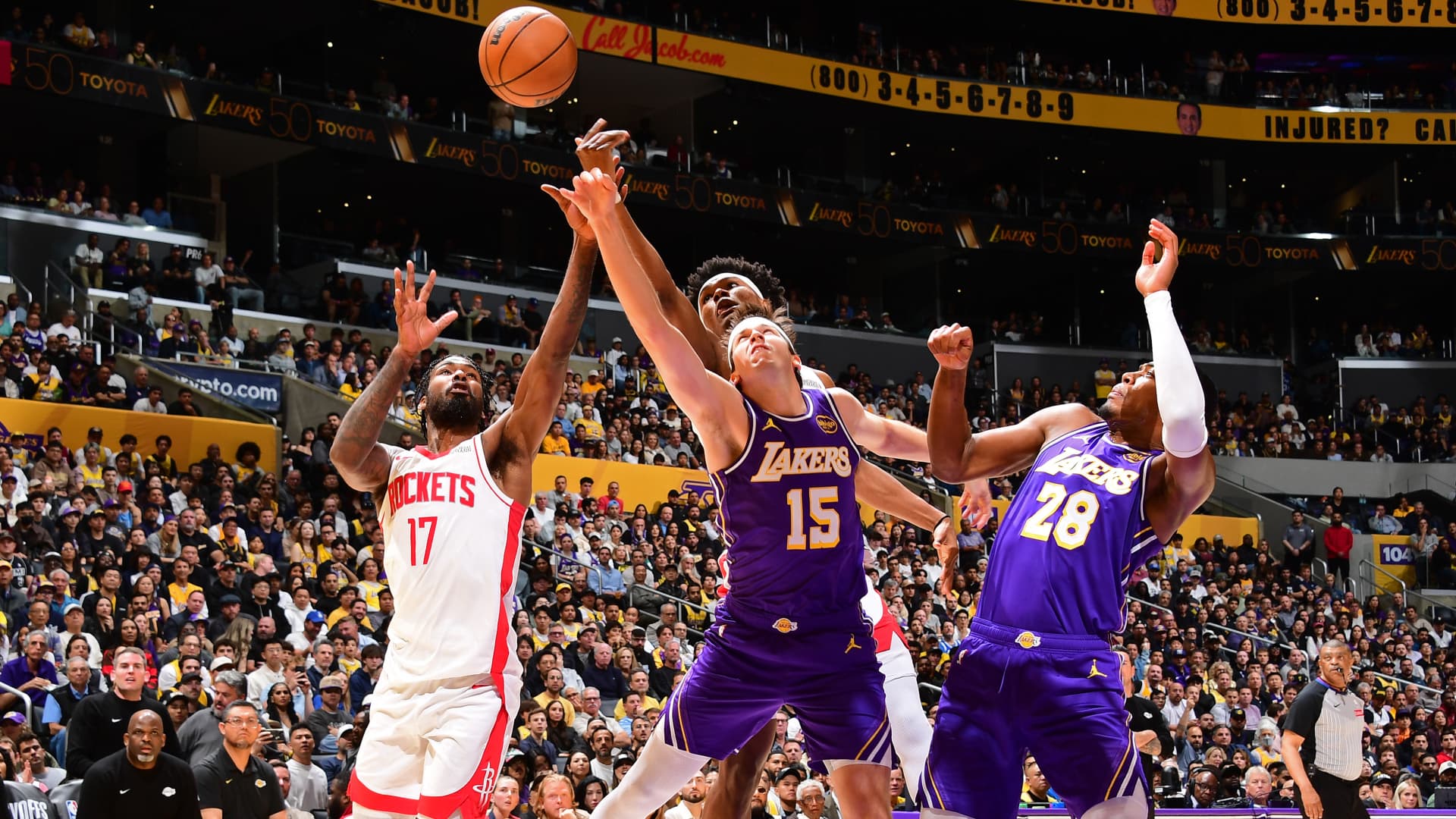
Tari Eason #17, Amen Thompson #1 of the Houston Rockets and Austin Reaves #15 of the Los Angeles Lakers go up for the rebound during the game during Round One Game Five of the 2026 NBA Playoffs on April 29, 2026 at Crypto.Com Arena in Los Angeles, California. Adam Pantozzi | National Basketball Association | Getty ImagesThe NBA is embracing prediction markets for the first time by naming leading platforms Kalshi and Polymarket as its preferred exchanges. Through the agreements, the league said there will be "significant integrity" protections for NBA markets, including limitations on which types of event contracts can be featured and information-sharing requirements regarding suspicious trades. "Protecting the integrity of the game is our top priority," said Scott Kaufman-Ross, NBA head of media distribution and partnerships in a press release. "These partnerships represent an important step in establishing a framework that creates new opportunities to engage our fans."As part of the announcements, the league also signed a memorandum of understanding with the Commodity Futures Trading Commission, the federal agency that asserts prediction markets are under its purview. The agreement seeks to maintain the integrity of both the NBA and event contract markets, the memo said, through exchanges of information. The NBA is the latest league to create partnerships with the booming prediction markets industry, which has seen much of its growth over the past year come from the popularity of its sports-related offerings. The NHL in October 2025 announced partnerships with both Kalshi and Polymarket, while the MLB announced a relationship with the latter company in March. Those same contracts, though, are under fire by states across the country, who argue that the offerings amount to sports betting and should be regulated by them. Platforms and the CFTC argue that event contracts are swaps, a type of derivative, and thus are regulated at the federal level. Courts across the country have delivered conflicting rulings on the issue, and many expect the Supreme Court will likely be needed to resolve the dispute. "The NBA is one of the most influential sports leagues in the world, and we're excited to work together to bring fans closer to the game," said Ari Borod, president of sports business development at Polymarket, in the press release. As preferred exchanges, Kalshi and Polymarket get rights to use NBA intellectual property along with marketing and licensing rights. "It's an exciting time for both NBA fans and Kalshi users," Adam Barrick, head of sports partnerships at Kalshi, said in the release. "The relationship we've built together reflects a shared mindset that prioritizes fan engagement, innovation and safety."The NBA's move on Monday now leaves the NFL as the outlier among major American sports leagues when it comes to prediction markets. Earlier this month, the NFL in an amicus brief to the Supreme Court said that sports-related event contracts should be regulated by the states rather than the CFTC. The league added that it's not opposed to the markets, but rather thinks they should have more guardrails.At the time, Kalshi told CNBC it had tried to work more closely with the NFL, but that the league hadn't engaged. Adam Silver, the commissioner of the NBA, though, took a different approach on the regulation question in an interview with CNBC's Contessa Brewer in early October. "From at least the NBA standpoint, we have roughly 40 different jurisdictions regulating us right now," he said. "So to have a consistent policy nationally, I think would be in our best interest."— CNBC's Jessica Golden contributed reportingDisclosure: CNBC and Kalshi have a commercial relationship that includes customer acquisition and a minority investment.
NBA enters prediction markets with Kalshi, Polymarket partnerships
Full Article
Original Source
Read the full article at Cnbc →KhanList aggregates and links to publicly available news content. We do not host full articles from third-party sources. Always verify important information with original sources.