
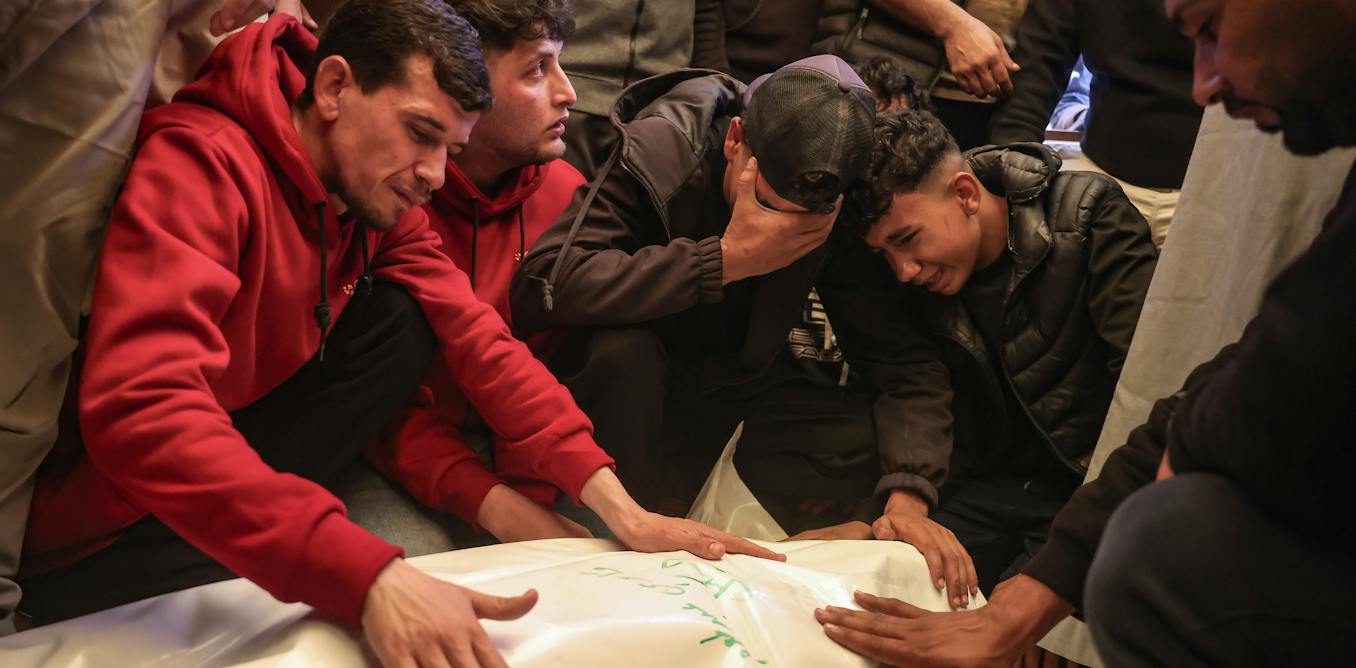
NAZA, a confronting new documentary by Israeli journalists Yuval Abraham and Rachel Szor, exposes how killing civilians in Gaza is a calculated, bureaucratic and disturbingly routine military practice. Set against everyday life in Tel Aviv, a city just kilometres away from the site of genocide, the documentary’s horror lies not in what we see, but what we hear in the chilling accounts of those who made it possible. Killing as a calculation Directed by two of the four filmmakers behind Oscar-winning No Other Land (2024), this 77-minute documentary builds on years of investigative reporting by +972 Magazine, Local Call and The Guardian, which also produced the film. At its centre are interviews with 24 Israeli soldiers and intelligence personnel conducted between 2023 and 2025. Their accounts reveal how artificial intelligence, surveillance technologies and military procedures were used to identify targets and authorise attacks in Gaza following October 7 2023. The film’s title itself is telling. NAZA is a military acronym for the Hebrew nezek agavi, meaning “collateral damage”. It describes the estimated number of civilians expected to die in an attack. Human lives, including children’s, are reduced to calculations: 10, 15 or 50 NAZA. We hear the soldiers describe Gaza become a “factory of targets”. Another acknowledges that an AI tool he developed had been used to kill thousands. Their chilling logic extends to deciding when people should be killed. One soldier explains why targeting Palestinians inside their homes at night, at times by hacking their children’s phones, is preferable to attacking them elsewhere. “You feel like God because you know everything about them.” Building on Abraham’s earlier investigation into Israel’s calculated bombing of Gaza, the documentary also explores how language can distance those conducting warfare from its human consequences. Military terms such as “collateral damage”, “target” and “operational necessity” obscure the people behind the numbers. They make civilian deaths seem like an unavoidable consequence, even as they are being anticipated. The violence we hear, the lives we see Much of the documentary unfolds at night. Interviewees appear as shadowy figures against the illuminated city. Szor’s camera moves slowly across residential buildings, observing Israeli women putting their children to bed, cleaning after dinner, or practising yoga. In one disturbing sequence, the camera glides upwards along a pristine, modern apartment building in Tel Aviv, as a soldier describes how Palestinian homes are identified and coded for bombing. The chirping of crickets punctuates the rooftop conversations between Abraham and the soldiers. This seemingly insignificant background sound becomes metaphorically ear-piercing – evoking the calm and safety of Tel Aviv while, about 60 kilometres away, atrocities take place. NAZA makes this short distance between violence and normality almost unbearable. One soldier describes killing people, taking a lunch break, killing again, then going out with friends. Another recalls how “enjoyable” carrying out a “mission” can be. Powerful insider testimony As a piece of investigative war journalism, NAZA’s greatest strength is its access. Military institutions tightly control information about targeting decisions and civilian casualties, so securing testimony from those directly involved is a significant undertaking. Abraham and Szor spent nearly three years identifying sources and gaining their trust, with some taking months to agree to be interviewed. Some spoke out of guilt or shame, hoping to expose wrongdoings. Others appeared motivated by professional pride in their military work. The sources remain anonymous. Although this makes sense, it does present a journalistic challenge, as audiences are left to rely on the filmmakers’ verification and investigative groundwork. Towards the end of the film, archival footage shows Benjamin Netanyahu defining terrorism as violence against innocent civilians for political purposes. His words acquire a devastating irony. NAZA Abraham’s questioning is persistent, often following a similar pattern across interviews. He asks how decisions were made, what soldiers knew, and whether they understood the consequences. At one point, he challenges an interviewee’s suggestion that his colleagues were not motivated by hatred of Arabs, pointing out that these same people had killed extraordinary numbers of them. He is met with silence. Soldiers describe burning Palestinian homes with leftover olive oil found in those very homes, and destroying buildings as quickly as possible before international pressure intensified. “We erased history”, one says. As expected, the Israeli military has rejected the allegations and questioned the verifiability of the anonymous accounts. Some of this response is included in NAZA, which is important. At the same time, responsible journalism doesn’t mean giving official denials and detailed insider testimony equal weight. As media studies scholars understand, the much bigger and more important journalistic task in this context is to assess competing claims against available evidence. Directors Rachel Szor and Yuval Abraham won the Venice film festival special jury prize for Naza. In this photo, taken in Ashdod, Israel, in September, their faces are graffitied over with the word ‘traitor’ in Hebrew. Ariel Schalit/AP Whose testimony counts? NAZA’s most consequential editorial choice is its overwhelming reliance on Israeli voices. Palestinians appear largely through descriptions of their suffering, surveillance records and images of destruction, rather than as people narrating their own experiences. This choice serves a clear investigative purpose. The film seeks to expose the machinery of violence through those who operate it, not retell the carnage through its victims. Yet it also raises a longstanding problem in mainstream (and predominantly Western) conflict journalism: the tendency to privilege powerful institutional sources when establishing what happened. After more than an hour into the documentary, we finally hear the human cost. NAZA closes with a Palestinian father desperately searching for his wife and children beneath the rubble, crying out to his missing son: “Sa'id! I told you to look after your sisters!” Mohammed al-Neder mourns over the bodies of members of his family, who were killed by Israeli fire, during their funeral at Shifa Hospital in Gaza, December 20, 2025. Abdel Kareem Hana/AP Normalising genocide NAZA is a powerful example of documentary war journalism that moves beyond the consequences of a genocide to investigating the decisions that produce them. In my work, I call this perpetrator-centric peace journalism. NAZA’s lasting contribution is not simply that it documents violence. Much of what it investigates has been previously reported, mainly by Palestinian journalists assuming extraordinary personal risk. Its distinctive achievement, rather, lies in using the documentary form and insider testimony to confront public denial. It exemplifies how, in war reporting, the most revealing testimonies can come not from those who suffer the violence, but from those who carry it out. NAZA is showing in Australian cinemas now.
NAZA: harrowing documentary shows how killing in Gaza became just another day’s work
Full Article
Original Source
Read the full article at Theconversation →KhanList aggregates and links to publicly available news content. We do not host full articles from third-party sources. Always verify important information with original sources.