
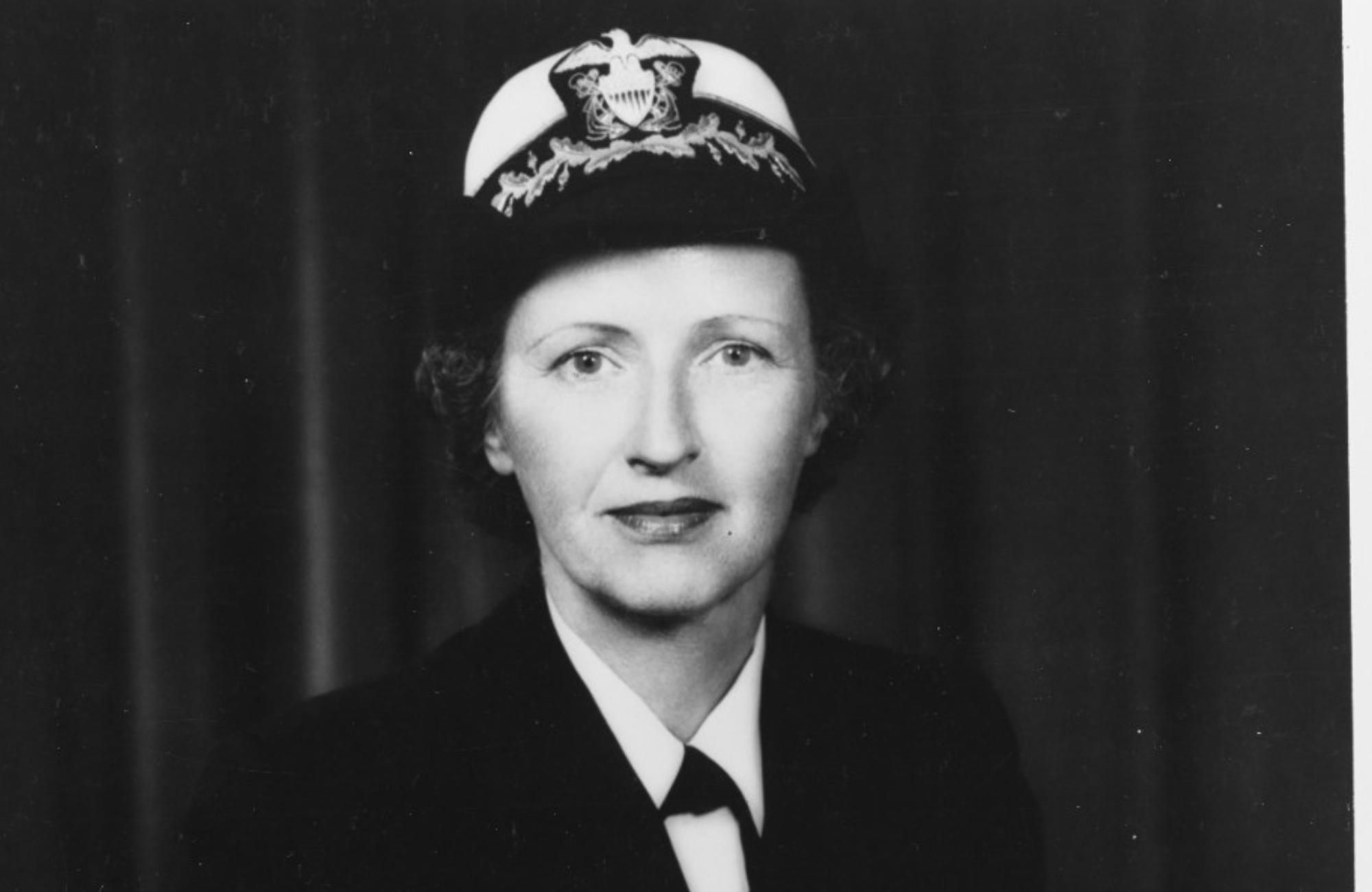
Navy Lt. Joy Bright Hancock recalled the mix of sorrow and pride she felt at the 1943 ceremony to christen the destroyer named for Navy Lt. Cmdr. Lewis Hancock, who was the second husband she had lost in a crash aboard a Navy rigid airship. Her husband, the executive officer of the 680-foot Navy dirigible Shenandoah, was among the 14 killed when the rigid airship was caught in a violent storm and crashed on Sept. 3, 1925, near Caldwell, Ohio. The pair had been married little more than a year. She tightened her grip on the traditional bottle of champagne used to christen a destroyer and picked out a smudge on the hull that would be her target. As she swung hard to break the bottle, she uttered, “I christen thee Lewis Hancock,” before turning to salute as the Fletcher-class destroyer slipped down the ways at the Federal Shipbuilding & Drydock Company in Kearny, New Jersey, on Aug. 1, 1943. The ship’s sponsor, Lt. Joy Bright Hancock, USNR, prepares for the christening of USS Lewis Hancock, 1943. (U.S. Navy) A Navy veteran of the First World War, Joy Bright Hancock, who would become known to her peers as the “First Lady of the Navy,” had just become the first Women Accepted for Volunteer Emergency Service, or WAVES, officer to christen a U.S. combatant ship and the first woman to christen a combatant ship while on active duty. In her autobiography, “Lady in the Navy,” Hancock recalled that the christening was “a really grand affair but my deepest feeling was not about the pride of sponsorship but the clear joy of knowing that Lewis Hancock had again gone to sea.” It was the second tragedy to befall Hancock in only a matter of years. While enlisted in the Navy during the First World War, moving up the ranks from a Yeoman to Chief Yeoman at the U.S. Naval Air Station in Cape May, New Jersey, Hancock met her first husband, Navy Lt. Charles Gray Little. “Never shall I forget his arrival in a gray Packard roadster, a dashingly tall blond young man with a New England accent,” she wrote in her autobiography. During World War I, Little served as a senior flight commander and chief pilot of dirigibles in France, and continued after the war, piloting the huge airships. The pair were married in October 1920; however, less than a year later, Little was killed at age 26 on Aug. 24, 1921, when the rigid airship USS ZR-2, which the U.S. had bought from England, suffered structural failure and crashed into the Humber River near Hull, England, during a test flight. “Of the 52 persons aboard, only one American and five British survived. My husband was not one of them,” Hancock wrote. Hancock went through nearly disabling periods of mourning after the deaths of Little and Lewis Hancock but each time returned to civilian jobs in the Navy. “Deep as was my sorrow,” she wrote, “I welcomed the return, even though slow, of a sense of reality and the renewal of a desire to do something.” The “something” became her effort to join others seeking a permanent place for women in the military. Between the wars, Hancock attended the Foreign Service School and also obtained a private pilot’s license before taking a position with the Navy’s Bureau of Aeronautics, where she served as head of the Editorial and Research section. The first members of the Women’s Reserve of the Navy and Marine Corps gathered in Hawaii to survey the assignment of female personnel overseas. (Naval History and Heritage Command) Then came Pearl Harbor, and with it the Navy’s sometimes reluctant realization that there just weren’t enough men to carry out the mission to dominate the Atlantic and the Pacific in World War II. The WAVES were officially approved as part of the U.S. Navy on July 30, 1942, when President Franklin D. Roosevelt signed the Navy Women’s Reserve Act into law. Hancock, who would be sworn in as a lieutenant, said in her autobiography that she had a hand in coming up with the “E” part of the WAVES designation. “I figured the word ‘Emergency’ would comfort the older admirals because it implies that we’re only in for a temporary crisis and won’t be around for keeps,” as happened to her and the 11,000 other women “Yeomen” of World War I who were disbanded after the war. The WAVES quickly proved that their service was crucial to the war effort and on July 30, 1943, the first anniversary of the establishment of the WAVES, Roosevelt said that “Thousands of fighting men are now at battle stations because they were released from vital shore jobs by women.” Hancock saw it as her duty to advise the women of the WAVES that “we were now in what was heretofore a man’s world, and we had to prove ourselves step by step,” but she also noted the development among the men of the Navy “a sincere feeling that we were worth shipmates.” In her vision, each woman who joined the WAVES “will go wherever she is sent and will be on call 24 hours a day. Her life will be different from that which she has known. Former secretaries will become machinists’ mates, control tower operators, instrument repairmen — in fact learn any trade that will be of benefit.” Hancock was promoted to captain after the war and in July 1946 became the third director of the WAVES. Her first task was to lobby for legislation to give women a permanent place in the armed forces, which would replace the bill that created the WAVES and the Women’s Army Corps, or WAC. The old bill limited women to serving “for the duration” of the war and for six months afterward. In the uphill battle to get new legislation passed, Hancock teamed up with WAC Army Col. Mary Hallaren to testify at Congressional hearings and win the support of Adm. Chester Nimitz and Army Gen. Dwight D. Eisenhower, but the outcome was not assured. “Admittedly, a great many officers were ready to resist what they apparently regarded as a feminine invasion of an area sacred to manhood,” she wrote. In his testimony before the House Armed Services Committee, Eisenhower said that when initial proposals to allow women to have permanent status in the military were floated, he initially was “like most old soldiers, violently against it,” but now he was in full support for the simple reason that “We need them.” Opposition to the new bill began to fade and on July 12, 1948, President Harry S Truman signed the Women’s Armed Services Integration Act, giving women the right to serve as permanent, regular and reserve members across all branches of the military, although women would continue to be restricted from direct combat roles and from combat aircraft. Hancock continued to serve as WAVES director and Assistant Chief of Naval Personnel for Women until her retirement from the Navy in 1953. One of her last acts was to address a graduation exercise at the U.S. Naval Training Center in Bainbridge, Maryland, at the invitation of Navy Capt. Frederick Wolsieffer, commanding officer of Recruit Training Command. Wolsieffer said he took pride in introducing “my esteemed friend and colleague, the Assistant Chief of Naval Personnel for Women, the First Lady of the Navy, Capt. Joy Bright Hancock.”
Navy legend lost two husbands in airship crashes before leading WAVES
Full Article
Original Source
Read the full article at Militarytimes →KhanList aggregates and links to publicly available news content. We do not host full articles from third-party sources. Always verify important information with original sources.