
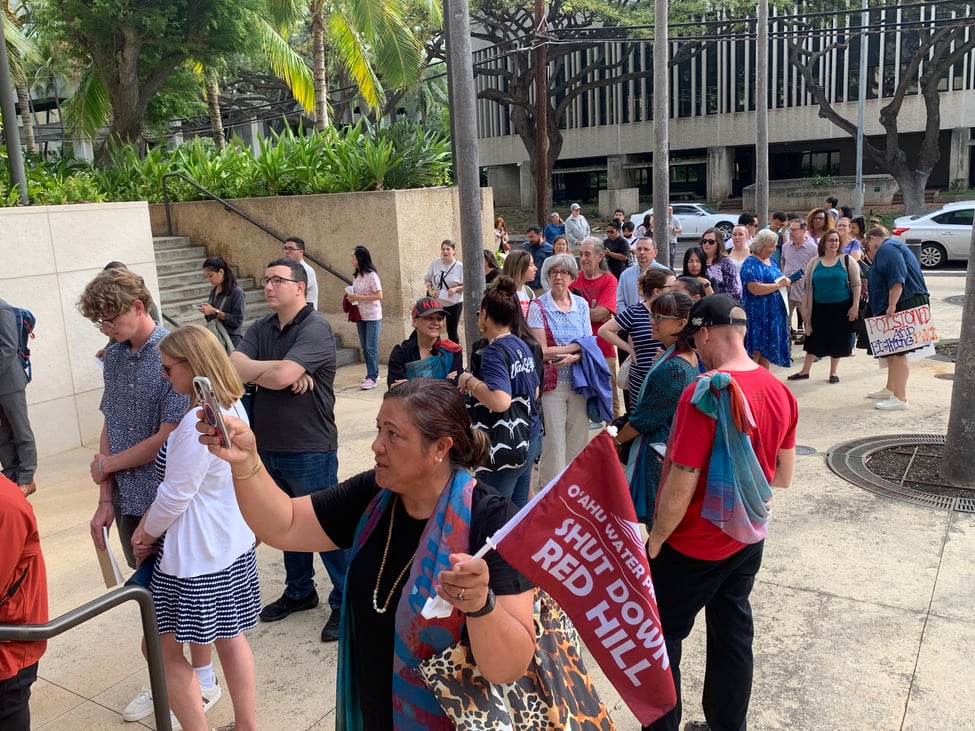
Activists claim the Navy's fractured fuel management put Pearl Harbor at ongoing risk. The Navy says the violations ended before the suit was even filed.HONOLULU (CN) — A federal judge ruled in favor of the U.S. Navy Wednesday in a yearslong citizen lawsuit over petroleum discharges into Pearl Harbor.U.S. District Judge Leslie Kobayashi, a Barack Obama appointee, issued her ruling in a case brought by the Wai Ola Alliance, a coalition of Native Hawaiian leaders and environmental advocates.The alliance accuses the Navy of discharging petroleum from above-ground fuel pipelines at harbor piers into Pearl Harbor and Halawa Stream. The group sued in June 2022, seeking daily civil penalties of roughly $60,000 per violation and a court order that plaintiffs said could reshape how the Navy manages fuel operations at the joint base.The case grew out of one of the worst environmental disasters in Hawaii’s history.On Nov. 20, 2021, a fuel pipe at the Red Hill Bulk Fuel Storage Facility ruptured, sending roughly 20,000 gallons of jet fuel into a tunnel near the Navy’s main drinking water well for 21 hours.Within days, residents in military housing near Pearl Harbor reported a fuel-like odor coming from their kitchen and bathroom faucets. Water samples from the Red Hill shaft showed petroleum contamination at 350 times the safe drinking water threshold.Roughly 4,000 military families were evacuated to hotels, and about 93,000 people served by the Navy’s water system were affected.Red Hill is a World War II-era complex of 20 underground tanks mined into a volcanic ridge above Honolulu. Built in the early 1940s to protect the Navy’s Pacific fuel supply from aerial attack, each tank stands roughly 250 feet tall and 100 feet wide, and together they can hold more than 250 million gallons of fuel.The facility sits just 100 feet above an aquifer that supplies drinking water to a majority of Oahu.The Hawaii Department of Health ordered the Navy to shut down and remove the fuel from Red Hill after the 2021 spill. After initially contesting that order, the Navy agreed to permanently close the facility. The fuel was removed, though cleanup of contaminated groundwater is expected to take decades.Wai Ola’s lawsuit does not target the Red Hill tanks directly. Instead, it focuses on a network of above-ground fuel pipelines at harbor piers, including Hotel Pier and Kilo Pier, that carry petroleum from Red Hill to ships and aircraft.The plaintiffs claim management failures behind a series of pier discharges remained unchanged and posed a continuing risk to Pearl Harbor and Halawa Stream, waters of cultural and environmental significance to Native Hawaiians.The case went to a three-day bench trial before Kobayashi in early April 2026.The coalition says responsibility for the fueling infrastructure was split among at least five separate federal entities operating in different command structures, with project tracking spread across at least seven different databases.“When everyone is in charge, no one is in charge,” plaintiffs’ attorney Daniel Cooper said.The group says critical repairs had been deferred for years as a result, pointing to thermal pressure relief valves shown in inspection reports as leaking, absent or improperly installed as far back as 2010, and petroleum pipes near a truck refueling station observed sitting directly in the dirt in 2015, in 2022 and again when the plaintiffs’ expert visited in 2024.The coalition’s central witness was William Rogers, a professor at West Texas A&M University with a doctorate in wildlife and fisheries sciences, who testified that when he visited the joint base in September 2024 he saw corroded pipe flanges and fuel lines without any secondary containment.“I’ve never seen anything like this in an active site,” he said.Rogers also testified that using the Navy’s own databases, he couldn’t confirm a significant portion of maintenance and repair orders were ever finished.“In my world, if it’s not documented, it wasn’t completed,” he said.A fourth day of scheduled proceedings did not take place. The defense rested early and renewed a motion under Rule 52(c), arguing the plaintiffs had shown only past violations and failed to establish any ongoing or reasonably likely future discharge. The plaintiffs opposed the motion, and Kobayashi took it under advisement without ruling from the bench.The Navy acknowledged fuel discharges occurred at Hotel Pier in 2020 and 2021, and at Kilo Pier in 2021, but maintained those discharges ended long before the lawsuit was filed.Navy attorney Alex Hardee of the Department of Justice told the court the Clean Water Act does not permit citizen suits over past violations alone.“The Navy discharged fuel from a defuel line at Hotel Pier in 2020 and 2021, and from an active fuel line at Kilo Pier in 2021,” Hardee said. “But those discharges ended nearly a year before the plaintiffs filed this lawsuit.”The Navy says it has already isolated the offending pipelines, spent tens of millions of dollars improving operations, and now runs a materially different facility than it did in 2021.Subscribe to our free newslettersOur weekly newsletter Closing Arguments offers the latest about ongoing trials, major litigation and rulings in courthouses around the U.S. and the world, while the monthly Under the Lights dishes the legal dirt from Hollywood, sports, Big Tech and the arts.Additional Reads
Navy dodges liability in Pearl Harbor Clean Water Act suit
Full Article
Original Source
Read the full article at Courthousenews →KhanList aggregates and links to publicly available news content. We do not host full articles from third-party sources. Always verify important information with original sources.