
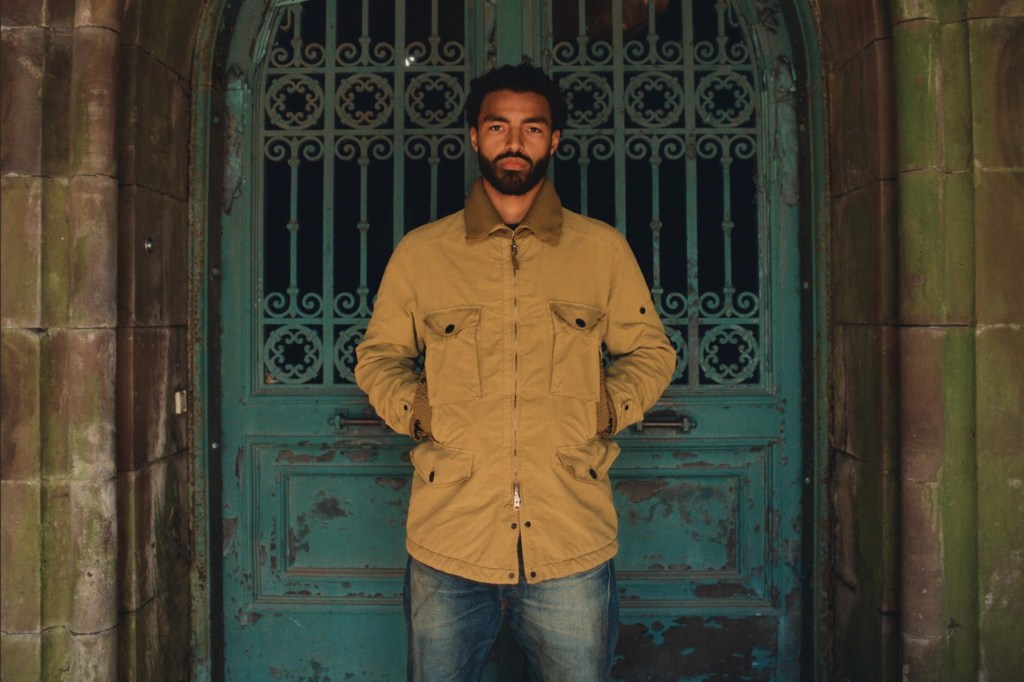
Sage Elsesser aka Navy Blue, continues to be one of the more interesting artists in the game. The California native is not only a rapper, producer, pro skater and model, he’s also cousins with James Earl Jones, and his late family member’s iconic voice is featured throughout this project as Navy used clips of his narration of Richard Wright’s classic Native Son. When asked if the classic 1940 novel inspired his tenth studio album and the third in his “Knighthood” trilogy, he said it was more about the gravitas of Jones’ narration. “I’ve always relied on literature, but Native Son the book itself wasn’t necessarily something that inspired the record,” Navy tells me during a nearly two-hour conversation at Billboard’s Manhattan office. “It was more so hearing James Earl narrate it, listening intently and finding something from the middle of the book that it was applicable to the beginning of the story.” Sir Render isn’t the typical installment in a trilogy. The 15-track tape is actually a prequel to the two previous albums Memoirs of Armour and The Sword & The Soaring. To explain this unique way of presenting a story, Sage uses the Game of Thrones universe as an example. “Game of Thrones is the main [anchor TV show],” he explains. “Then they have House of Dragons, which goes way back in time, and the most recent A Knight in the Seven Kingdoms.” (We start to go back and forth about how good the side mission the latter was — that’s another conversation for another day, though I will share our brief shared review: “That s—t is hard. Nah, It was tough.”) Sir Render features the talented rapper and producer Mike Shabb out of Montréal, dynamic duo Armand Hammer, Navy’s right hand in Earl Sweatshirt and his mentor the late, great Brooklyn rapper and producer Ka. The production credits are also a family affair, including Jason Wool, The Alchemist, Vertiqua, the aforementioned Shabb, Mario Luciano, QThree, Bori, Malik Abdul-Rahmaan, Shungu, and of course, Navy Blue himself. This record has layers to it, and the only way to peel them back is to listen intently and let the music take you into the world the West Coast MC first introduced with Memoirs in Armour. You’ll have visions of knights in battle, and the sound of swords sheathing, as Navy gives the listeners some of his best raps and storytelling yet. Billboard sat down with the rapper to talk about each track on the new project. Check out Navy Blue’s Sir Render track-by-track breakdown below. “Commencement” Producer(s): Jason Wool The music video for Sir Render’s intro track “Commencement” was you at the Arsenal championship parade. Why did you choose to go that route for this particular song? Well, the honest answer is, I was going to London for the parade — and a producer I’m working with, Nick, was like, “Well, if you’re already going, should we just get some content out of it?” And he pitched the idea, and initially after he ran it by me, I said “no,” because I didn’t feel like it was exemplary of what the album was about. I wanted to lead with “Sir Render,” but he was just like, “Yo, why not highlight a moment in history?” And it was just kinda like blind faith, like, “All right, I’ll give it a shot.” He set it all up, and I’m glad I did it now. It’s one of those things where I’ll look back and be happy that it exists. It made sense after I went back and watched it after listening to the album. The first lyrics on “Commencement” are, “I simply couldn’t fathom what it’d take.” And it’s just kind of like years and years of putting pain in and struggling, and then to be able to reflect on my life, where I’m from, where I’m at now, with the perspective that I’ve gained through that, so it felt perfect. When I was in the parade and I was seeing it all happening around me, I was like, “Oh, this is perfect.” It’s celebratory. Now the story begins. As an Arsenal fan its like, now the bar has been set. Let’s go win another one, and another one and another. Did you recently find out that James Earl Jones is your cousin? He’s always been part of our family. And you’re using clips of him narrating Richard Wright’s Native Son throughout the project. Why did you choose to go that route? Well, beyond him being a relative, he arguably has the most iconic voice. He comes from a theater lineage and when he’s on stage it’s like his second home. I had the privilege of seeing him on Broadway about 15 years ago. Do you remember what what play was? At first, I thought he was reading Othello, because it sounded like a play and then you have these themes of knighthood. I forget what play it was, but that’s pretty much where it started. I was trying to find recordings of Othello, and a lot of the monologues from Othello didn’t really fit. If a song is a minute and 30 seconds long, people generally are like, “Oh, we need to put a little clip at the end of someone saying something.” It’s kind of the formula, but for me, I’m really intentional about the voices that I use and the people whose voices I use. There’s another man named Martin Prechtel who I’ve used on pretty much all of my albums from Song of Sage onward, and I’d always collected certain clips of James Earl, and when I found these, they just felt right, especially because I had read Native Son when I was 13, I’d say. And what the book is about is so much different than what Sir Render is about. I said in other interviews, the thing that I identified most with is that the main character has had an experience that’s changed him forever, and his whole reality has become entirely skewed. It’s like upside down. Sir Render is an album about reflecting on a time when my world was upside down, but through the lens of a narrator. You know when you’re watching a movie and you get the opening scene and it’s a baby being born and then there’s a distant voice. Someone comes in there like, “He’s born under a full moon,” and the story begins. So, I was imagining speaking from the perspective of a narrator. “Commencement” is one of those songs where even my performance is really laid back and spoken really straightforward because I was inspired by narration. I was read somewhere that it took you five years to make this and that you were working on this before Memoirs in Armour and The Sword & The Soaring, so it’s essentially a prequel. I wouldn’t say I was working on this for five years. I worked on it for about two and a half years. Three maybe at most, and completed it and just left it because it was supposed to be the next album. I had the closing chapter of my book an instead of just having that stand on its own, I have this be the moment, the pinnacle where you’re like, “Oh, okay.” So, it’s Memoirs in Armour, which was me imagining you seeing armor, you know, and then you’re seeing the tools that are used with The Sword & The Soaring and then Sir Render is the person beneath the armor and the person wielding the sword. You know what I mean? But yeah, sorry, to answer your question because you asked me about Jason Wool. I love Jason Wool and working with him. He’s a piano technician by trade. That’s what he does. But I built a really special relationship with him. There’s those kind of relationships when you work with certain people. I’ve broke bread with Jason. I’ve traveled to Portland to spend time with him and Mario [Luciano], and make music and nerd out on a bunch of music that we’re into. Jason has become one of those like friends that, you know, once you connect, the music is easy. “Baron” Producer(s): The Alchemist The piano sample and kick reminded me of some QB s—t. I noticed it from jump. That was actually one of the first joints that me and Al did together. However long ago. There’s a bunch that we had done together that just kind of got scrapped. I was still figuring it out. That’s something that I love about Al. He’s always supported me from the first day I met him when I was 15, and he was like, “Yo, I heard you make beats. Let me hear some of your stuff,” and I’ll play them for him. He would always big me up. And when he found out I was rapping he would always be like “Yo, whatever you need from me,,” “Yo, pull up.” He’d play a beat for me and I’d be like, “Yo, this is cool,” He’d be like, “Do your thing on that.” Someone like that gives you confidence, right? Oh yes, definitely, especially from one of my favorite producers. He’s another person, similarly, where it’s like, yeah, we make music, but we’ve spent countless hours watching dumb YouTube videos and eating food and cracking jokes and talking about life so the music is easy. That’s why I think a lot of people value working with Al — because as big as his name is, he’s still so down to earth. I can pull up, and he’s just there, make beats in front of you, like, “Go ahead, do your thing.” He always throws it off the glass, and that was one of the ones that stuck. You always had this in mind for these albums, or did you kind of realized that it fit? There’s a couple joints where I was putting shots up, and then I was going into a certain sound and working with Budgie. But I knew in my heart of hearts there was a sound, a sonic, a frequency that I was going for that I wanted to go back to, and that was definitely inspired by Ka. Like a sound that I felt like wasn’t super in your face. A certain bag where like-minded people would understand the intentional choices that are being made. So, once I started getting back to what I guess some would deem “a more somber sound,” I felt like that was there and present for Song of Sage, but when I started working on Sir Render, I was reflecting on a time that was somber, but now with perspective because I went through it. This joint I did with Al, [those] were the early, early stages of getting back to that. The time that you’re talking about, how long ago was this? This is 2020, but “Baron” might’ve been maybe from 2019, maybe earlier. I’m not quite sure. It’s one of those joints that I was just always confident in. “Sir Render” Producer(s): Vertiqua The title track. Are you Sir Render? I’m assuming it also doubles as “surrender.” I had a different title before, but it felt befitting. It’s not necessarily surrender. It’s not me, no. Sir Render is another person, but you know, it’s kind of a tale. A kid reads about King Arthur, and the kid identifies with him. I guess because it kind of also reminded me of Don Quixote. It’s like, you’re going through this journey, through this tale, whatever. Someone I met had called themselves “Sir Render,” and I can identify with that. It’s kinda like, for lack of a better term… not a costume, but it’s like universal armor that I think that we all put on, you know? Then I started thinking about myself, and there’s always this classic storyline like in Cinderella. She’s with the stepmom, and she goes through the trials and tribulations of being a cleaner, and then all of a sudden, she’s “The One.” “Sir Render” felt like the perfect outline, where anybody could insert their experience. This one was produced by Vertiqua. How did you source these beats? Did you have them for a while? Were you hitting people up as you were working on this project? The thing is, during this era, I always knew what I was looking for. Whenever I’m getting beats sent to me — I think it’s actually one of my strong suits — I’m really good at picking beats. I met Vertiqua through MIKE. He’s from Berlin, and I met him again out there through , and we just kind of chopped it up and he was like, “Yo, I’d love to send you some beats.” He was just so cool, and I wasn’t really too hip to his music. And he was like, “Yo, I think I have some stuff specifically with you in mind.” So, he sent a couple joints through, and that one — I think he sent two beats, literally just two beats — and that was one of them, and I was like, “Whoa!” It was so layered. There’s so many good beats, but I don’t really care about good beats. I want to make a movie, you know? If I’m not like, “Oh, this feels grand.” That’s always what I look for. So, that was one of those joints where I was like, “This is special.” I was gonna ask you about the music video, but now the music video makes sense from the way that you’re explaining how this beat made you feel. The video shows a kid in a play right with cardboard armor and a cardboard castle with adults in the audience looking on. Who are the men that are coming in to watch this? Who do they represent? Are you related to them? Yeah, a little bit. I mean, I know all of the men that I chose, and the young men. I know all of them personally. Everybody who was in the video, I have some type of relationship with in some capacity. The video is something that I always imagined when I started making Sir Render. I didn’t know what video it would be for. I’m a very intuitive person, and I’m someone who, when I have an idea, it doesn’t matter how much time passes — if the idea is good enough, it’ll stand. It was just beautiful to be able to make it happen, and how it took a new form, and working with my friend Ahab [Mullick], how that changed my perspective. I loved that video. It was inspired by a conversation that I had with Sideshow, Al, and I think Thebe as well. This is when Haram came out, the Armand Hammer album. The last song off that album, “Stonefruit,” Sideshow was like, “Yo, E L U C I D is rapping like a talking tree.” And then I started thinking about Harry Potter, that one tree that’s like alive. It makes the connection to childhood. It’s like the beginning. This is where it all started. I used imagination as a child, so Sir Render is one of those joints where I’m almost speaking to me as a kid.What did the men in the audience represent? Pretty much, the men are supposed to be men from all walks of life, and similar to Weapons where all the kids get the call. The video is about a kid who’s performing in private, giving the analogy or the metaphor of armor. So, the curtains being drawn is like his armor, and he’s doing this safely because he feels like nobody’s watching. And all these men are just drawn to this theater, and they’re like, “What’s going on? This feels so familiar,” almost like in a daze, and they don’t even realize what they’re doing. Then when the curtains are drawn, the kid is exposed, and all of these men are looking at this child, going, “Wow! Yo, he’s he’s free. He has so much freedom. I wish I had that.” Like, it reminds these adult men of a time when they weren’t scared. And the cool thing is that usually a kid, when he realizes that the people in the audience can see him would run off and be scared. In the first draft, me and Ahab were talking and He’s like, “Maybe little Billy should look around and run off.” I said, “Nah, I want him to notice that everyone sees him, and he like puts his sword down and he’s like, “Yeah!” And I don’t know if you can tell, but in Little Billy’s eyes, when he puts the sword down, all he sees is his father. It’s really about identity. As a man, you’re supposed to be a certain way, and the performance that we put on in society as men, like don’t cry, don’t speak about your feelings, keep it all hidden. When those curtains are drawn, he’s like, “Nah, this is who I am.” “Over” (feat. Mike Shabb) Producer(s): Mike Shabb This one features Mike Shabb and was also produced by him. Talk about linking with him for this track. He’s someone that I built a friendship with. I went out to Montreal for a skate trip and ended up staying longer to just post up with him and [Nicholas] Craven to crack jokes, eat food, sit in the park. Those are the things that make it easy to do music. I loved that that Shadow Moses EP that Craven and Shabb did. I was listening to it a lot, and I was really inspired by Shabb. He has a certain freedom and I felt very confined and insular, and he’s able to do so much. We did a bunch of joints and I wish the other ones could’ve come out. They’re good, but they didn’t make it. This one kind of fit the sound of the project better. Yeah, and then he’s speaking about his life on this song in a way that I hadn’t really heard heard him before. He was going off on that s—t. It”s really easy to work with Shabb. This beat felt like one of those ones like I mentioned earlier about “Baron” and “Sir Render.” I’m imagining like a knight, looking up and seeing something in the clouds. It’s that ethereal vibe to it when you’re looking at a crazy sunset after a long battle. Just grand, when you feel little, you know? Making that track was so easy. Did you make this song while you were kind of working on this particular project. I was just out there. It felt strong enough for me to be like, “Damn, I gotta put this on here.” The album wasn’t really complete, but the structure was there. I took a joint off and replaced it with this one. “Reflections” Producer(s): Jason Wool & Mario Luciano This is another one with Jason Wool and Mario. You mentioned Mario before. Did you make this song while you were kind of working on this particular project. I was just out there. It felt strong enough for me to be like, “Damn, I gotta put this on here.” The album wasn’t really complete, but the structure was there. I took a joint off and replaced it with this one. I really like the piano on here. Jason again. That was one of the first ones that I picked. This is a song that I had for a minute. I’ve been performing it for a long time. I would incorporate it into my live shows, just as a little unreleased joint that I would do. This was one of those joints where I felt like I was really leaning into the kind of music that I wanted to make. I felt like I captured that feeling really well in that song. And “Refections” was called “Reflection” at first, then I was thinking about that idea of, how many people will listen to this? And it’s not just one reflection at that point; it’s plural, you know, so it’s like reflections. The song felt good, but when I just added that “s” on, it felt like the song got big. This is bigger than just my reflection, this is about everyone else’s. I love, love, love that song. I would say that “Reflections” is the song that I made from when I was making the album, when I knew that I was in a bag. Talk about Jason and Mario. They’re like a tandem, yeah? I’ve worked on music with Jason just solo, but him and Mario are like a great team. Mario has something called, PolyPhonic Music Library. You know “8am in Charlotte”? The Drake joint that Conductor did. That sample is from them. They do a lot of music for people to sample. But the thing that I love about Mario and Jason is that when they’re together, they’re like students. They’re always just trying to create something. It’s not like, “I want to make this kind of sample, and this kind of sample.” It feels intentional. They’ve made some incredible, incredible work together. Did you go to the studio to work with them on this track? Jason sent me this one, and I rapped on it immediately. I hadn’t even met him at that point, but then after we met and built, they were both like, “Yo, that ‘Reflection’ song was special. We would love to do some more stuff with you.” So, I went out to the Northwest and we made a bunch of fun stuff together. Didn’t even rap, we just made a bunch of live music together, which was nice. “Residuum” (feat. Armand Hammer) Producer(s): Navy Blue “Residuum” is with Armand Hammer. This the one that you start off with the swordplay, in keeping with the whole armor/knighthood motif. I wouldn’t even necessarily like say that it’s like a motif or a theme. I’m really trying to create a world. I’s not like I’m gonna just throw some sounds on it. No, no, yeah. At that point in the album, at the end of “Reflections,” James Earl is talking about breathing. He’s like, “In, out, in, out.” He’s struggling with his own breath. He says, “Well, there he was now. The room was quiet. What would happen?” And then it goes into this battle scene where he’s preparing. So, I’m imagining a knight sitting by himself, getting ready because the next morning he’s gonna go to battle. So, those strings feel like getting ready for a battle and that sound that you’re referring to is actually the sound of a sword being forged. It’s a blacksmith hammering away and a hot blade going into cold water. The song felt like the battle scene. I was imagining a close shot of a knight’s helmet and Sir Render’s pretending that he’s prepared, but he’s not. He’s scared, but what are you gonna do? You’re riding into the battle. All the adrenaline and anxiety is coming in. Yeah, like just kind of wearing the fear, but not being consumed by it. There’s an urgency in in my voice and that beat, because at first I rapped over those strings the whole time, and then I randomly found this drum break and I chopped it up. I put the drums around my verse, which was really cool. I’d never really done that before. I felt like the way that I was rapping on that one felt like I was kind of drumming a little bit, do the drums feel important. Talk about getting Armand Hammer on here with you. Were you guys in the studio together? I hit up Woods to get on it, and he sent me like a really short verse. So, I felt like it was only right like that I get Elucid on it — because I’d already kind of thought about it, but I was like, “Ah, maybe it’ll be too long,” you know? I initially heard Wood’s voice, and then getting on it was the cherry on top. And watching him record that song when he was holding his son in the studio, that was special. I know this isn’t that type of song but when you guys lay down verses on the same track, do you ever try to one up each other? I’m not even thinking about that. That’s from that era of hip-hop of like masculinity… being in competition with each other. Anybody that I work with, the majority of the time, are generally people I look up to. I know that nobody can do what I do, and nobody can do what Woods does, and no one can do what Elucid does. We’re all speaking to completely different things. I think that oftentimes, the reason that I work with people that are my friends is because they can ultimately tap into my world. Right when I sat down with with Elucid, he was like, “Yo, so your verse it feels like you’re saying this, and Woods is saying this.” He’s automatically thinking, how can I compliment? Not, “Oh, y’all are talking about this. Let me like one-up you guys.” These are the kind of people that I that I work with. This is what I was trying to get at. You sent them the beat with your with your verse on it, and then they listen to it and fit into your world by complimenting it. That’s one thing what Woods does really well. He listens to what you’re saying. He’s like, “How can I elaborate on your idea?” He always does it whenever we work together. When we did “Poderoso” from Song of Sage, he took something that I say in my verse, and elaborated on it. In my verse, I say, “Mona Lisa’s eyes will follow you around the room,” and he talks about the canvas stretched across the wall. He gives you these visuals that compliment. That’s the thing that I’m most proud of is that I create a space and a canvas where people can plug themselves in really easily. “Crux Ansata” Producer(s): QThree I can speak to my friendship with pretty much every person on here. There’s some history; it’s not just like I found and bought this beat from somebody. Q and everybody I work with seems to know the kind of sound and feeling that I’m looking for, and Q and I have that kind of relationship where he’s like, “Yo, check this out,” and he sent me that one. I was just like, “Whoa, yeah, this special,” and I was really proud of it when I recorded it. I actually sent this one to Ka like, “Yo, check out this joint I did,” and he was like, “Oh yeah, let me write to this.” But we never got around to it — but it exists as it is. One of my favorite, favorite joints, and I’m really proud of the video that we did for “Crux Ansata/Bleeding Scarlet.” It’s a short film. So, is the name of the track based on the cross with handle? Because there’s also an H.G. Wells book of the same name. It’s kind of a play on both. It’s like the critique of the Catholic Church, and it’s a play on colonialism, slavery, and simultaneously the Ankh and what that represents. Like divine masculine, and feminine all in one. I just love that title. What’s the significance of the music video? It’s you and your sister, and you’re each holding a bow and an arrow in way where if you slip the arrow could go into someone’s neck. It’s an idea that my friend Ahab presented to me. He’s another person, like a collaborator, that he’s really digging into the music and the lyrics, and he’d always been inspired by the performance piece, Marina Abramović and Ulay’s “Rest Energy,” where she’s holding the bow and he’s holding the arrow. So, I thought, what would happen if mid performance, the roles get reversed, and now I’m on the receiving end? And it’s like, “Wow, this is what it feels like to be on the other side of this, and now I have to really trust you.” I only feel safe because I feel the responsibility. I’m not gonna let it go, but the real premise of this is that we’re performance artists, and I don’t have the courage to tell my sister that I’m not confident, because I’m hiding a wrist injury that I haven’t told her about, and I think that she doesn’t know. So, as the film progresses, there comes a moment where she takes it upon herself to be the one to bear the responsibility because she knows that I don’t feel confident, and it’s just about trust, you know? It’s not about the stigma around surrender. It’s not about giving up. It’s more so about…You know when they say you’re in the ocean and you try to fight the the waves, you’ll drown? But if you surrender to the wave, if you surrender to the current and let it take you where it’s meant to take you, then you can get out of it. It’s a similar play on words and similar idea. She’s older than you, right? Have you guys always had this great relationship, all this trust? I have three sisters, and I have somewhat of that same kind of bond with each of them. Initially the idea was for me to have to do it with another woman. It was supposed to represent like a romantic relationship, and I was expressing to Ahab that doesn’t feel very accurate for me. It would need to be someone that I have a real lived connection with, speaking specifically to this time of my life, and my initial thought was for it to be a mother and son, and I wanted it to be my friend’s mom and little brother. But they were busy, so I was like, “What if it’s me and my sister?” And I’m glad it was me and my sister, because it was a really beautiful experience. “Belladonna” (feat. Earl Sweatshirt) Producer(s): The Alchemist You kinda got a family affair going on here, with Earl being featured and Al behind the boards. How did this one come together? All the joints with Al were recorded at his studio in the same room he made that beat. Al knows that me and Thebe [Earl’s real name] love beats in different time signatures, and Al’s always like, “Yo, check this joint out. I did this this new one.” It had that similar vibe that I look for and we just started writing. Me and Thebe have this kind of connection that is kinda inexplicable. We don’t even need to look at each other or “Yo, check out what I got.” We both just write, and I look over there. I’m done. He’s like, “Yeah, go ahead, go.” And then, you know, he comes in after, and it was just like we have that connection, where we trust that we’re both gonna tap into the same frequency when we’re in the same room writing together. Working with them is a layup. It’s easy. You made this before you even thought about making this album? Nah, I think this was while I was making it. Definitely like maybe a year or so after making “Baron.” You kick it at Al’s joint, he’ll make a beat. I knew we had something special with that one. Yeah, you and Earl always have good chemistry. My verse ends with, “Would you rather be happy or right, G? Do you choose wisely?” And then Thebe was like, “Yo, we gotta put like some three-card monte-like moment there,” and then he says, “We finna take risks. I can get us paid.” Our verses just connected so well. We found the right clip. “Aegis” Producer(s): Navy Blue & Bori This one is produced by you and Bori. I think he goes by YaTuSabe and he makes clothes. He’s ill. You gotta check him out. I’m assuming he’s Puerto Rican or Dominican. Probably both because “Ya tu sabe” is more of a Dominican thing. He’s both. [Laughs.] His name’s Matthew. He’s just one of those multi-hyphenate people who’s just ill at all the things he does. “Aegis” is my favorite song on the album. It’s like the sleeper to me, it’s the most poignant. It felt like it was the most specific that I got on the album. Working with Matt, he had this beat that he was looping up, and I was like, “Whoa, what’s that?” Then we added the drums on there. It’s just like, you know, if we’re talking references of The Odyssey, it’s kinda like when they go to Hades, and it’s the black sand beach. He’s dancing with death, but there’s like a certain confidence with all of those spirits around him, and he’s just like, “Pffft, whatever.” Send me on my way. Tell me what I gotta do to get out of here. I think I was writing my absolute best there, speaking about probably the most life-changing experience ever — which was my brother passing when I was a kid. The poetic language that I’m using is so specific, that if you weren’t there, then you don’t really know what I’m talking about. I saw it through my eyes. Sometimes listen to it, and I’m like, “Yo, this is crazy.” I would say “Aegis” was the first time where I really got to appreciate my work. It’s one of those songs that I think I’ll return back to when I’m old. Such simple writing, but so deeply layered, and it’s not for everyone, you know? It’s for me. It’s one of the joints I’m most proud of. You mentioned, “At the age of five, I was distilling.” Is it you now as an adult being able to kind of make sense of the feelings that you maybe couldn’t make sense of at that time? Yeah, for sure, but I was really cognizant of all of it. Unless you’ve been there, the things specifically that I’m speaking about…”We saw him dead when we was children/ I know the feeling way too well. I know the smell.” If you haven’t been in an enclosed room with a newly embalmed body. Also, it’s like you’re an adult, you’re way over the body. But I was five, the casket was like this, and I was like this and I could smell it. Yeah, you could see the makeup and all that stuff. It’s different when you’re like this, right? Like looking down versus if you’re a kid like this. It’s a different vibe. And I said, “My horizon line, the age of five is when I was distilling…like when a son dies.” It’s little things like that where I be like, “Yo n—as cannot fuck with me.” It reminds me of when Ka used to sometimes be like, “Yo, ain’t nobody f—kin’ with it. People can do all the trickery, but simplicity… the idea of a sun setting, I was the only sun at this point now. His son died, “Casket at my eyes.” It’s referential to drawings, there’s a horizon line. “Circa” (feat. Ka) Producer(s): Malik Abdul-Rahmaan You guys were close. Talk about your relationship with Ka. Ka was one of those people that I would go to for a lot of inspiration, for words of wisdom, for laughs. And similar to Al, he always supported me. Always like, “Yo, what you’re doing is special. Don’t shy away from what you’re doing. you’re making something special,” and he saw that early. And the thing that I love so much is that the two songs that we did together, I produced. “In Good Hands” is off of Àdá Irin, I produced that one, payed it for Ka. He was like, “Yo, I’m getting on this.” And then we did another joint, “We Living,” which is on A Martyr’s Reward. He’s like, “Yeah, need that.” I always wanted to do one that was like hard, you know? Not that the ones we did weren’t hard, but l wanted one that was a bit darker. Keeping you on that right path. Exactly, and I guess to speak to to “Circa,” Ka and I had worked on music before. It was always a dream of mine make music with him early on. He’s actually featured on my first studio album. He was tapped in with me when I was making s—t on SoundCloud. I think he just could see my heart. It’s almost like we knew each other and then to find out that we actually already had a familial connection between his family and mine without even knowing. When we found that out, he was like, “Yo, of course, there’s already connections between us.” Like family, family? We’re not related by blood, but someone in my family is good, good friends with someone in his family. It made that connection. When stuff like that happens it’s like, “Maybe I could trust this guy a little bit more.” That’s the thing. It’s not even like, “I trust this guy more,” it’s more that it stamps it. Did you have to ask the estate for the verse? Is this a a song that you guys had recorded already that you were holding on to? Yeah, of course, I had to consult Ka’s wife. I feel weird about posthumous verses, but this was already made [for] this. I can’t stand when people do that thing where they take somebody’s verse from a hard drive and put it on some new s—t. I was confident to put this out, because I watched Ka listen to that mix and even [remember] him saying, “Yo, whoever mixed that killed it.” He was hyped. I like the chorus. He says, “I’m from the field, made use of my shield.” But the cool thing about this track, to answer your question, is that we did that together in the same room. I was in Western Massachusetts, where my man Malik lives, and I was up there getting a break from the city and watching Arsenal with him and going on hikes — and then finally, we worked on some music. He was just playing beats, and he played that, and it kinda like went by and I was like, “Yo, yo, what was that? This is so crazy, I love this.” So, we built on it and he grabbed some records and added some extra percussion along with some other sounds that we were both talking about that we heard. Then I wrote my verse, recorded a scratch one, and I told Malik, “Yo, I hear Ka on this.” I sent it to Ka and he was like, “Oh, yeah,” and he wrote his verse really quick, and he’s like, “Yo, let’s record it.” Then when I was out in L.A., we met up and recorded it at Al’s place and I remember being just in love with the verse. We also wrote the hook together, which I always wanted to do with him and then I remember sending him a rough mix, and he was like, “Yo, let me retouch my verse,” because he thought he could make it better, and I was like, “No way, you trippin’.” And somehow he made it better by adding some extra stuff. We recorded it in one take, and we layered our vocals together. I’m really proud of that one because it was already stamped. I already had it mixed. I had the album together, and I got to play most of it for him. After “Circa,” he was like, “Alright, that’s enough. I want to hear the rest of it when it comes out.” So, he didn’t get to hear the rest of the album. I know he can probably hear it from the spirit world. “If God Had Legs” Producer(s): Jason Wool & Fahem Erfan I love “If God Had Legs.” That’s also another one that felt like I was getting somewhere. It’s another key moment in the process of making this album. I’m reciting two parts of the same poem in reverse, which is alluding to the process of telling the story backwards. That poem is a poem. I took the end of the poem and put it at the front, and put the beginning of the poem at the end of the song. You’re gonna make me go back and listen to this again after this conversation. Jason sent me that one. There’s certain joints that get sent and you’re just like, “Whoa, I gotta go right now.” And that title felt so strong, which is pretty much trying to say, that you can’t humanize the energy that people say is God. People love to play God or be God, and try to humanize God, and I think that does a disservice to an energy that’s an inexplicable force. People like to say He reached out His hand. To me, God is like an omnipresent energy source of everything. It’s kind of a play on that. When you write, are you a pen and paper guy? Do use your phone more? Nowadays, I’m generally on the phone, but a lot of this was written on paper. This was one of those songs that I wrote, and the dismount felt so graceful. I said, “Grandma said I was his heir/ Another path to repeat/ Seen a spirit on the stairs and understood what living means.” This is what the idea of Sir Render is. As a knight, you serve the kingdom, you serve the king. You are of service. So, when I say, “another path to repeat,” it’s like I have to follow in his footsteps and be this person that that I saw him be. I have to be the glue for my family. I have to be the representative that holds himself in certain regard. My grandfather was in service to humanity. He was one of those people, you know? I have to live in his honor. I have to remember him and be the kind of person that he would want me to be. “Next Life” Producer(s): Shungu Shungu handled the production on this one. Talk about how this one came together. There’s producers that represent eras for me, and I think that Shungu, Jason Wool, and Child Actor have been pillars for me. When I get packs from them, it’s time to tap in. Shungu sends a lot of beats, and I’ll sit there and listen to all 100 of them. He sent me a message after I recorded it. He’s like, “I think this is one of my favorite songs that I’ve ever done.” It’s one of those joints that I love because he loves it. So, he’ll send you a pack of beats specifically for you like, “Navy will f—k with this.” Cool thing that I love about him is he’s always says, “You always pick the beats that I love, but sometimes I feel like don’t get attention.” And I often feel that way with a lot of the people I work with. I send other people beats, and they look for the banger and I’m looking for the energy. That real place where I can tap in. That s—t that makes you want to write when you hear it. I travel to a memory immediately. I heard “Next Life,” and it felt like being in the den of my friends Chris and Nolan’s grandparents’ house, and I can smell cigarettes on their porch. That’s the vibe for me. If I hear a song, I immediately transport to a memory. That’s mad specific. This song is so special to me because it’s an extension of “Aegis” talking about that reference at the end. I often talk about my brother’s passing because it was the introduction to human life for me. It almost feels like I spawned in at five, and I’m just like dealing with death immediately. It changed my world. Do you know what I mean? II was taking it all in. I was grieving, I watched my dad grieve, and then it was tough watching everyone grieve around me, and how it changed everyone. It was the first time where I had enough confidence to express how frustrated I was about it. At the end of the song I say, “But I needed you.” Almost as if the universe jobbed you a little bit. I’ve been able to connect with my brother’s brother who lives out in England, and we’ve been communicating. And when the Colors video posted he left a comment saying something like, “Michael’s spirit lives through you. This is his vibe, I know he’d be proud of you,” and that was the greatest compliment. “The Birth of Medicine” Producer(s): Shungu Shungu also produced this one and I don’t know why, I like this title for whatever reason. Why’d you choose that that title for this? I was having a conversation with a friend about our parents, right? And I was kinda carrying that with me when I ran into someone older than me, whose opinion I value and respect, and who would always challenge me on ideas. So, in conversation, he’s like, “Children are our medicine. We birth our medicine. You are your parents’ teachers. They come together, birth you, and then learn from you.” I thought that was so beautiful. I’m not a parent, but it’s almost like right when that happens, your identity just changes. It also feels like you learn how to be patient. I’m not a parent but I’m the oldest, so I know what you mean. My parents took a different approach with my younger brother. It’s one of those songs where I feel like I set out with the thesis being about my parents, but then it turns into how my experience as the child of two people, then informs them. None of the s—t that I’ve gone through is in vain. It’s almost like a lot of the karmic s—t that I’m dealing with….when I’m struggling with my mental health or I’m struggling with this or that, my parents are looking like, “Damn, what did I not confront as a child that now I’m witnessing my child experience?” So, throughout the song, I’m just expounding on my experience as a child, how it informs them… the karmic debt from my grandparents moves on to my parents and then it moves on to me, and I’m the generation that’s challenging it. For example, my grandmother is a Chilean refugee, and she doesn’t really want to address — and rightfully so — how traumatic getting out of Chile was in the ’70s when I try to talk to her about it. This is the Pinochet era, correct? The s—t that my family experienced, like they don’t even…I ask them like, “Yo, should we go to Chile?” And they’re like, “Hell no, I don’t want to go back there.” And rightfully so, but the reality is, if I don’t know what we went through, then I won’t be able to work on it in myself. You know, it’s like when people talk about, “Oh, Black people can’t swim.” The math is really simple on that. Why you think Black people don’t like swimming? Because it comes from generations of people that were scared of the water. This song is really just about… imagine if you come from a really strict family upbringing, then all of a sudden your kid is gay. So what, you’re not gonna love your kid? You’re gonna abandon them? My parents were so cool and laid back, and when I have kids, I wanna continue that legacy of being like, “Do what you wanna do.” I remember being on an audition for a commercial. I’m walking in and they’re like, “Oh, he’s so cute. Can you like, dance?” I was a kid, maybe like six or something, and I remember looking up at my dad so scared and frightened. And my dad just whispered down to me and said, “You don’t like these people, huh?” Next thing you know he’s like, “Thank you so much, we’re gonna get out of here.” And they were like, “What? No, no, no, he’s got the job,” and my dad was like, “He doesn’t really f—k with y’all…” My dad’s ill like that. He’s like, “I don’t care about the money at all. He didn’t like them.” He didn’t want you to dance for them people. With the quickness. That’s something that I value. It’s just like no bulls—t, straight to it. And he listened to you. He didn’t force you to do it. None of that. Some parents would’ve been like, “Do it, or else!” He’s always protected me in that way. “Bleeding Scarlet” Producer(s): Navy Blue You produced this one and decided to combine this with “Crux Ansata” for the music video. Yeah, I actually wasn’t sure about them being put together. The “Crux” video was just supposed to be for “Crux,” and Ahab was like, “Yo, we have so much footage. How do you feel about making it two songs? I think ‘Bleeding Scarlet’ could be a great extension.” So, I trusted him and we did. I love “Bleeding Scarlet.” It’s one of my favorite beats. I knew when I said that first line, “Navy blue, but I’m bleeding scarlet,” that it would be a strong title — because I wanted to romanticize the idea of bleeding. Imagine if you were living in times when colors were being introduced, and a certain artist was using a color that you had never seen before, so I was trying to give romantic language to like the color of blood. Instead of using red or like crimson. Yeah, like a beautiful rich color. It had felt kind of royal in that way. Your bleeding is in a sense artistic. It’s a song that I felt like I had fun with. Almost all of these songs are one take. I love, love, love this song. I knew that this was going to be the outro. “F.E.A.R.” (Bonus Track) Producer(s): Navy Blue Why you felt the need to add “F.E.A.R.” as the bonus track? I was looking through a bunch of old tracks, and I found this one. And I remember making it, thinking, “This is this is kind of whatever.” But after revisiting it, I thought it was really special actually. Did you have the song title already? It was called “Dear Sage.” I got this idea to make this kind of song from “Jesse” by Dijon, and it has the same energy of a love song, but he’s talking about his friend. At least that’s how I’m interpreting it, because he might hit me and be like, “Yo, yo, that’s not at all what it’s about.” But anyway, what I heard in the Dijon song is he’s like, “Yo, this is my friend. He’s struggling, but I don’t mind. I love this dude.” He’s talking about his friend struggling, and I wanted to create that same feeling in a song. At first I said I was gonna add it on the vinyl, because I always love when people have like an extra song on the vinyl — and my sister, who’s also my manager, was sending the music out to people, and she was including it in the listening link. And when I was sending it out, I sent a link to my girl ,and she posted on her Close Friends on Instagram a photo of her bawling tears and she wrote something like, “LOL. The last song on Sage’s album just did this to me.” And I hit her up, and she was just like, “Oh my God, that last song was so beautiful,” and I was like, “Damn, that’s cool. It’s gonna be on the vinyl.” She was like, “What? No, no, no, no. There’s no way. Why not let everybody have access to it?” Get them streaming numbers up, bro. And I was like, “All right, let’s do it.” Then I hit up my team super last minute and I’m glad I did because it seems like everyone really loves that one. It’s just one of those joints that I had a lot of fun writing. I was writing from the perspective of my addiction. I just loved being able to write from a different perspective because so often I get really insular, and I’m talking about my experience. That could be overwhelming too, right? When you’re always talking about your feelings and s—t. So, it was like a good exercise for you. Yes, exactly. Exercise is the right word. It felt like a like a free writing experiment, when your teacher would give you a word to write about. There’s some beautiful imagery in there that I love. Like when I say, “I saw you close your eyes and hold me in your hands.” It’s like the first time I got high, you know? “I would walk a thousand miles just to see you hurt again.” It’s about being in such a toxic relationship where it’s like, “I need you down bad, because then you embrace me.” I love it. It also resembles relationships. You’ve seen it in movies. He’s fully gaslighting me like, “Yo, you think you different now?”
Navy Blue Breaks Down Each Track From ‘Sir Render’
Full Article
Original Source
Read the full article at Billboard →KhanList aggregates and links to publicly available news content. We do not host full articles from third-party sources. Always verify important information with original sources.