
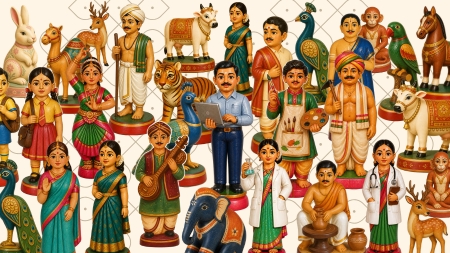
As the Navaratri season begins, people across South India unwrap meticulously packed dolls in preparation for the famed stepped kolu Arranging dolls on steps might look easy, but for some, the task takes weeks and even months. After all, rarely does a kolu come without a tale to tell. Bommai Kolu A tale a step For all the tales it can tell, every kolu starts with the same one - that of the celestial durbar. The celestial durbar Since navarathri is essentially a celebration of the Goddess Durga, the kolu, in a sense, is to celebrate her divinity. So, the kolu arrangement is said to mimic a divine court, or durbar, presided over by the Goddess for the nine days of the festival. This court can come in all sizes. Though this court comes in various sizes, a rough hierarchy prevails within. The supreme deities are placed at the top, spiritual leaders in the middle, and dolls of prominent persons on the lower steps. Below them are figures representing people from different professions and settings, with animals placed at the bottom. Here's how this order pans out in a real-life kolu. Scroll ➤ Top step: Lord Ganesh and other prominent dieties Ashtalakshmi set A wedding ceremony Animals A mirror to the past Besides being spiritual, kolus can have much more under their sleeves, or in this case, steps. If you want a snapshot of the past year, just go kolu-hopping to houses. The major events can be seen highlighted in vast thematic arrangements, or occupy a small corner on a step. They can come in handmade setups or store-bought sets. Paper, wood, glass, clay, fibre - anything can be the medium of expression. As one correspondent wrote in The Hindu’s archives in 1950, “there is really no end to the variety that can be introduced into the kolus. It all depends upon the tastes, the fancies and the mechanical ingenuity of which the producer of the kolu is capable.”This holds true across the decades. Each decade’s kolu morphed to accommodate new trends and sentiments, mirroring the society in large. Meet Shobana, a fictional kolu connoisseur from Tamil Nadu. After several days of thought, she has finalised her kolu theme - the evolution of the kolu over the years. Get your bowl of sundal and explore her exhibit! Psst! Shobana won't let you refuse! Kolus of the past and present Handicrafts and exhibits using cheap supplies were big parts of how kolus in the 1930s were put together.Lighting with petromax and hurricane lamps was also as much part of the kolu as were the dolls! Although preference is given to dolls depicting Gods and Goddesses and characters from the epics, Ramayana and Mahabharatha, nowadays attention is paid to the figures of our National heroes and architects of Indian Freedom.Now, at the time of the emergency in the country, he [the dollmaker] has to concentrate more on the figures of our jawans and the heroes of battle. He should make such figures and scenes that depict the driving away of the enemy on all fronts. 1960s 1990s Some traditional kolu keepers feel the cricket set to be a delightful addition. Others, not so much! Today lack of enough living space has scaled down kolu to little showcases, or maybe three steps, or the windowsill. The busy daily schedule also makes it difficult to store and maintain the dolls all through the year for the festival. -The Hindu archives, 2001 Late 2000s According to the authorities, a new medium, fibre, has been introduced this year. The doll is unbreakable, durable and the material so ductile that artisans have been able to bring out fine details on the figurines with ease.-The Hindu archives, 2008 As COVID-19 gripped the nation, dolls began wearing masks, and vaccination campaigns became miniaturised beside the kolu steps. 2020 Make your own kolu Now that you know the ins and outs of a traditional kolu, it's time to test your kolu-building skills. Use our widget to build your own kolu, and become the envy of the town! Click the name to change it Drag a doll from the dock onto a step Concept and Design: Godhashri S Frontend development: Godhashri S, Eunice Dhivya Editing: Deepalakshmi K, Ramesh Rama Chandran K.P. Photographs: R. Ashok, N. Bashkaran, G. Karthikeyan, M. Karunakaran, E. Lakshmi Narayanan, Liffy Thomas, M. Periyasamy, B. Velankanni Raj,, C. Venkatachalapathy, Special arrangement Archival support: Vibha Sudarshan, SK Subrramanya, K Arun Kumar Kolu images from The Hindu's archives Gemini AI used for coding assistance and image re-touching, Sarvam AI for voiceovers
Navratri 2026: South India's 'kolu' tradition: An interactive guide
Full Article
Original Source
Read the full article at Thehindu →KhanList aggregates and links to publicly available news content. We do not host full articles from third-party sources. Always verify important information with original sources.