
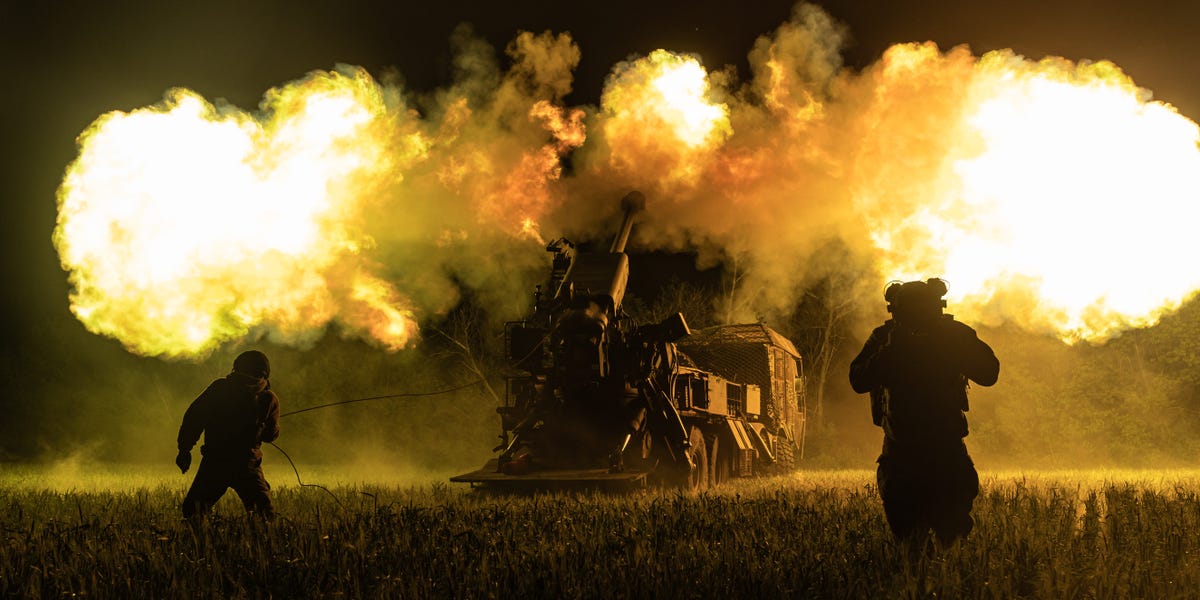
NATO trainers say Ukraine's rapid wartime pace is spotlighting just how slowly the West moves in peacetime Ukrainian soldiers are working at speeds that allies can't match, and Western training led by allies at peacetime has had to adjust. Diego Herrera Carcedo/Anadolu via Getty Images Working with Ukraine's soldiers has shown NATO trainers how far Western peacetime processes often lag behind the pace of a military fighting for its survival.Norway runs Operation Legio, a multinational effort that trains Ukrainian troops at Camp Jomsborg in eastern Poland while feeding battlefield lessons back into NATO militaries.Maj. John, the S3 Operations Officer in charge of synchronizing the training operation, told Business Insider that there's "a lot of learning to be done for European nations."Camp Jomsborg is trying to adapt to the "operational tempo of a wartime nation," he said, but for much of Europe, more broadly, questions remain about fast, responsible procurement and quick training pipelines that preserve quality.Brigadier Atle Molde, the commander of Task Force Legio, told Business Insider that "it's not difficult to see that the way we operate in peacetime West wouldn't work." "I think that's something that frustrates us all the time," he said.Keeping pace with UkraineJohn said that the operation is working within a "challenging dynamic," with the Camp Jomsborg training sitting at "the mental and geographical middle point between war in the east and peacetime mechanism in the West."Ukraine needs training and equipment fast, "and our processes, our mechanisms are not that used to that tempo," he said. Ukrainian soldiers are training at Camp Jomsborg in eastern Poland. Synne Nilsson / Forsvaret The West, John said, is "used to long planning horizons." Ukraine "needs effects now." However, "we are improving," he added.Trying to maintain the right pace has "met some difficulties," John said, but the multinational effort has shown it can adapt when required.Such adaptation can be seen in how the camp was built. It was carved out of the forest and built in just a few months.The training also evolves constantly as Ukrainian instructors and returning soldiers share lessons from the front lines. Jomsborg's training teams have already overhauled the trench network several times.Learning from Ukraine's speedMolde said that peacetime regulations for procuring and updating weapons systems are "frustrating every day" for Norway's own military. Many other NATO military leaders and Western officials have previously expressed similar frustrations amid concerns about the potential for further aggression from Russia.Operation Legio is designed to bring some Ukrainian expertise back to Norway's own military. John described one of the operation's aims as taking some of Ukraine's "experience back to our own armed forces."Molde compared Western procurement with Ukraine's wartime approach.If a drone needs an update, he said, "you have to send it to a Western country or a company, and an update takes six months." But in Ukraine, "they have the engineers sitting close to the front updating every two days, every two weeks, developing software, adapting it to genuine situations."Partner nations say Ukraine has shown that faster weapons development requires less bureaucracy, more risk tolerance, and closer cooperation with industry.Molde said he "absolutely" wants to see a greater spirit of innovation in Western militaries, but the laws and regulations sometimes stifle some of that. "So to be able to do that, it has to be some major changes that have to be done on all levels when it comes to legislation."He said that if you give army engineers money, resources, "and no restrictions, they can do magic."Camp Jomsborg has, in many ways, demonstrated what is possible. By bypassing certain regulations, they were able not only to build the camp quickly but also to create more realistic training environments.On the camp's construction, Molde said the head of Norway's parliamentary committee for Defense and Foreign Affairs told him, "I'm not sure that all national procedures for applying for building licenses and stuff like that have been followed."And he replied, "No, ma'am, none of them."And for combat training, eastern Poland offers far fewer constraints. Drone and electronic warfare work is often harder to conduct at scale across much of Europe because "the airspace we need to operate drones is more restricted," Molde said.Western military leaders and officials acknowledge that Ukraine's wartime footing gives it freedoms and urgency that peacetime militaries rarely have, but they also say that NATO cannot wait until a conflict begins to accelerate procurement, innovation, and decision-making.Sir John Stringer, NATO's Deputy Supreme Allied Commander for Europe, told Business Insider recently that "one of the things you're seeing in Ukraine is a sheer pace of adoption and adaptation in technology. It is measured in weeks."Mark Rutte, NATO's secretary general, called for "a bonfire of red tape, in our procurement and in our cross-border regulation." He said in July that "to meet the challenge, we need a transatlantic defense industrial revolution. The hum of machinery must become a roar." Read next Sinéad Baker is a Military and Defense Correspondent based in Business Insider's London bureau, writing about Russia's invasion of Ukraine and NATO actions.Sinéad most often covers soldiers' experiences, military strategy, battlefield developments, weapons systems, the defense industry's response, and the impact on NATO and European security, and geopolitical decisions that surround the Ukraine war. She has reported from NATO’s frontlines and around Europe, has interviewed multiple prime ministers and defense ministers, has appeared on BBC News and The Guardian's politics podcast, and has been cited by Congressional hearings.Sinéad has also extensively covered US politics and previously led Business Insider's breaking news coverage from London.Sinéad previously completed a master's degree in investigative journalism at City, University of London, and has written for The Guardian, The Observer, and TheJournal.ie. Sinéad is the former editor of the multi-award-winning The University Times in Dublin.ExpertiseExperiences of soldiers in Ukraine, including battlefield developments and tacticsWestern military responses to the war, and lessons they should learnNew weaponry built for and in response to the war Email Sinéad at sbaker@businessinsider.com or find her on X. NATO Ukraine Russia More
NATO trainers say Ukraine's rapid wartime pace is spotlighting just how slowly the West moves in peacetime
Full Article
Original Source
Read the full article at Businessinsider →KhanList aggregates and links to publicly available news content. We do not host full articles from third-party sources. Always verify important information with original sources.