
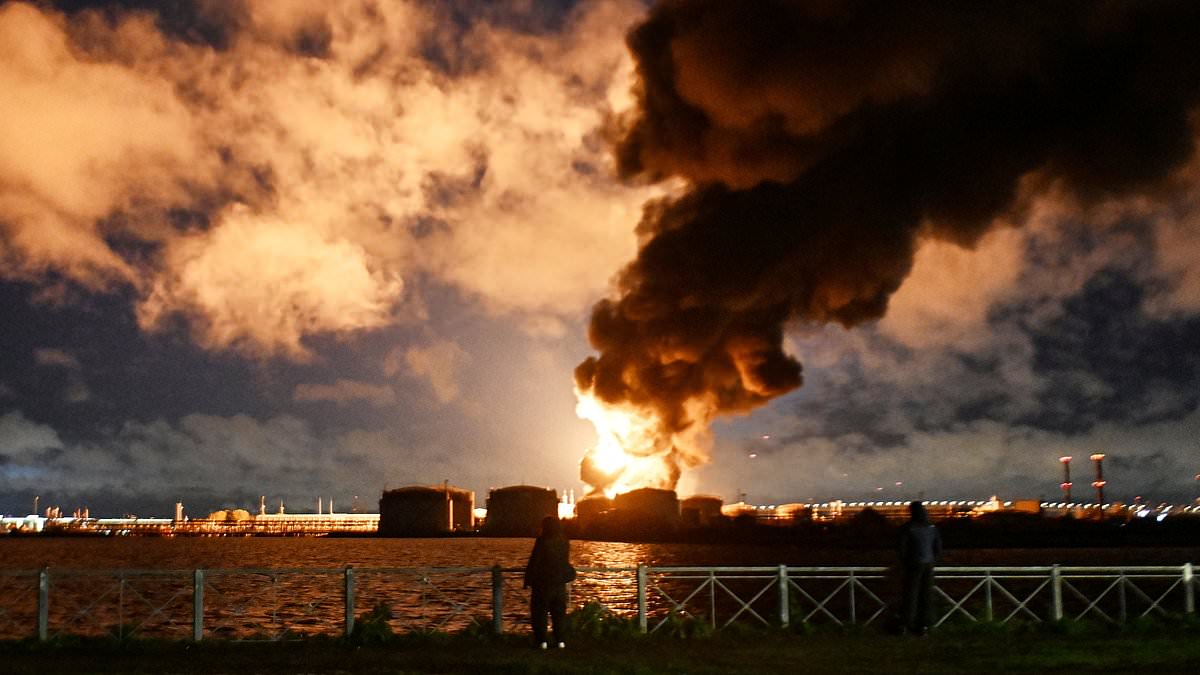
The conflicts in Ukraine and the Middle East are pushing NATO to rethink how it would counter a Russian attack - including by launching precise long-range strikes deep inside the country, according to a report.Protecting the alliance's European territory for decades focused on the military equivalent of putting up roadblocks, but now the 32-member bloc is considering more aggressive tactics, the Wall Street Journal claimed.Deterring the Kremlin from invading the continent requires more active prevention, entailing not just blasting troops that might cross borders, but also hitting military bases, supply depots and industrial facilities beyond the front line.The strategy was discussed by top generals and officials at the alliance’s first-ever Deep Strike Symposium, hosted in June by US Air Force Gen. Alexus Grynkewich, NATO’s top military commander.The discussions and wargame addressed a topic few attendees would have openly addressed until recently, spurred on by almost five years of Moscow's war in Ukraine.Now, NATO strategists are sure that a Russian invasion won’t be thwarted by merely impeding an advance, and more decisive action is required.Grynkewich recently elaborated on the approach in a speech on his 'theory of victory,' explaining that NATO’s defensive forces would first block the initial wave of any attack and then blunt follow-on action.If the offensive were to continue, 'we will break the warfighting system engaged against us' by striking both advancing forces and 'anything and everything that supports, sustains, or controls that force', he told a Warsaw audience.People watch the burning oil terminal following an air attack in Saint Petersburg on October 18 Russia shot down dozens of Ukrainian drones near Saint Petersburg, authorities said on October 18, 2026, with an oil terminal hit and flights disrupted at one of the country's busiest airports Vladimir Putin has launched several long-range strikes on Ukraine, ordering a combination of pinpoint attacks on strategic targets and widespread destruction of civilian assetsCentral to the strategy is highly precise deep-strike weaponry - both expensive and more cost-effective.Washington has recently been upgrading and extending its array of precision deep-strike missiles, including Tomahawk cruise missiles and Atacms rockets, while manufacturing new systems. European allies, who have long lagged behind, are rushing to field new models and increase their small stocks of Storm Shadow, Scalp and Taurus cruise missiles. Across the continent, at least 48 new low-cost cruise-missile projects involving 20 manufacturers have been publicised, according to Fabian Hoffmann, a senior researcher at the Norwegian Institute for Defence Studies who specialises in missiles.It remains to be seen when any of these will deliver arms; several won't come to fruition, and even those that progress will need years.Definitions of 'deep' vary from around 100 miles to hundreds of miles, but the term broadly refers to targets far behind the front line. In the scenario of war, long-range missiles, rockets and drones would be used to strike not only traditional military targets at great distances - such as air fields or army compounds - but also Vladimir Putin's industrial facilities, essential infrastructure and resource bases that lie thousands of miles from NATO borders.The strategy - often dubbed hitting an archer, rather than shielding from arrows - is one that Kyiv has taken against Moscow.By deploying increasingly powerful weapons, including the domestically developed Flamingo cruise missiles, Ukraine has struck distant Russian military and economic assets, including rocket-fuel producers, drone-battery plants, oil refineries and data centres.The US used the same approach against Tehran this year.Putin, meanwhile, has launched several long-range strikes on Ukraine, ordering a combination of pinpoint attacks on strategic targets and widespread destruction of civilian assets.Kyiv has run short of Western-supplied interceptors to shield itself, so is increasingly depending on deep-strike 'proactive defence' to target Russia, said Ukraine’s ambassador to NATO, Alyona Getmanchuk. 'Air defence is like a painkiller - it can alleviate the symptoms - but you need to target the source of the pain,' Getmanchuk told a conference on Ukrainian defence.An important lesson for NATO from Ukraine is that 'defence also means striking back', Polish Maj. Gen. Ireneusz Nowak told the Journal.'We definitely would want to strike the defence-industrial base' in a fight with Russia, he said, and precision deep-strike attacks are a crucial part of that.'We need to treat deep precision strike as deterrence,' Nowak added, noting that if Kyiv had it early in the conflict, fighting wouldn’t have 'resulted in trench battles like in World War I'.Military leaders across the alliance now recognise 'denial' as doctrine - the active prevention of Moscow's conventional forces.But many experts question if European politicians would stomach a deep-strike response to a Russian incursion. 'There is a disconnect between the military planning that is reasonable to defend against Russia - which definitely includes offensive components - and the political decision makers, who believe defence is just putting up a wall or readying a drone wall,' Nico Lange, a former chief of staff in Germany’s Defence Ministry, told the Journal.Military strategies like Grynkewich’s aim to make deep-strike attacks essentially automatic following a Russian military attack. They also attempt to clarify why stockpiling the weapons is necessary. Kyiv has proved that large supplies of precision weapons are crucial because new targets continually emerge as war wears on. Fixed assets like factories are relatively easy to target, but they may be relocated to several, covert locations - as Ukraine has done. Moving targets like launchers, meanwhile, can be even more difficult to target because they are small and continually reposition. 'What we’ve seen is that you don’t want to be caught in a high-intensity conflict where your adversary has access to deep arsenals of long-range strike capabilities and not have them yourself,' said Hoffmann. Deep precision strikes were debuted during the first Gulf War in 1991, when Washington fired hundreds of Tomahawks. They travelled horizontally, using small jet engines, rather than rockets like ballistic missiles. Since then, America, its allies and enemies have expanded cruise-missile arsenals, developed precision rockets like Atacms fired from US Himars trucks, and recently blurred the lines between drones and missiles. According to NATO commanders, to prepare for war, and to ultimately deter it, Europe must hastily build out its deep-strike arsenals.'The message needs to be: Don’t do anything stupid, because we can punish you,' concluded Poland’s Nowak. 'But to be credible, we need to have those capabilities.'
NATO draws up plans for long range strikes deep into Russia in the event of war breaking out following invasion into Europe
Full Article
Original Source
Read the full article at Dailymail →KhanList aggregates and links to publicly available news content. We do not host full articles from third-party sources. Always verify important information with original sources.