
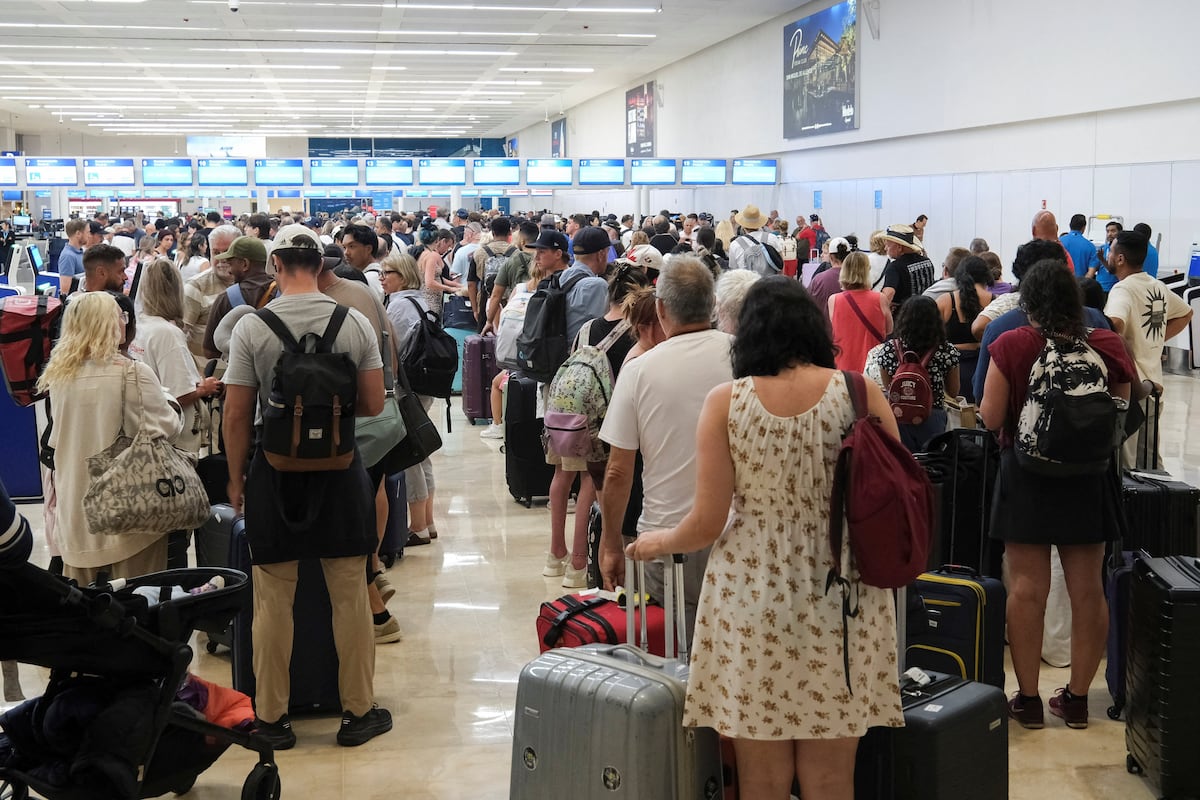
Taking a flight in the United States has become a test of patience and a source of unease. For some it is an adventure; for the more fearful, a trip to hell. The U.S. air system collapsed this Friday due to a problem in the computer system that manages communications. The government blamed the failure on an update to the fiber‑optic network (on Sunday, in social media posts, President Donald Trump blamed the Joe Biden administration). The incident forced authorities to cancel nearly 10,000 flights and delayed another 25,000, plunging airports across the country into chaos and affecting hundreds of thousands of travelers. It was the worst day for flying since the September 11, 2001 attacks, when authorities shut down the airspace for two days.The episode has exposed the deterioration of the U.S. airport management network, long considered one of the safest in the world. Transportation Secretary Sean Duffy attributed the incident to obsolete computer systems, devices, radars and telecommunications equipment. “What we have is an incredibly old air traffic control system,” Duffy said. “We have old switches, old routers, we use 1980s little copper lines. It’s an old system that went down everywhere, it got overloaded,” he added, before urging Congress to increase funding to modernize the network. He requested $50 billion after the Trump administration had cut budgets and closed some agencies responsible for advising on aviation and airport security.But the problem in U.S. skies is not only a matter of money. Multiple causes explain the gradual deterioration of the system that makes traveling in this country increasingly burdensome. Travelers endure long security lines, endless walks through ever-larger, more uncomfortable terminals, and frequent delays and cancellations. Incidents that were once anecdotal have become routine and accidents are growing more frequent.Even so, flying in the United States remains the safest form of travel, far safer than driving or using other modes of transportation. James Fallows, a private pilot for more than three decades and author of a dozen books, published an extraordinary and, in hindsight, prescient article this Wednesday in The New York Times titled: ‘Is air travel getting less safe?’ Fallows concludes that the system is sound, but something has changed in the approach to safety under the Trump administration. In his view, the Department of Transportation led by Sean Duffy has peeled away some layers of the complex system designed to reduce risk in the name of cost savings and efficiency.There are also external factors that contribute to the system’s decline: consolidation of the sector after the financial crisis increased congestion at major airports at the expense of mid‑size city facilities; climate change has intensified extreme weather, affecting flying conditions; and air traffic control centers have fewer staff despite a rise in flight numbers. Technology helps mitigate some of these deficiencies, but the air system is becoming more complex and authorities are slow to adapt.End of the longest safety spellIn fact, concern about aviation safety was at a low until January 29 of last year, barely a week after Donald Trump’s inauguration. The United States had gone nearly 16 years without a single fatal air accident when a U.S. military helicopter and an American Eagle passenger plane collided over the Potomac River, a few miles from the White House. The crash left 67 dead, including the three people aboard the Black Hawk.The incident ended the longest period without air disasters in the history of U.S. aviation. From February 12, 2009, when a Continental Airlines passenger jet crashed into a house on the outskirts of Buffalo, killing 50, until the Potomac accident in 2025, there had been no deaths in U.S. airspace. During that time there were more than 150 million flights carrying nearly 10 billion passengers with no fatalities or major incidents, according to the Bureau of Transportation Statistics (BTS).But incidents have multiplied since the Potomac crash. In March of last year several commercial aircraft reported problems due to debris from a SpaceX rocket launch; exactly one year ago, the engine of a UPS cargo plane detached during takeoff in Louisville, Kentucky, killing 15 people; a month later, a JetBlue flight was forced off course to avoid colliding with a military tanker that had turned off its transponder because it was on a covert operation in the Caribbean. This past February in San Antonio, a police helicopter nearly collided with a commercial aircraft when their paths crossed. A similar near miss occurred last March in Burbank, California, when a TV news helicopter almost collided with another arriving aircraft. On March 22, an Air Canada plane struck a fire truck at New York’s LaGuardia Airport, killing two pilots. In May, two Navy EA‑18G Growler warplanes collided during an air show in Idaho. On July 15, a Blue Angels demonstration flight in Pensacola, Florida, flew dangerously close to spectators. In early August, the presidential helicopter, Marine One, briefly encroached on the path of a commercial aircraft taking off from nearby Ronald Reagan Airport in Arlington, Virginia. Additionally, runway incidents involving aircraft have increased over the last two years.The Swiss‑cheese modelFallows, who is also a journalist, uses a telling metaphor to explain how the United States built one of the world’s safest air systems through the “Swiss‑cheese" model of protection. The idea is to layer safety protocols so that if one layer has a hole—like a slice of Swiss cheese—other layers will overlap with that hole and block the hazard. Thus, during the 1980s and 1990s layers of processes were added covering every phase of flight: from mechanics to flight attendants who require passengers to stow away their laptops and fold the tray tables during takeoff and landing. Regulations and procedures were refined to anticipate weather changes, agencies were created to analyze every failure, incidents were scrutinized, more precise navigation systems were implemented and assistance protocols introduced to reduce errors. But the trend began to break down in January 2025.The Potomac crash occurred just a week after a newly emboldened Donald Trump had been sworn in as president for a second term. The Republican president addressed the media after the crash to deliver a message to victims’ families, but during the White House press conference he attributed the accident to equality, diversity and inclusion policies (DEI) introduced under President Barack Obama. That was a declaration of intent: the new president used the air disaster to signal what his radical, nationalist policies would look like.After the crash, the Federal Aviation Administration (FAA) launched a painstaking investigation to determine the causes. Several independent government agencies tasked with preventing other accidents and drafting recommendations to reduce risk, such as the National Transportation Safety Board (NTSB), participated in the process. When the work concluded, the NTSB found that the cause of the Potomac accident was congestion in the air corridor between National Airport and the restricted airspace over the White House and the Capitol. Of the 33 recommendations the NTSB made, the FAA had adopted slightly fewer than half two years later. Agency executives warned of a change they had detected. Many of the hundreds of people interviewed during the inquiry resisted speaking for fear of reprisals from the Trump administration.Elon Musk’s cutbacksBut soon after the crash, the occupant of the White House began dismantling the aviation safety net as part of a deregulatory strategy to reduce federal bureaucracy. In those early weeks he issued dozens of executive orders to eliminate committees and bodies. One of those dismantled was the Aviation Safety Advisory Committee (ASAC), created in 1989 to advise on aviation security, from insider threats to baggage control. He also quickly shut down the Research, Engineering and Development Advisory Committee (REDAC), which verified the safety of research and development projects and was particularly useful in aeronautics. “We will remember decisions like these as the first step in a future chain of accidents,” warned Bruce J. Holmes, an experienced aviator who served on REDAC, to The New York Times.While the Trump administration cut back in some areas, it handed out no‑bid contracts elsewhere. The Department of Transportation commissioned a team from Elon Musk to review the system and implement “quick safety improvements in the air traffic control system.” At the time Musk, founder of Tesla and SpaceX, had accepted a federal role to reduce bureaucracy. His streamlining department was nicknamed DOGE, an acronym for the Department of Government Efficiency. While continuing to cut administrative structure that was essential to maintain safety standards, Elon Musk attempted to replace Verizon’s proven telecommunications system with his Starlink satellite network, though after several trials and conflict‑of‑interest allegations he dropped the effort.Lack of controllersMusk soon fired about 500 employees at the Federal Aviation Administration, the agency that manages U.S. air traffic. The FAA was already suffering from staff shortages and a deficit in air traffic controllers. It had not yet recovered from the large layoffs approved by Ronald Reagan in the late 1980s. As a result, there are few air traffic controllers, and those remaining work long shifts and are exhausted.Transportation Secretary Sean Duffy appears more interested in media exposure than in solving his department’s problems. He produced a documentary showing him traveling the country with his wife and nine children to commemorate the 250th anniversary of independence the United States celebrated this year. In his effort to address staffing shortages he had two ideas: recruit video‑game enthusiasts, believing they had the dexterity to handle the work of controllers, and modernize air traffic with a new computer system dubbed Smart.The new system launched at Washington area airports last September amid chaotic conditions. Its rollout coincided with a failure in air traffic communications that interrupted hundreds of flights after an optical fiber line was accidentally cut. It was in fact the software update to the fiber‑optic server that was responsible for this Friday’s airport chaos. “Patches don’t work,” Duffy said on Friday, predicting further incidents. “A complete overhaul of the system is necessary.” In addition to updating the IT system, the administration will need to add more slices of cheese to the safety sandwich.Sign up for our weekly newsletter to get more English-language news coverage from EL PAÍS USA Edition
Nationwide ground stop exposes the nightmare of flying from US airports
Full Article
Original Source
Read the full article at English →KhanList aggregates and links to publicly available news content. We do not host full articles from third-party sources. Always verify important information with original sources.