
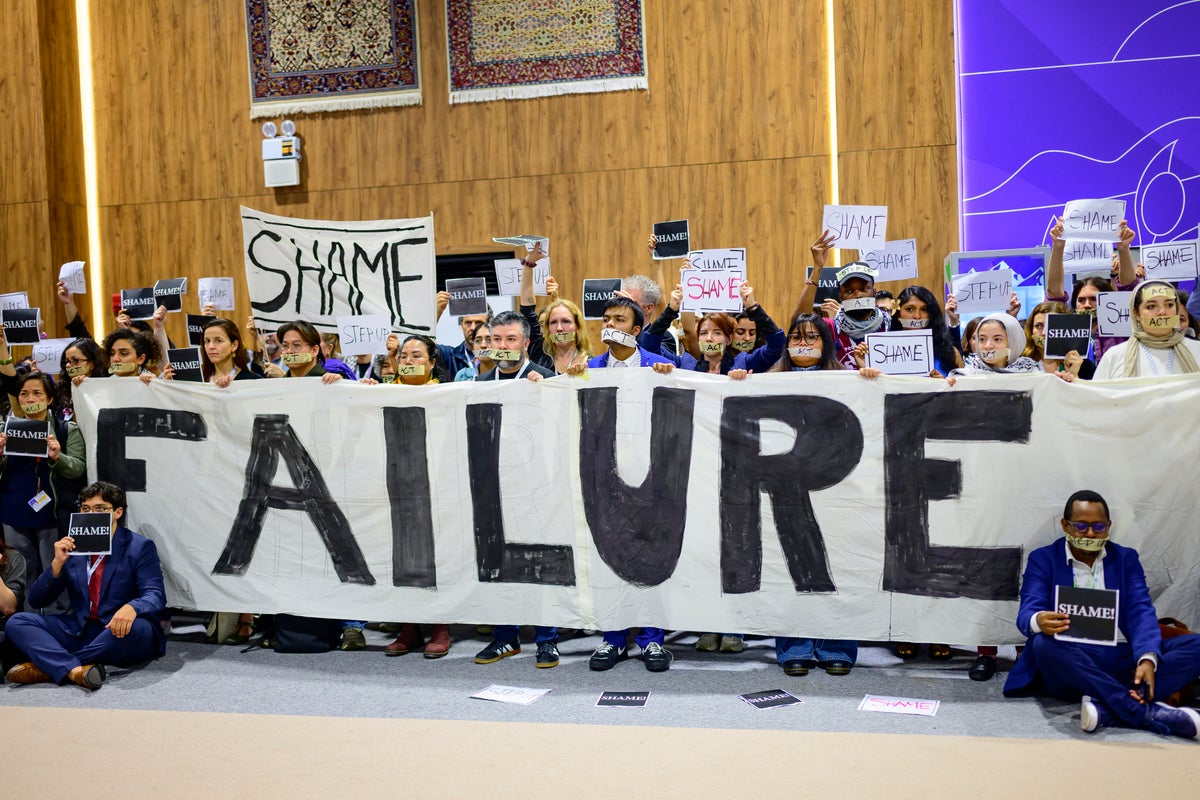
Negotiators at the United Nations climate talks in Turkey are working into an extra day in an attempt to reach a final agreement addressing global warming, though hopes are slim that additional discussions at Cop31 will result in any concrete plans to drastically slash the use of fossil fuels.To avert the most catastrophic effects of warming, experts warn of the need for urgent and deep cuts to emissions, mainly from the use of coal, oil and gas. The world is already on track to blow past the 2015 Paris Agreement goal of limiting warming to 1.5 degrees Celsius (2.7 degrees Fahrenheit) above pre-industrial temperature.Civil society organisations wrote to Cop31’s joint presidents, Australia’s Chris Bowen and Australia’s Murat Kurum, overnight to tell them they had hours left to avoid making it “one of the most disappointing Cops [the UN] has ever had”.“The Global South is being abandoned,” they said. “Developed countries have blocked progress across the negotiations and arrived with no new finance commitments.”It was hoped that a year of climate disasters could help sharpen minds at the conference. Devastating floods in Mozambique flooded more than 150,000 homes and killed at least 22 people. Coming off the back of other climate disasters in the country - including Cyclone Kenneth in 2019, as well as a crippling drought across 2023 and 2024 - charities told The Independent they were struggling to attract donors due to foreign aid cuts.In August, after a piece of melting glacier dislodged high up in the mountains, devastating floods in Nepal caused an estimated $4.8bn in damages, and left 1,500 dead and 10,000 injured.There is also the threat a record breaking El Nino weather event that the UN’s World Food Programme (WFP) has projected that an additional 49 million more people could be pushed into hunger globally.A climate “loss and damage” fund was established at Cop27 in Egypt in 2022 in order to provide developing countries with compensation for climate disasters. But it has so far secured just $822m in pledges, and countries affected by climate disasters are limited to apply for only $20m per disaster – less than half a per cent of Nepal’s needs.“Nepal did not create the climate problem. But we keep being hit by massive floods, not just this year but also in 2025, 2022 and other years,” said Bisesh Sangat, a Nepali attendee of Cop31 who works for the NGO Practical Action. “There’s a lot of big infrastructure losses, but also the human losses mean that you go to villages and there are lots of widows and children without fathers, so the losses are very profound.”There was already deep disappointment after a draft published on Thursday afternoon failed to include any mention of fossil fuels - despite the fact that this had previously been mentioned in the outcome of Cop28 in Dubai in 2023. This cover decision is seen as the key outcome of the UN climate conference, and is set to be a key signal that countries will take home and implement in national policy. Mohamed Adow, director of the Power Shift Africa thinktank said: "If this version of the text remains, it will be a ghost COP. The summit will have nothing to show for what happened here. After the progress made in 2023 at Cop28 in Dubai where fossil fuels were mentioned for the first time, there is now no mention of the f-word at all. Cop31 has been muzzled on the most important threat causing the climate crisis."Stories emerging from the negotiating room suggest that the usual suspects were to blame for an outcome that was less ambitious than hoped. Saudi Arabia has been among the main objectors to any wording on the “transition away from fossil fuels”, with insiders suggesting that the world’s largest oil exporter played a key role in blocking ambitious language. Pelin Zorlu, senior research fellow lead on climate and energy at the Chatham House think tank, said: “The Cop Presidency has acknowledged the difficulty of reaching consensus on fossil fuels, with opposition from the Arab Group, Russia and others.”But others pointed their fingers at the EU for not being ambitious enough, particularly around Turkey’s high profile pledge to raise electricity's share of total final energy consumption from around 23 per cent today to 35 per cent by 2035. Such a move makes sense if the electricity is powered by renewables – but not if it is done so with coal. Laurie van der Burg, from NGO Oil Change International, said: “The EU is trying to shift blame onto others and it is deeply hypocritical. At the beginning of Cop31, it signalled it was prepared to drop the renewable energy sources ask from the electrification target and it has failed to put forward an EU fossil fuel transition roadmap. Even worse, the EU blocked progress on the public finance, adaptation, and just transition that developing countries urgently need. These are not side issues. They are essential to making a fair fossil fuel phaseout possible and protecting communities from climate disasters.”At the same time, the EU and other wealthy democracies have expressed dismay at receiving too much blame when it is they who are providing the bulk of climate finance - and especially so with the US absent. EU member states provided €32.3bn in public “climate finance” in 2025, which mobilised a further €9.3bn in private finance. There is growing disquiet that the group of countries who are required to provide this “climate finance” – crucial capital needed to decarbonise and adapt to climate change – is fixed around a list of developed countries that was devised in 1992, known as “Annex II”. It means that newly-wealthy countries, including China, the UAE, South Korea and Singapore, do not officially have to provide climate finance, while the likes of Greece and Portugal are required to.While plenty of lobbyists were in attendance, one group was conspicuously absent: world leaders. Neither China’s Xi Jinping or India’s Narendra Modi, or any hint of the US federal government made an appearance – with Andy Burnham the only G7 leader in attendance. Yet, while powerful countries fight it out, ultimately it is the world’s most climate vulnerable countries who are losing out. On Friday afternoon, Ghana's minister for environment, science and technology, Dr Zanetor Agyeman-Rawlings did not mince her words. Africans were being “excluded by the use of technicalities, with the use of inaccessible finance, and with the use of shifting goalposts and lack of commitment and delivery on promises… Africa is not a continent merely seeking assistance. We are asking the developed countries to keep promises that they already made.”In what seemed to be a reference to the US, she said: “There are countries who from the onset decided not to be a part of this agreement. There, they were plain and honest… What we do not appreciate are those who choose to remain a part of the framework and yet continue to undermine the process and undermining trust and the credibility of what we do.” There were some positives however, with organisations in some specialist areas hailing signs of success. For example, more than 50 countries backed a new initiative pushing geothermal energy, while the UN announced that nations and oil and gas operators have delivered total cuts in methane emissions that are equivalent to taking 26 million cars off the road for a year since 2023. Turkey's drive to put waste reduction at the heart of Cop31 has also won widespread praise.
Nations race to avoid making Cop31 ‘one of the most disappointing ever’
Full Article
Original Source
Read the full article at Independent →KhanList aggregates and links to publicly available news content. We do not host full articles from third-party sources. Always verify important information with original sources.