
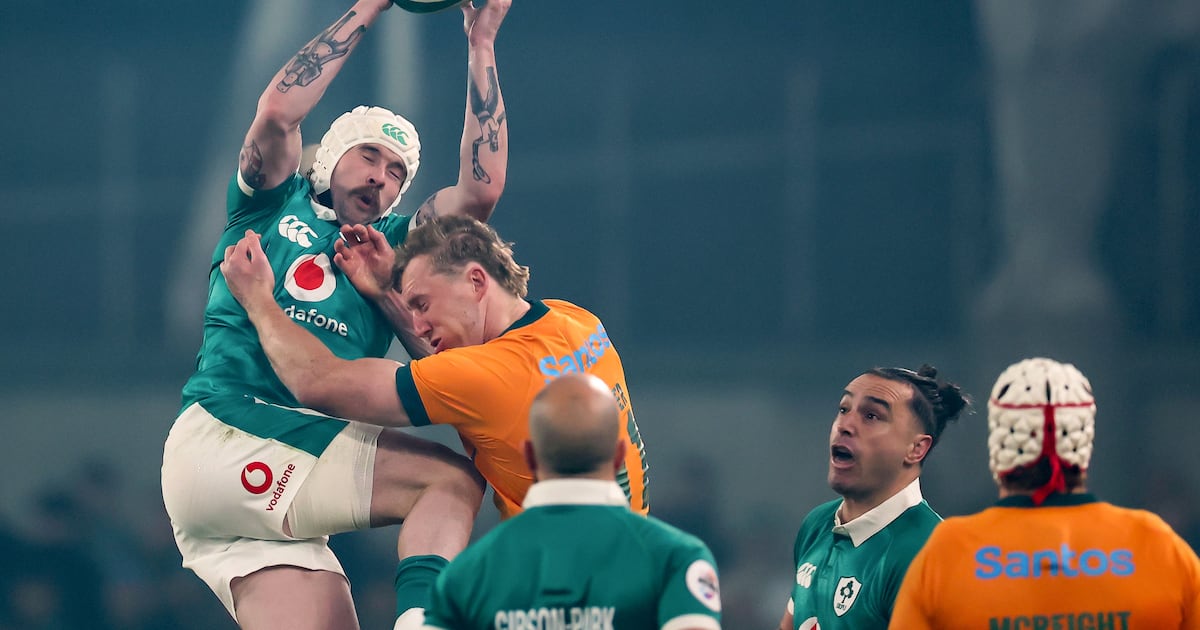
Less than a year out from the World Cup, the consensus view is that Ireland are the world’s fourth best team. Comfortably behind France, New Zealand and South Africa, but ahead of England and Scotland having beaten them in last year’s Six Nations. We’ll find out on Friday if Andy Farrell and co are stronger than an Argentinian outfit that once again has its best players available.The last international window, July’s opening set of Nations Championship matches, did little to dispel such notions. Ireland’s set-piece faltered, they were forced into more defensive work than would be ideal and the attacking game plan veered sharply from what we saw in the spring.After a Six Nations campaign that started poorly but trended upwards as Ireland improved with a clear style of play, the summer made things more murky. In a number of basic yet vital statistical categories, Ireland ranked among the worst teams in this new competition.They are not, to be clear, suddenly a bad team. Still, looking at the upcoming stretch of four games, there are multiple areas of improvement required to allow us to answer an important question: what is this Irish team fundamentally about?READ MOREStarting with the most basic areas, Ireland allowed a sloppiness to enter into their game during the summer. Set-piece was an issue, Farrell’s side too often unable to retain possession in comparison to other top teams.Ireland forwards coach Paul O'Connell during the warm-up ahead of the Nations Championship match against New Zealand in Auckland. Photograph: Billy Stickland/Inpho The lineout has been an off-and-on problem throughout this World Cup cycle. Ever since the Paris quarter-final defeat to All Blacks, when they realised the best way to limit Ireland’s high-possession, intricate phase-play attack was to stop it at source, the set-piece has been a regular source of discussion. To be fair to Paul O’Connell, the relevant assistant coach, Ireland were very good in the Six Nations, winning back 94.7 per cent of their lineouts – good for the second best team in the competition.However, in July that figure dropped to 84.9 per cent, ranking Ireland worst of the 12 teams in action. The scrum was hardly much better, Ireland’s success rate of 86.7 per cent good for last but one of the dozen competitors. Discipline across the board was also an issue, Ireland’s 9.3 penalties per game leaving them as the ninth-worst team for getting on the referee’s bad side. Contrary to their somewhat spiky reputation, Argentina conceded the fewest average penalties in July.[ Andy Farrell has been charged with a close to impossible task ahead of the World CupOpens in new window ]With all these numbers, the caveat applies that the most recent window was just three games. When moving from a relatively small sample of five Six Nations matches to an even smaller one in July, significant fluctuations can happen. Still, the point stands that Ireland faltered in a number of basic categories.Struggling to hold on to the ball at source inevitably had an impact on Ireland’s attack. In July, Ireland were largely a bottom-half side in a number of attacking metrics among the 12 Nations Championship teams. They were eighth in points scored and ninth for carry metres, line breaks and defenders beaten.Of some comfort, attack wise, may be Ireland’s numbers in the 22. Despite the struggles in other metrics, they still averaged 12.3 entries into the opposition 22, an increase on their Six Nations figure of 9.6. When close to the opposition line, Ireland scored 3.6 points per entry – between three-to-four points is generally seen as a mark of efficiency. Albeit in rugby’s high-scoring era, perhaps these numbers need to rise to keep up with the pack.Ireland scrumhalf Jamison Gibson-Park launches a kick during the Six Nations match against Italy. Photograph: Inpho Global trends towards attacking rugby, with teams that look to be positive with the ball generally being rewarded, may well explain arguably the most intriguing part of Ireland’s earlier Nations Championship performances. Ireland kicked significantly less in the summer after spending the Six Nations developing their kick chase and counterattack, averaging 28.4 open-play kicks in the spring before dipping to 19.7 down in the southern hemisphere.A criticism often levied at Irish teams, be they at international or provincial level, is that when they struggle in big games against stronger opposition, they are guilty of overplaying, of holding on to the ball for too long in a bid to find a gap. This leads to empty, wasteful attacking sets. Could this inefficiency be behind the stagnating attack numbers of the summer?The return of Mack Hansen to the starting XV does not suggest that Ireland will abandon their desire to keep ball in hand. A true second playmaker who was absent in the summer, he is a critical part of a backline that will all but definitely look to be ambitious.Join our Irish Times Rugby WhatsApp communityGet the best of our writing in the Irish Times rugby community. Photograph: Henry Simpson/Inpho Join our Irish Times Rugby WhatsApp community and get our best rugby writing sent directly to your messages inbox. From provincial and European news to coverage of Ireland’s Autumn internationals, you won’t miss an update. Join here: https://chat.whatsapp.com/DaV5S7cDxWF0xDDILjarcwPerhaps Ireland’s game plan will fall in the middle of what was attempted during the last two windows, combining the good transition work of Twickenham with a more effective phased attack. Think back to the Australia game in the last November window, where Hansen successfully chased contestable kicks while providing a vital set of hands from fullback.All told, we should learn plenty about how Ireland want to play across this four-match window. With the game at a stage where attack dominates defences, Ireland’s historical desire to play with the ball rather than swarm with kicking and defensive pressure could well be a strength.We did not see this attacking game come to fruition in the summer. Perhaps fatigue was a factor at the end of a long season. Faltering basics, including dwindling set-piece returns, certainly don’t help. Sorting those issues will have been top of the to-do list prior to the Argentina showdown. If fixed, then we can start putting together more definitive answers to the question of how Ireland want to play.
Nations Championship: Here’s where Ireland must improve and why return of the Mack could be key
Full Article
Original Source
Read the full article at Irishtimes →KhanList aggregates and links to publicly available news content. We do not host full articles from third-party sources. Always verify important information with original sources.