
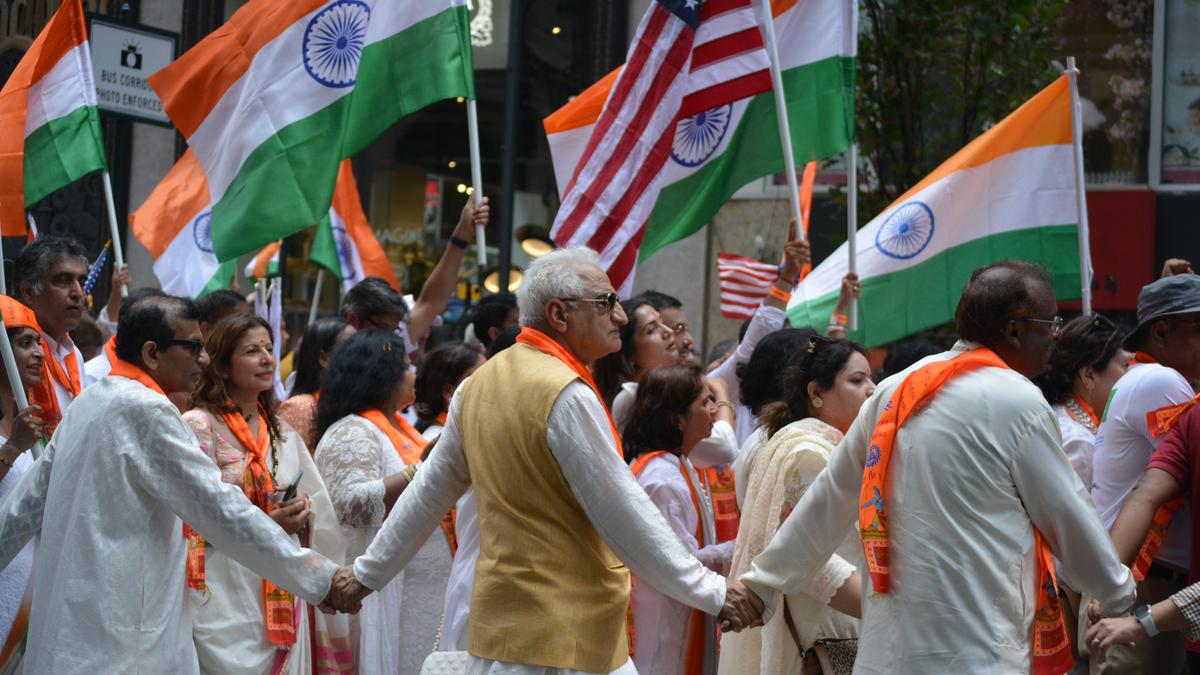
A section of Hindu nationalists in India has long questioned the national loyalty of its religious minorities. Under attack, Muslims and Christians have often sought to affirm their loyalty to the nation. But in a curious turn of history, the Rashtriya Swayamsevak Sangh (RSS), a key platform of Hindu nationalism, is now explaining to the world that loyalty to a nation is not determined by the faith traditions of its citizens.“There is no conflict in being Indian and being a citizen of another country for a Hindu,” RSS chief Mohan Bhagwat said. At an event titled Celebrate Oneness/Celebration of Oneness in London, on September 6, 2026, Mr. Bhagwat said: “If British Hindus are good, committed, and true Hindus, there will never be a conflict between British and Bharat interests. If at all that happens, it is obvious that British Hindus will go with Britain. Exceptions may happen, but Hindutva is clear on this. Your Karmabhoomi is where your loyalties lie. Your Janmabhoomi, or land of your origin or your birthplace, Punyabhoomi or Janmabhoomi, is where you get your values, and you have to live those values in your Karmabhoomi, serving the Karmabhoomi. So, Hindutva never asks you to betray your Karmabhoomi. You are living there, you are earning there, you are living there,” he said.Two forms of nationalismNationalism is a shared sense among a group of people that they are a group. Broadly, there are two types of nationalism: territorial and cultural. Territorial nationalism supposes that all people who are in a particular place are one. Whether one is Hindu, Christian, or Muslim, everyone who lives in India is Indian, according to this conception. Cultural nationalism, on the other hand, assumes that all people who share a culture are one, regardless of where they live. For instance, it could hold that all Christians, Muslims, or Hindus form one nation, wherever they live.In real life, it is impossible to enforce such clear notions, because people and ideas move across national borders, which are themselves subject to change over time. Concepts and practices often get mixed up. In the Indian context, the territorial nationalism depicted in Jawaharlal Nehru’s The Discovery of India draws upon culture too.The cultural nationalism that the RSS represents considers all Hindus around the world as one nation, but it also holds strident views about the territory of India. The RSS anthem is the Sanskrit hymn Namaste Sada Vatsale Matribhume, underscoring the primacy of territory even while claiming Hindu universalism. Secularists, on the other hand, also draw upon the cultural iconography of Bharat Mata.The link between culture and territory in the conceptualisation of the nation has never been simple, but it has been further complicated by globalisation and anti-globalisation politics around the world in recent decades. It is this complication that Mr. Bhagwat has been trying to grapple with through his global outreach tour to mark the Sangh’s centenary. On average, around 1.5 lakh Indians give up their Indian citizenship each year to become citizens of another country.They may find themselves caught in the political equivalent of what clinical psychologists term dissociative identity disorder, or split personality disorder. After giving up their Indian passports, they attend meetings such as those addressed by Mr. Bhagwat and those organised by Prime Minister Narendra Modi in various parts of the world, where they chant “Bharat Mata ki Jai”. In Australia and the United Kingdom, some of them support India when it plays cricket against their newly adopted motherlands. Not only are they caught between two mothers in terms of their loyalties, but they have also transported their fraternal conflicts from the subcontinent to the new territories. They carry their old battles over sects, castes and religions to their new motherlands.The ‘internal enemy’ themeHindutva’s foundational author, V.D. Savarkar, framed this concern about the split loyalties of those residing in the territory. In Hindutva: Who Is a Hindu?, he distinguished between those who are in the territory of India by the accident of birth and those who consider it their sacred land.The true Hindu, in his formulation, is one who has India as both pitrubhumi and punyabhumi, a test that excludes Muslims and Christians who may have their sacred lands elsewhere. This fear of the resident alien, or even the enemy within, continues to persist in Hindutva thinking. Mr. Bhagwat himself has spoken of this. “This war is not against an enemy without, but against an enemy within. So there is a war to defend Hindu society, Hindu Dharma and Hindu culture. Foreign invaders are no longer there, but foreign influence and foreign conspiracies continue...” he told Organiser in an interview in 2023. This theme of the internal enemy continues to animate Hindutva nationalism, at any rate, a vocal section of it.When the RSS says it is spreading the message of the oneness of the world, how does this sit with its notions of territory and people? Is the RSS an organisation meant for all Hindus, wherever they may be in the world, or is it about uniting all Indians?Rather than an easy answer, what one might encounter in the Sangh’s stated principles and practices are contradictions, and perhaps a struggle to come to terms with a changing world. The Sangh has become a global actor, partly by accident and partly by design. Mr. Bhagwat also maintains that all people who are in India and share the same ancestry are all Hindus.If all people who share the same ancestry are Hindus and part of the nation, there is no reason why the RSS should be anxious about the movement of people from anywhere in the subcontinent. But that is not the RSS’s position, which calls for the stringent protection of Indian borders and the removal of so-called infiltrators by all possible measures.Migrations linked to colonialism dispersed Indians across distant shores. Wherever Indians settled, the anti-colonial movement also took root. Intellectual and organisational strands of the Indian national movement were present in many parts of the world in the early 20th century. In fact, both Mohandas Karamchand Gandhi and Vinayak Damodar Savarkar developed their ideas while living in the United Kingdom.Diaspora dilemmaThe visible emergence of Hindus in the West as a political community in recent decades has been a double-edged sword for Hindutva. The U.K. has had a Prime Minister of Hindu faith, Rishi Sunak. The RSS and the Bharatiya Janata Party introduced a new vocabulary of the janmabhoomi-karmabhoomi duet when they launched their diaspora politics under Atal Bihari Vajpayee’s government. This worked quite well in reaching out to western audiences until native nationalisms in the West began to view migrants with suspicion. It so happened that the RSS’s intensive diaspora politics, which became part of India’s state policy under Mr. Modi, coincided with the rise of nativism in the West. Mr. Bhagwat’s London speech sought to address this concern: Can a person of an allegedly foreign faith be a loyal citizen of the country?If this moment is truly one of self-reflection and marks an evolutionary milestone for the RSS in its 100th year, it must apply the same standard everywhere, across the entire bhumi. What is true in London must be equally true in Lucknow: loyalty to the nation is not determined by the faith one follows, but by one’s residency and the modern concept of citizenship. Mr. Bhagwat has done well in stating that people of Indian origin must choose their adopted country over India in all situations, echoing Jawaharlal Nehru’s position on this question. However, Mr. Bhagwat’s words will be tested equally in the Indian context if they are to be accepted as a marker of the RSS’s evolution.varghese.g@thehindu.co.in
Nationalism beyond borders, the question of loyalty
Full Article
Original Source
Read the full article at Thehindu →KhanList aggregates and links to publicly available news content. We do not host full articles from third-party sources. Always verify important information with original sources.